
A clear 2026 guide to the latest Boiler Upgrade Scheme grant values, including the new air to air heat pump category. It explains how BUS, the Warm Homes Local Grant and the Warm Homes Plan fit together, and what homeowners should check before asking for quotes.
The Boiler Upgrade Scheme changed in April 2026, and the headline is simple. The main £7,500 support for air to water heat pumps is still there, ground source heat pumps still receive £7,500, biomass boilers still receive £5,000 where they meet the rural and off gas grid rules, and air to air heat pumps now have a separate £2,500 grant category.
That matters because many homeowners are trying to work out whether 2026 is the right year to replace a gas boiler, oil boiler, LPG system, electric heating or older storage heaters. It also matters because the Boiler Upgrade Scheme now sits alongside the Warm Homes Plan and the Warm Homes Local Grant, rather than replacing them.
The right route depends on your property, your income, your heating system, your EPC, your location and the type of heat pump being considered. A household that can afford the remaining cost may use the Boiler Upgrade Scheme. A low income household in England with an EPC of D, E, F or G may be better suited to the Warm Homes Local Grant. A homeowner who is not eligible for grant support may later use low or zero interest finance under the Warm Homes Plan as that support develops.
This guide explains what changed, what each grant is worth, which route to check first, and what to prepare before speaking to an installer.
What changed in April 2026
GOV.UK updated the approved Boiler Upgrade Scheme grant categories and values on 5 May 2026. The new grant values apply from 28 April 2026.
The approved categories now include air to water heat pumps, air to air heat pumps, ground source heat pumps and biomass boilers. The approved grant values are £7,500 for an air to water heat pump, £2,500 for an air to air heat pump, £7,500 for a ground source heat pump and £5,000 for a biomass boiler.
The important change for many households is the air to air heat pump category. Air to air systems heat rooms directly using indoor units rather than wet radiators. They can be useful in electrically heated homes, flats, smaller properties, open plan spaces and homes where a full wet central heating retrofit would be disruptive.
The £2,500 value is lower than the £7,500 air to water grant because the system type and installation scope are usually different. It should not be read as a sign that air to air is always second best. It simply means the support level is different.
The 2026 Boiler Upgrade Scheme grant values
The values now approved by GOV.UK
- Air to water heat pump, £7,500
- Air to air heat pump, £2,500
- Ground source heat pump, £7,500
- Biomass boiler, £5,000
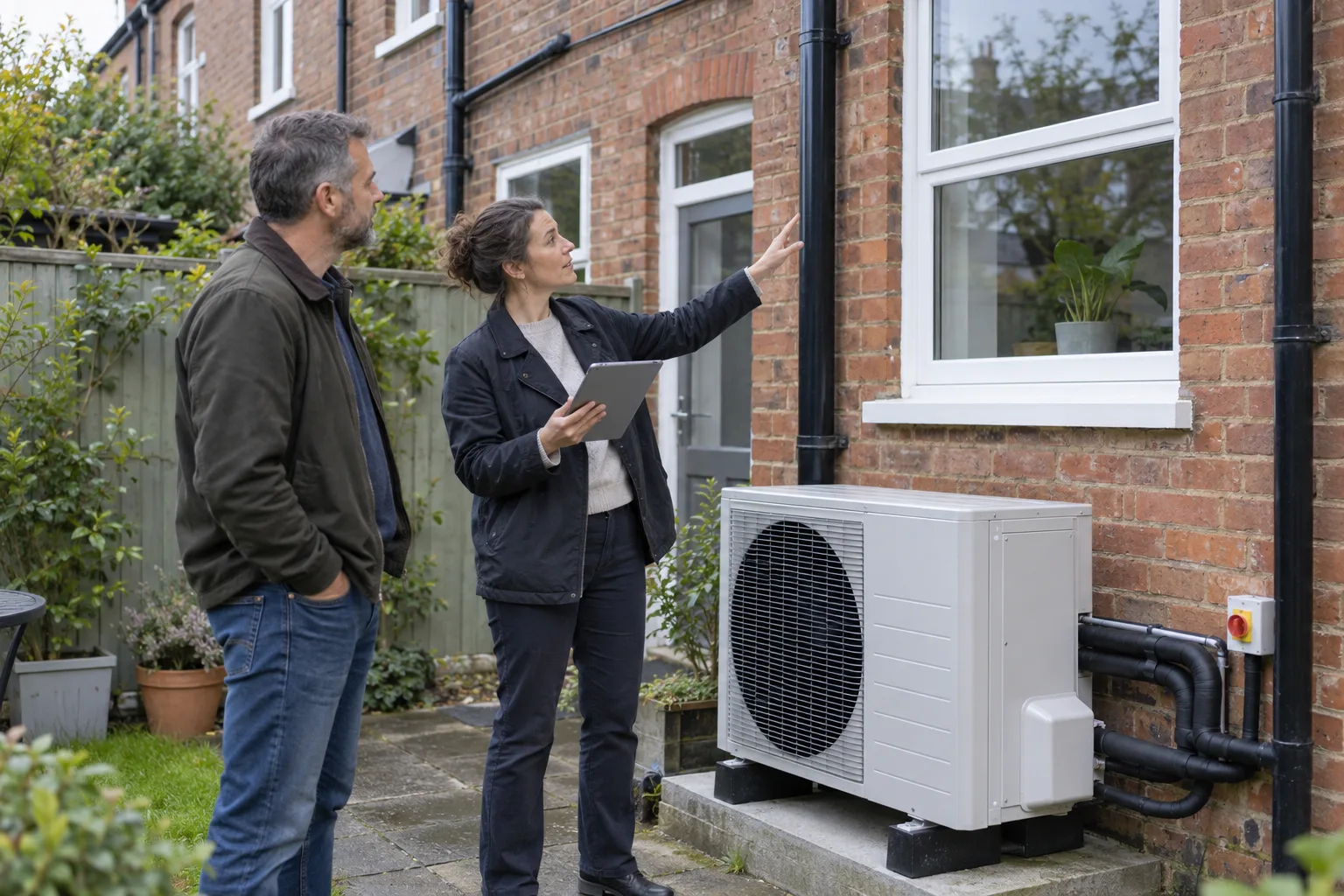
An air to water heat pump is the familiar outdoor unit that connects into a wet central heating system. It normally feeds radiators, underfloor heating and a hot water cylinder. This is the most common replacement route for homes moving from a gas boiler, oil boiler or LPG boiler.
An air to air heat pump uses an outdoor unit and one or more indoor fan units. It provides warm air rather than hot water through radiators. Some systems can also provide cooling, but the grant should be considered as support for low carbon space heating rather than as an air conditioning subsidy.
A ground source heat pump uses pipework in the ground to collect heat. It can be very efficient, but the installation is usually more involved because it needs ground loops or boreholes.
A biomass boiler burns eligible biomass fuel and has tighter eligibility rules. GOV.UK says a biomass boiler grant is only available where the property is off the gas grid, in a rural location and the boiler has an emissions certificate showing that polluting emissions are kept to a minimum.
Who should look at the Boiler Upgrade Scheme first
The best fit for owner funded projects
The Boiler Upgrade Scheme is usually the first place to look if you own a property in England or Wales and want to replace an existing fossil fuel heating system with a heat pump.
It can suit homeowners who do not qualify for low income grant funding but still want upfront support. It can also suit landlords with eligible privately rented homes, although the system still needs to meet the scheme rules and the property must be suitable.
The grant is not paid directly to you as a cash payment. The installer applies for the voucher and takes the grant value off the quote. That means the installer must be eligible, the product must be eligible and the paperwork must be correct before the voucher is redeemed.
This is why a very cheap quote from an uncertified installer is not a like for like comparison. If the installation cannot produce the right certificate and scheme documentation, it may not qualify.
Who should check the Warm Homes Local Grant first
The Warm Homes Local Grant is different. It is only available in England, and it is aimed at low income households, households getting certain benefits, or households in certain postcode areas.
GOV.UK says the home must be in England, privately owned, either by the occupier or the landlord, and have an EPC rating of D, E, F or G. Household income must usually be £36,000 a year or less, although some households can still be eligible through postcode or benefit routes.
If you qualify and your council has funding available, the council arranges a survey and agrees which improvements are suitable. GOV.UK lists possible measures including wall insulation, loft insulation, underfloor insulation, air source heat pumps, smart controls and solar panels.
The key point is that the council organises and pays for the agreed work. GOV.UK says the household does not need to pay for the improvement work agreed under the scheme.
Why the council route can be stronger
For a household on a low income, that can make the Warm Homes Local Grant more useful than the Boiler Upgrade Scheme. A £7,500 heat pump grant is valuable, but it may still leave a remaining contribution. A council funded package can deal with insulation, controls and heating together where the property qualifies.
How the Warm Homes Plan fits in
The Warm Homes Plan is the wider government programme for improving homes and reducing energy bills. GOV.UK says it includes support through the Warm Homes Local Grant for low income households in England with EPC ratings below band C.
The Warm Homes Plan also refers to low and zero interest consumer loans and wider finance for the home upgrade sector. That means the 2026 picture is not just grant or no grant. It is a mix of fully funded help for eligible households, voucher support through the Boiler Upgrade Scheme and finance support for households outside the low income route.
For homeowners, the practical message is to check grant eligibility before signing a private finance agreement. If your home is EPC D, E, F or G and your household may meet the income, benefit or postcode route, check the Warm Homes Local Grant first.
What the Boiler Upgrade Scheme does not solve on its own
The Boiler Upgrade Scheme helps with the capital cost of the heat pump, but it does not remove the need for a good design.
Energy Saving Trust says the typical cost of installing an air source heat pump is around £11,000, and that costs vary by heat pump size, property size, whether the property is new or existing, and whether radiators need upgrading.
That means a £7,500 grant can reduce the headline price substantially, but it does not make every installation automatically cheap. A home that needs a new hot water cylinder, larger radiators, pipework changes, electrical work or fabric improvements can still have a meaningful remaining cost.
This is also why the lowest quote is not always the best quote. A system that is undersized, poorly controlled or installed without enough emitter capacity may be cheaper on day one but more expensive to live with.
Why design quality matters in 2026
MCS updated its heat pump design standard in December 2025. The current MIS 3005 D standard includes air to air heat pumps and sets design responsibilities for certified contractors.
The standard says heat pump systems can serve space heating and domestic hot water, and it covers categories including ground and water source systems, air source systems, exhaust air systems, gas absorption systems, solar assisted systems, domestic hot water heat pumps and hybrid systems.
It also says an installation must be registered on the MCS Installation Database no later than 10 working days after commissioning, with an MCS certificate generated and sent to the customer for the handover pack.
That certificate matters because it is part of proving the installation was completed under the recognised scheme. It can also matter later for warranty, property sale documents, tariff eligibility and consumer protection.
Running costs still depend on the tariff
The grant reduces installation cost. It does not set the running cost.
Ofgem says the price cap from 1 April to 30 June 2026 is £1,641 a year for a typical household paying by Direct Debit. The average electricity unit rate is 24.67p per kWh and the average gas unit rate is 5.74p per kWh for that period.
This electricity to gas price gap is why heat pump running costs can vary. Energy Saving Trust says heat pump running costs depend on whether radiators are appropriately sized, the electricity tariff and how the heat pump is controlled.
A well designed heat pump can turn one unit of electricity into several units of heat, but it still needs the right flow temperature, controls and usage pattern. In many homes, a heat pump tariff can improve the case further by shifting some running time into cheaper periods.
Air to water or air to air
The new 2026 grant values make this question more common.
Air to water is usually the stronger fit where the home already has a wet radiator system, a suitable hot water cylinder location and a need for whole house heating and hot water.
Air to air can be worth considering where the home is electrically heated, lacks a wet central heating system, has open plan rooms, needs room based heating, or would face expensive disruption from new radiators and pipework.
The right answer is property specific. Air to air does not normally provide domestic hot water, so a separate hot water solution may be needed. Air to water is broader, but the installation can be more involved.
The grant difference matters, but it should not be the only factor. A £7,500 grant on the wrong system is still a poor decision. A £2,500 grant on the right system can be better than forcing a property into a design that does not fit.
Biomass boiler grants are narrower than heat pump grants
The £5,000 biomass boiler grant is still available, but it is not a general boiler replacement grant.
The rural and off gas grid test
GOV.UK says biomass boiler support requires the property to be off the gas grid, in a rural location, and fitted with a boiler that has an emissions certificate showing that polluting emissions are kept to a minimum.
You cannot assume a rural home qualifies just because it has oil or LPG. You also need to consider fuel storage, delivery access, maintenance, emissions, local planning and whether a heat pump could be a better long term route.
For many homes, especially where insulation can be improved, a heat pump will be the first option to compare.
What to prepare before asking for quotes
- Your current EPC rating if you have one
- Your current heating fuel and boiler age
- Your annual electricity and fuel use from bills
- Photos of radiators, hot water cylinder and outdoor space
- Details of loft, wall and floor insulation
- Whether the property is privately owned, rented or social housing
- Whether household income, benefits or postcode may fit the Warm Homes Local Grant
- Any planning constraints, such as conservation area status
This information helps the installer or adviser point you towards the right route before design work starts.
It also reduces wasted time. If the household clearly fits the Warm Homes Local Grant, it may be better to start through the council route. If the property is not eligible for that grant but is a good heat pump candidate, the Boiler Upgrade Scheme may be the right route.
Common mistakes to avoid
- Assuming the £7,500 grant covers the full installation
- Assuming every heat pump type gets the same grant
- Ignoring the new £2,500 air to air grant category
- Comparing quotes without checking what is included
- Choosing a system before checking insulation and radiator capacity
- Forgetting that the Warm Homes Local Grant may cover a wider package
- Proceeding without checking the installer is eligible for the scheme
- Treating the grant as more important than comfort, noise, control and running cost
The best grant is the one attached to the right design. A grant should make a good project more affordable. It should not be used to justify a poor fit.
How landlords should think about the 2026 changes
Landlords need to look at both grant eligibility and property strategy.
A privately rented home may be eligible for the Warm Homes Local Grant where the household and property meet the rules and the landlord agrees to the work. The Boiler Upgrade Scheme can also support eligible private properties, but social housing is excluded from the scheme.
For landlords, the decision is not just about heating. It is also about EPC risk, tenant comfort, future regulation, void periods, maintenance and property value. A well planned heat pump or insulation package can reduce exposure to future energy performance requirements, but a rushed installation can create tenant complaints and higher running costs.
The first step is to review the EPC, the current heating system and any recommended insulation measures. Heating should not be considered in isolation.
The bottom line for 2026
The Boiler Upgrade Scheme is still one of the strongest heat pump support routes in England and Wales. The £7,500 grants for air to water and ground source heat pumps remain central, and the new £2,500 air to air category makes the scheme relevant to more property types.
The Warm Homes Local Grant is the route to check first for low income households in England with EPC D, E, F or G homes. It can support insulation, heat pumps, smart controls and solar panels, with councils organising and paying for agreed work where funding is available.
The Warm Homes Plan is the wider framework that connects these grants with future finance support and a broader push to improve homes.
For most households, the next step is not to pick a heat pump from a brochure. It is to check eligibility, confirm the property condition, compare the grant routes and insist on a proper design before committing.