
Solar battery storage sized around the property’s real energy use.
We match usable capacity, charge rate, solar self-use, household demand, landlord objectives and tariff strategy before recommending storage.
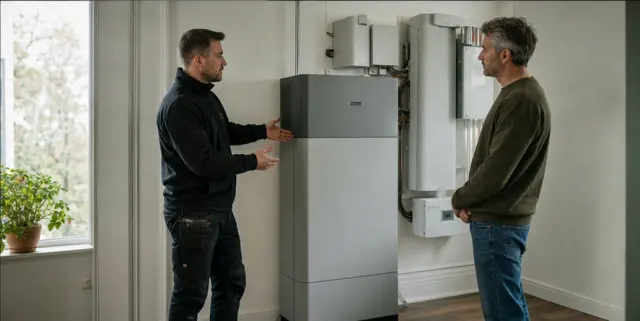
The use case decides the size and controls.
Storage can increase solar self-consumption, move grid use into cheaper periods or provide selected backup. Those are different objectives and they lead to different designs.
Solar self-use
Store daytime generation for evening demand while comparing export income with avoided import cost.
Plan solar and storageTime-of-use shifting
Charge when electricity is cheaper and discharge during expensive periods, subject to tariff rules and losses.
Review consumptionHeat pump and EV loads
Model large electrical loads carefully because energy capacity and power output are separate limits.
Whole-home planningResilience
Define which circuits need backup, for how long and under what outage conditions.
Discuss backup design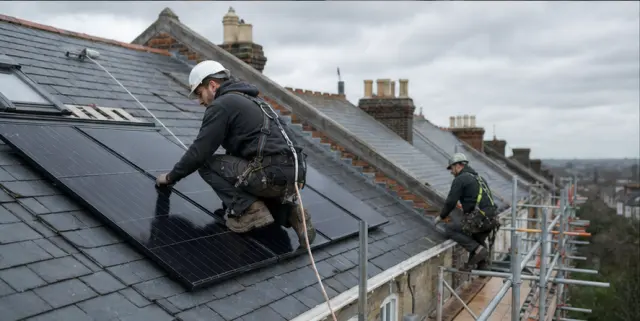
Location, protection and commissioning are part of the product.
Battery systems need an appropriate location, electrical protection, isolation, ventilation or environmental conditions specified by the manufacturer and a clear emergency procedure.
Monitoring should allow the owner to understand state of charge, import, export and any fault condition without making the tenant or homeowner manage a technical experiment.
- LocateChoose a compliant, accessible position with the correct environmental limits.
- IntegrateCoordinate inverter, meter, solar, EV charger and heat-pump controls.
- HandoverProvide system settings, warranties, monitoring access and emergency information.
Show the storage calculation before choosing the capacity.
Compare usable kWh, charge/discharge power, efficiency, cycle warranty and the loads you actually need to shift. A large battery can be poor value if the home rarely fills or uses it; backup needs a separately specified electrical arrangement.
Illustration only: storing 1 kWh of surplus solar at 90% round-trip efficiency delivers 0.9 kWh later. At an assumed 25p import rate and 8p export rate, the gross difference is 14.5p before equipment cost, degradation and other losses. These are example inputs, not current tariff quotes or a savings forecast.
Use the same household profile to compare solar with and without storage. For a rental, agree who controls the battery and who receives the benefit; the whole-home survey should capture those constraints.
What to establish before committing
- Usable capacity and power against demand.
- Import/export assumptions, losses and realistic annual cycles.
- Location, fire/electrical design, backup scope and maintenance.
Evidence first, then a defined next step.
Each stage should reduce uncertainty about the property, the technical scope, the funding or payment route and the party responsible for delivery.
Analyse
Half-hourly use where available, solar yield and tariff structure.
Specify
Capacity, power, inverter arrangement and backup scope.
Install
Electrical work, protection, commissioning and network requirements.
Optimise
Configure tariffs and review performance after real use.
Answers before you commit.
Direct information on suitability, cost, evidence and responsibility.
Usually not. Most home systems reduce grid use but still rely on the network, especially through winter.
No. Backup requires a compatible system and specifically designed circuits or whole-home arrangements.
Yes, subject to a suitable design, ownership and access arrangements, tenant information and the relevant electrical and building requirements.
It depends on chemistry, cycling, temperature and manufacturer terms. Compare usable capacity, throughput or cycle warranty and end-of-warranty capacity.
Give storage a clear job.
Share your solar, tariff and electricity-use information so the battery can be sized around evidence.