
How to reduce energy bills without buying the wrong upgrades.
Start with no-cost controls and the property’s real heat and electricity use, then compare fabric, heating, solar and storage in the right sequence. Landlords can use the same plan to reduce tenant bills without promising permanent zero bills.
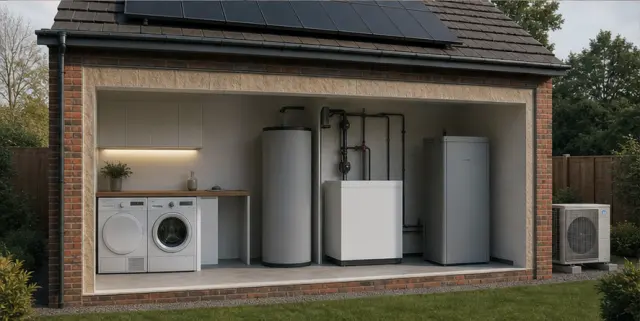
Four systems must work together.
A home with solar, a battery and a heat pump can still import significant winter energy. A useful design models seasonal demand, not just a bright summer day, and states how tariffs, occupancy and behaviour affect the result.
Fabric and ventilation
Reduce avoidable heat loss while protecting indoor air quality and moisture performance.
Fabric-first planningHeating and hot water
Size the heat pump, emitters and cylinder from room-by-room demand.
Heat-pump designBattery and controls
Set storage capacity and operating strategy around tariffs and major loads.
Battery storage guide
A direction of travel, measured honestly.
Fixed charges, winter demand, equipment limits and household behaviour mean a permanent zero energy bill cannot be guaranteed. Some well-suited homes may achieve very low net electricity costs over a period, especially where export income is included, but the model must show its assumptions.
We use the phrase to describe a whole-home strategy that systematically reduces purchased energy and exposure to future price changes.
- BaselineUse actual consumption and current system performance.
- ScenarioCompare fabric, heating, solar and storage combinations.
- ReviewMeasure results after commissioning and adjust controls.
Reduce waste first. Price the upgrades second.
Check meter readings, tariffs, hot-water schedules and heating controls first. Use occupied-room comfort and safe ventilation as constraints: reducing bills should not mean leaving a damp or dangerously cold home. Then investigate the largest avoidable losses before choosing equipment.
A home energy survey can separate control changes from insulation work, heating design and solar/storage. For landlords, agree who controls equipment, who pays each energy account and who receives any export income. Improvements should benefit the actual occupier, not only a sales calculation.
Compare annual energy use under the same weather, occupancy and tariff assumptions. Standing charges, maintenance, finance and winter demand still matter. Zero bills homes depend on specific system and tariff arrangements; permanent zero bills cannot be promised for every retrofit.
What to establish before committing
- Baseline: annual kWh, tariff, standing charges and occupancy.
- Sequence: controls, defects/fabric, heating, then generation/storage.
- Handover: clear tenant instructions, maintenance owner and review of actual use.
Need support with the work? Compare home energy grants before deciding how to pay.
Evidence first, then a defined next step.
Each stage should reduce uncertainty about the property, the technical scope, the funding or payment route and the party responsible for delivery.
Measure
EPC, bills, interval data, fabric and heating demand.
Model
Seasonal generation, import, export and major loads.
Sequence
Fabric, electrical work, heating and renewables in the right order.
Optimise
Commission controls and review real performance.
Answers before you commit.
Direct information on suitability, cost, evidence and responsibility.
No. Fixed charges, weather, occupancy, tariffs and system performance prevent a responsible universal guarantee.
Not always. A staged plan can protect cash flow and use measured results to refine later work.
No. Landlords can use whole-home planning where ownership, tenant benefit, metering and maintenance responsibilities are clear.
BUS may support eligible heat pumps and targeted household schemes may support other measures. Each route is checked separately.
Build one energy plan for the whole property.
Bring the EPC and recent bills. We will map the useful sequence rather than sell disconnected products.