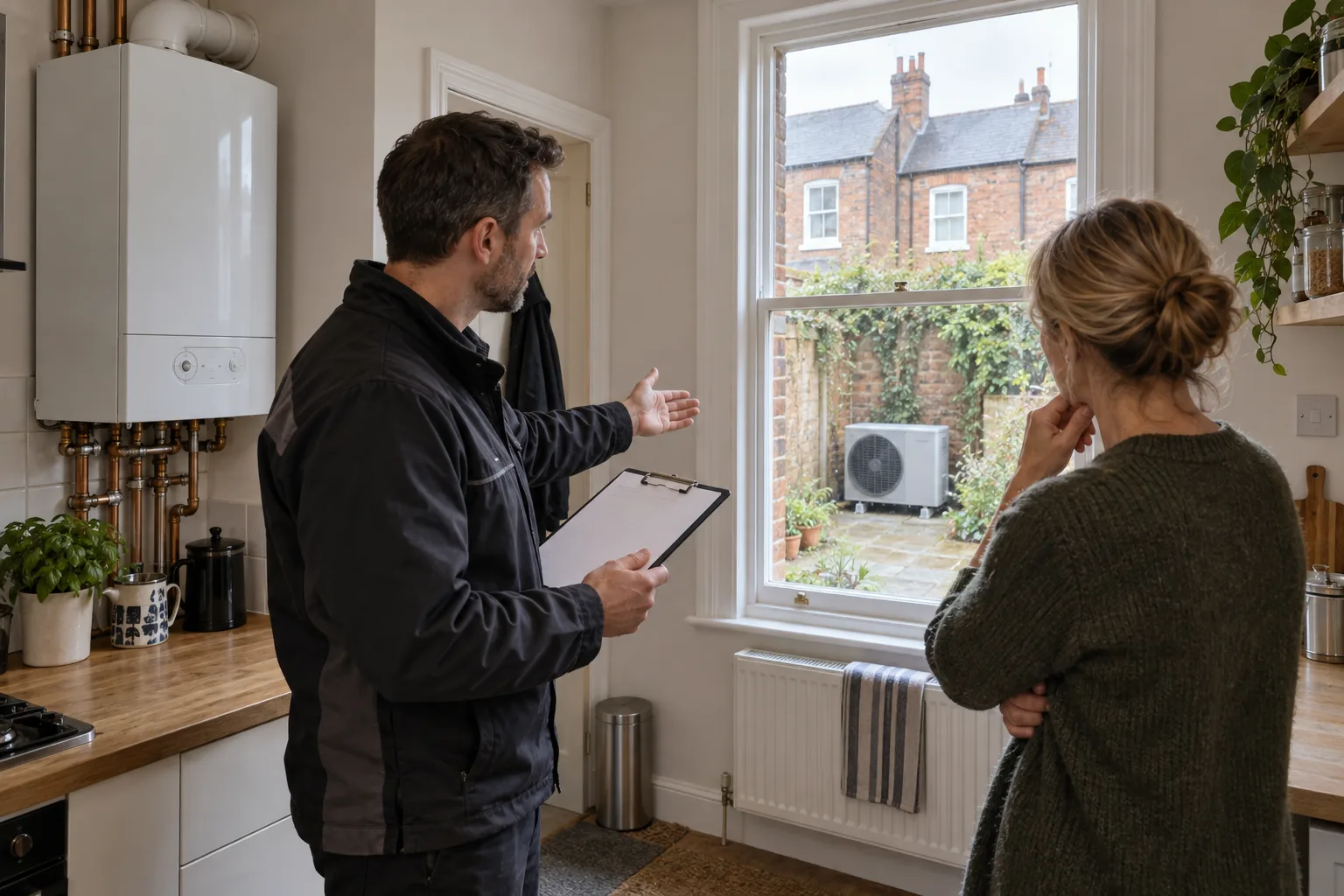

HMRC currently applies 0% VAT to the installation of specified energy-saving materials in qualifying residential accommodation until 31 March 2027. The relief can cover heat pumps, insulation, solar panels, batteries and heating controls, but it does not make every product or item of building work zero-rated.
Is there still 0% VAT on heat pumps in 2026?
Yes. HMRC says qualifying installations of specified energy-saving materials are zero-rated until 31 March 2027. The list includes fixed air, ground and water source heat pumps, insulation, solar panels, electrical storage batteries, smart diverters, draught stripping and central-heating or hot-water controls.
The relief is about installation. Materials sold without installation are normally standard-rated, and unrelated building work can carry a different VAT rate. From 1 April 2027, the qualifying installation relief is scheduled to revert to 5% under the current rules. Check the live HMRC VAT Notice 708/6 and ask the contractor to show the VAT treatment clearly on the quotation. Official position checked 24 August 2026.
Why VAT relief matters in 2026
The temporary VAT rule for energy saving materials is easy to miss, but it can make a real difference when a household is pricing insulation, solar panels, batteries or heat pumps in 2026. The main point is simple. HMRC says a zero rate applies to the installation of certain specified energy saving materials from 1 May 2023 to 31 March 2027. HMRC also says that from 1 April 2027, those installations revert to the reduced VAT rate of 5 percent.
That does not mean every green home product is automatically VAT free. The wording matters. The relief is about qualifying installed energy saving materials in the right type of property. It is not a general discount on every building job, every repair, every retail purchase or every quote that mentions energy efficiency.
For homeowners, landlords and tenants planning upgrades, 2026 is a useful year to check the VAT position before work is agreed. The quote should show what is being supplied, who is installing it, which elements qualify and which elements do not.
The short answer
If a contractor supplies and installs qualifying energy saving materials in residential accommodation, HMRC says the installation can fall under the zero rate during the temporary window. The relief can also apply where the customer bought the materials and pays a business to install them. But HMRC says the sale of materials without installation is standard rated.
The temporary window is important because it is not open ended. The 0 percent rate applies from 1 May 2023 to 31 March 2027. From 1 April 2027, HMRC says installations revert to the reduced rate of 5 percent.
In practical terms, households should not just ask whether a measure is eligible for a grant. They should also ask how VAT is being treated on any privately funded part of the work.
What counts as energy saving materials
HMRC lists the materials covered by the relief. The list includes controls for central heating and hot water systems, draught stripping, insulation, solar panels, wind turbines, water turbines, ground source heat pumps, air source heat pumps, micro combined heat and power units and wood fuelled boilers.
From 1 February 2024, HMRC says additional materials were added to the temporary zero rate scope. These include water source heat pumps, electrical storage batteries and smart diverters.
That list covers many of the measures households usually compare when trying to reduce heat loss or energy bills. Loft insulation, wall insulation, floor insulation, heating controls, air source heat pumps, solar panels and batteries can all be relevant, depending on the property and the quote.
Installation is the key word
The word installation is doing a lot of work here. HMRC says the relief applies to the services of installing energy saving materials. It can also apply to the supply of the materials by the person who installs them.
That means a supply and fit quote may be treated differently from a retail purchase. HMRC gives the broad rule that the sale of energy saving materials by a retailer is always standard rated if the retailer is simply selling the goods without installing them.
So a household buying insulation rolls, batteries or controls from a shop should not assume the product price has the same VAT treatment as an installed job. The contractor, quote and invoice should make the position clear.
Why mixed building work needs care
Many home upgrades include more than one thing. A loft insulation job might include access work. A heat pump job might include pipework, controls and electrical work. A solar battery job might include electrical changes. A renovation could include insulation as part of a larger construction project.
HMRC guidance explains that the VAT result can depend on whether the work is a single supply or multiple supplies. If the energy saving material is the main element and other work is just supporting that installation, the VAT treatment may be different from a larger building project where insulation is only part of the construction work.
This is why households should ask for itemised clarity. A vague quote makes it harder to see whether the VAT treatment is correct.
Insulation and the 2026 quote
Insulation is one of the clearest categories in the HMRC list. HMRC says insulation includes materials designed and installed because of their insulating qualities, including insulation for walls, floors, ceilings, roofs or lofts, water tanks, pipes and other plumbing fittings.
Energy Saving Trust says professionally installing 270mm of loft insulation in an uninsulated semi detached home costs around £900. It also says typical cavity wall insulation installation costs in Great Britain are around £2,700.
Those figures are not quotes for every home. They are benchmarks. Access, property size, wall condition, damp, ventilation, scaffolding and preparation can all affect real pricing. But they show why VAT treatment still matters. On a privately funded job, 5 percent can be meaningful when the work is planned alongside other upgrades.
Solar panels, batteries and smart diverters
Solar panels are included in HMRC guidance as energy saving materials. From 1 February 2024, electrical storage batteries and smart diverters were added to the temporary zero rate scope.
That is important for homeowners comparing a solar only quote with a solar and battery quote, or adding a battery to an existing solar system. The quote should show whether the battery is being installed as part of a qualifying supply and whether any other electrical work is treated separately.
The same point applies to smart diverters. A diverter can help send spare solar generation to hot water or another electrical load, but the VAT treatment still depends on the actual supply and installation.
Heat pumps and VAT
HMRC includes ground source heat pumps and air source heat pumps in the energy saving materials list. It also added water source heat pumps to the temporary zero rate scope from 1 February 2024.
GOV.UK says Boiler Upgrade Scheme grants are currently available at £7,500 for an air source heat pump, £7,500 for a ground source heat pump, £5,000 for a biomass boiler and £2,500 for an air to air heat pump. GOV.UK also says systems must meet standards, and lists capacity limits of 45kWth for individual systems, 70kWth where a heat pump is installed with one or more additional heat pumps and 300kWth for shared ground loops.
Grant value and VAT treatment are separate questions. A quote can include a grant funded part, a privately funded part and work that may have different VAT treatment. The household should ask the installer to show the numbers clearly before agreeing.
Warm Homes Local Grant and VAT
GOV.UK says Warm Homes Local Grant can support measures such as wall, loft and underfloor insulation, air source heat pumps, smart controls and solar panels where the council agrees the work. GOV.UK also says the home must be in England, privately owned and have an EPC of D, E, F or G. Household income must usually be £36,000 a year or less, although a postcode or benefit route may apply.
For eligible households, the council can organise and pay for agreed work. GOV.UK says applicants do not need to pay for it, although landlords may need to pay for some improvements.
Where a grant covers the whole agreed package, the household may not see VAT as a separate cost. But where extra private work is added, or where a landlord contribution applies, VAT treatment should still be checked.
Energy prices make timing more important
Ofgem says the price cap from 1 July to 30 September 2026 is £1,862 per year for a typical direct debit dual fuel customer in England, Scotland and Wales. Ofgem also lists average direct debit unit rates for that period of 26.11p per kWh for electricity and 7.33p per kWh for gas.
Those figures do not predict one household bill. A cold solid wall house, a flat, an electrically heated home and a rural property can use very different amounts of energy. But they do show why reducing wasted heat and improving control remain practical priorities.
VAT relief does not make a poor measure good. It can make a suitable measure slightly easier to justify when the survey, design and quote are already right.
What should be on the quote
A clean quote should make the VAT position easy to understand.
- The measure being installed.
- The installation address.
- Whether the property is residential accommodation.
- The supply and fit price.
- Any separate retail only products.
- Any building work that is outside the qualifying measure.
- The VAT rate used for each part.
- The grant value, if a grant is involved.
- Any private contribution.
- The installer details and certification where relevant.
If the quote does not show enough detail, ask for a clearer version before paying a deposit.
Questions to ask before agreeing work
The best questions are direct.
- Which parts of this quote are being treated at 0 percent VAT.
- Which parts are being treated at another VAT rate.
- Are materials being supplied and installed by the same business.
- Is any building or repair work separate from the energy saving material.
- Is the measure grant funded, privately funded or both.
- Will the invoice match the VAT treatment shown in the quote.
- What happens if survey findings change the scope.
- Are guarantees, certificates and handover documents included.
- Is any landlord contribution required.
- Is the installation expected before 1 April 2027.
Good installers should be able to answer these points without making the customer feel difficult.
What the 2027 date means
The temporary 0 percent period is due to run until 31 March 2027. From 1 April 2027, HMRC says installations of energy saving materials revert to the reduced VAT rate of 5 percent.
That does not mean every household should rush into work. A badly chosen measure can cost more than VAT relief saves. The order still matters. Fix damp before insulation. Check heat loss before a heat pump. Confirm roof condition before solar panels. Think about ventilation when draught proofing or insulating.
But where a suitable project is already being planned, the 2027 change is worth having on the timeline.
Common mistakes to avoid
The first mistake is assuming a product is VAT free because it is energy efficient. HMRC draws a distinction between installed qualifying materials and retail sale of materials without installation.
The second mistake is assuming a grant and VAT relief are the same thing. A grant may reduce the amount the household pays. VAT relief affects how VAT is charged on the supply.
The third mistake is accepting a single vague price for a mixed job. If a project includes insulation, building work, repairs and decoration, the quote should explain how each part is treated.
The fourth mistake is treating VAT as the main decision. It should be part of the calculation, not the reason to install the wrong measure.
How to plan the work
Start with the property problem. If the home is losing heat through the roof, loft insulation may come first. If walls are uninsulated, wall type and damp risk need checking. If heating is expensive or uneven, a heat loss survey and controls review may be needed. If the roof is suitable and electricity use is high enough, solar panels and a battery may be worth comparing.
Then check funding. Warm Homes Local Grant may help eligible homes in England where the property and household route fit. Boiler Upgrade Scheme may help with eligible low carbon heating. VAT relief can then be checked on any qualifying installed work.
The best plan joins these pieces together rather than treating them as separate deals.
Useful next steps
For measure planning, compare this guide with Warm Homes Plan, home insulation grants, EPC checks before grants, heat loss surveys, loft insulation, cavity wall insulation, air source heat pumps, solar panels and smart heating controls.
Those pages help compare the measure options before a quote is agreed.
The bottom line
In 2026, the temporary 0 percent VAT rule is a useful part of the home energy upgrade picture. HMRC says qualifying installations of energy saving materials can be zero rated until 31 March 2027, before reverting to 5 percent from 1 April 2027.
The practical action is to check the quote. Ask what is being installed, which parts qualify, how grants are shown and whether any extra work has a different VAT treatment. VAT relief is most valuable when it supports a well planned upgrade that suits the home.