
The Smart Export Guarantee pays you for the surplus solar electricity you send to the grid, but two identical systems can earn very different amounts depending on the tariff. This guide covers how the scheme works in 2026, who must offer it, what you need to claim, and how to find the best export rate.
If you have solar panels on your roof, or you are thinking about fitting them, the Smart Export Guarantee is the part of the system that pays you back. It is the scheme that lets you earn money for the electricity your panels generate but your home does not use, by sending it to the grid. Yet it is also one of the most misunderstood parts of going solar. Two households with identical systems can earn very different amounts each year, purely because one picked a better export tariff than the other.
This guide explains exactly how the Smart Export Guarantee works in 2026, who has to offer it, what you need in place to claim it, and how to avoid leaving money on the table. Every rule and figure below has been checked against the primary sources at Ofgem, GOV.UK and the Energy Saving Trust.
What the Smart Export Guarantee actually is
The Smart Export Guarantee, usually shortened to SEG, launched in January 2020 to replace the old Feed-in Tariff, which closed to new applicants in 2019. Under the SEG, electricity suppliers pay small-scale generators for the surplus renewable power they export to the National Grid.
The key word is export. The SEG does not pay you for the electricity you generate and use inside your own home. It pays you only for the units you send back to the grid because you were not using them at the time. That is why how much you export, and when, matters just as much as how big your system is.
The scheme is regulated by Ofgem, but the individual tariffs are not price-controlled. Suppliers set their own export rates. Ofgem's job is to make sure the larger suppliers offer a compliant tariff at all, and that every SEG rate stays above zero.
Who has to offer a SEG tariff
Not every energy supplier is obliged to run an export tariff, but the big ones are. Under Ofgem's rules, any licensed electricity supplier with at least 150,000 domestic electricity customers is a mandatory SEG licensee. That means they must offer at least one SEG-compliant tariff to eligible generators, and they cannot simply choose to stop offering it once they do.
Smaller suppliers can offer a SEG tariff voluntarily, and some do to attract solar customers. This matters because you are not tied to buying your export tariff from the same company that supplies your electricity. You can import from one supplier and export to another, which opens up the whole market when you are hunting for the best rate.
What technologies qualify
The SEG is not solar only, although solar photovoltaic panels are by far the most common way households use it. Ofgem confirms the eligible technologies are:
- Solar photovoltaic, known as solar PV
- Wind
- Micro combined heat and power, or micro-CHP
- Hydro
- Anaerobic digestion
Your installation must be located in Great Britain and can be up to a capacity of 5MW, or up to 50kW for micro-CHP. For a typical home that ceiling is irrelevant, since a domestic rooftop solar array is usually somewhere between 3kW and 6kW.
What you need in place to claim
There are three practical requirements to start earning through the SEG, and it is worth checking each one before you expect any payments to land.
MCS certification or an equivalent
For solar PV, wind and micro-CHP installations up to 50kW, Ofgem asks applicants to show that both the installation and the installer are suitably certified. In practice this normally means a Microgeneration Certification Scheme certificate, known as MCS, although Ofgem does recognise that other schemes may be treated as equivalent.
This is one of the most common reasons an application stalls. If your panels were fitted by an installer who was not MCS certified, or you cannot lay your hands on the MCS certificate, a supplier can refuse your SEG application. Always keep that certificate safe. If you are choosing an installer now, confirm they are MCS certified before you sign anything.
A smart meter that can read your exports
To be paid for what you export, your supplier needs accurate half-hourly readings of the electricity flowing out of your home. That requires a second-generation smart meter, a SMETS2 meter, or a first-generation SMETS1 meter that has been enrolled onto the national Data Communications Company network.
Without a suitable smart meter, the supplier cannot see your export data, and most SEG tariffs simply will not accept you. If you do not have one, ask your electricity supplier to arrange an installation before you apply.
An eligible, correctly documented system
Finally, the system itself needs to be eligible and properly documented, with the paperwork from your installer to prove the capacity, the commissioning date and the certification. Keep everything from the install in one folder.
How much you can earn
This is where the money is won or lost. Because suppliers set their own rates, SEG tariffs in 2026 range enormously, from just a few pence per kilowatt hour up to more than 30p per kilowatt hour for the most competitive fixed offers. The only hard rule is that the rate must always be greater than zero.
To put that spread in perspective, here are some published examples from 2026. Octopus Energy, which had held its fixed export rate at 15p per kWh since 2022, cut its Fixed Outgoing rate to 12p per kWh on 1 March 2026. Its basic export-only SEG route pays around 4.1p per kWh. At the top of the market, some of the best flat rates have been advertised in the region of 24p to 25p per kWh, although the sharpest deals often come with conditions such as buying your import electricity from the same supplier, or having a home battery.
The Energy Saving Trust gives a useful worked example of how export payments fit into the wider picture. In its illustration, a 4.5kWp solar system delivered combined bill savings and SEG export payments of roughly £495 a year, based on a household that exported around 65% of what it generated. Your own figure will depend on how much you use during daylight hours, how much you export, and crucially which tariff you are on.
Fixed versus variable export tariffs
There are two broad shapes of SEG tariff, and which one suits you depends on your setup.
A fixed export tariff pays you the same rate for every unit you export, whatever the time of day. It is simple, predictable, and easy to compare. For most households without a battery, a strong fixed rate is the straightforward choice.
A variable, or agile, export tariff pays a rate that changes every half hour, tracking wholesale electricity prices. These can pay significantly more than a fixed rate during peak demand in the early evening, but far less in the middle of a sunny day when everyone else's panels are also flooding the grid. Variable tariffs tend to reward households with a home battery, because you can store your midday surplus and release it to the grid when export prices spike. Without a battery, a variable export tariff often works against a typical solar home, since you export most when the price is lowest.
How to get the best deal
Because your export tariff is separate from your import tariff, and because the rates vary so widely, choosing well is the single biggest lever you have over your solar returns. A few practical steps:
- Confirm you have MCS certification and a working export-capable smart meter before applying, so nothing holds up your first payment.
- Compare export tariffs across the whole market, not just your current supplier, since you can export to a different company from the one that supplies your power.
- Read the conditions, not just the headline rate. The highest rates often require you to also buy your import electricity from that supplier, or to have a battery installed.
- Match the tariff shape to your setup. Choose a strong fixed rate if you have no battery, and seriously consider a variable export tariff if you do.
- Review your tariff at least once a year. Suppliers change their rates with notice, as Octopus did in March 2026, so a deal that was competitive when you signed up may no longer be.
Batteries and the SEG
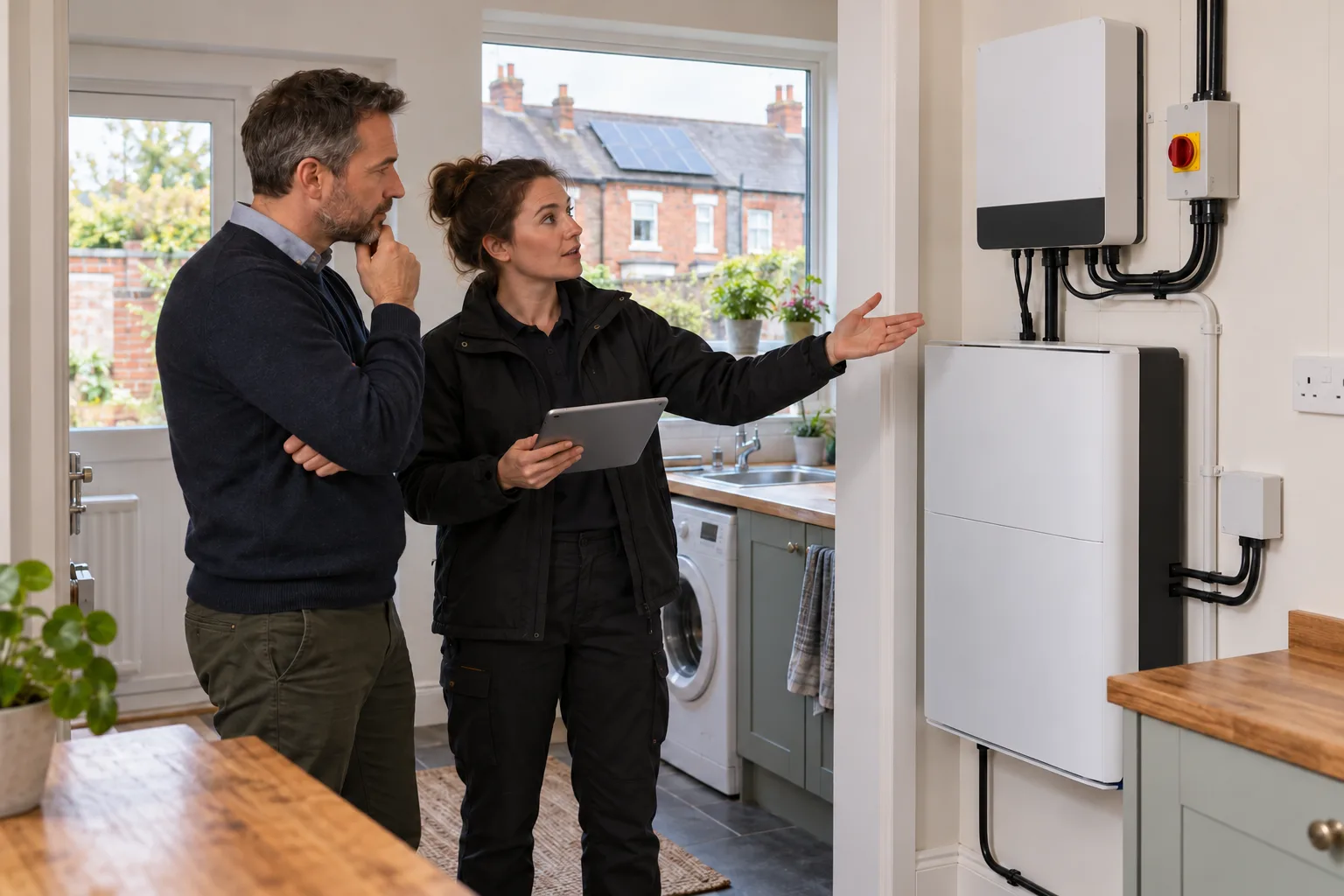
A home battery changes the maths of the Smart Export Guarantee more than almost anything else. Without storage, your panels export the most in the middle of a bright day, which is exactly when wholesale prices, and therefore variable export rates, tend to be at their lowest because generation across the country is high. A battery lets you capture that midday surplus and decide when to use or export it.
There are two ways households use a battery to improve their returns. The first is simple self-consumption. By storing daytime generation and using it in the evening, you buy less expensive imported electricity, which usually saves more per unit than you would have earned by exporting it. The second is arbitrage on a variable export tariff. You hold your stored energy back and release it to the grid during the early-evening peak, when export prices can be several times higher than the midday rate. This is why the most competitive variable export tariffs are aimed squarely at battery owners.
The trade-off is upfront cost. A battery adds a substantial sum to a solar installation, often several thousand £, so it is worth modelling whether the extra export income and self-consumption savings justify it for your usage pattern. Households that are out during the day and use most of their power in the evening tend to benefit most.
Common reasons SEG payments do not arrive
If you have applied for a SEG tariff but no payments are showing, the cause is almost always one of a handful of things:
- No suitable smart meter, so the supplier cannot read your half-hourly export data.
- Missing or invalid MCS certification, or an installer who was not certified at the time of the install.
- Incomplete paperwork, such as no proof of the commissioning date or system capacity.
- Applying to the wrong supplier, for example one that only offers its best export rate to its own import customers.
- Exporting very little, because a high share of your generation is being used inside the home. This is not a fault, but it does mean smaller payments.
Working through that list resolves the vast majority of cases. If everything checks out and payments still do not appear, contact your SEG supplier directly, as they administer and pay the tariff, not Ofgem.
SEG and other schemes
The Smart Export Guarantee sits alongside, rather than inside, the main government grant schemes. It is not part of the Boiler Upgrade Scheme, which funds heat pumps and biomass boilers, nor the Warm Homes Local Grant, which funds insulation and low-carbon heating for lower-income households in England. You can benefit from the SEG at the same time as those schemes if you qualify, but it is a separate payment stream funded by suppliers, not by the taxpayer.
If you are combining solar with a heat pump, the SEG becomes even more relevant. A heat pump increases your electricity use, so making the most of your own generation, and exporting the rest at a good rate, has a bigger effect on your annual running costs than for a home with a gas boiler.
The bottom line
The Smart Export Guarantee is the mechanism that turns your rooftop surplus into an income. The scheme itself is straightforward once you know the rules. Suppliers with 150,000 or more domestic customers must offer a tariff, every rate must be above zero, and you need MCS certification plus an export-capable smart meter to claim.
Where households win or lose is the tariff choice. With rates ranging from a few pence to more than 30p per kilowatt hour, and with the freedom to export to a different supplier than you import from, the difference between the best and worst deal can be £200 or more a year. Get your certification and smart meter in order, compare the whole market, match the tariff shape to whether you have a battery, and revisit it every year.
If you want help making sense of your options, or you are planning solar panels, a battery or a heat pump and want to understand how they work together, our team can talk you through what would suit your home.