
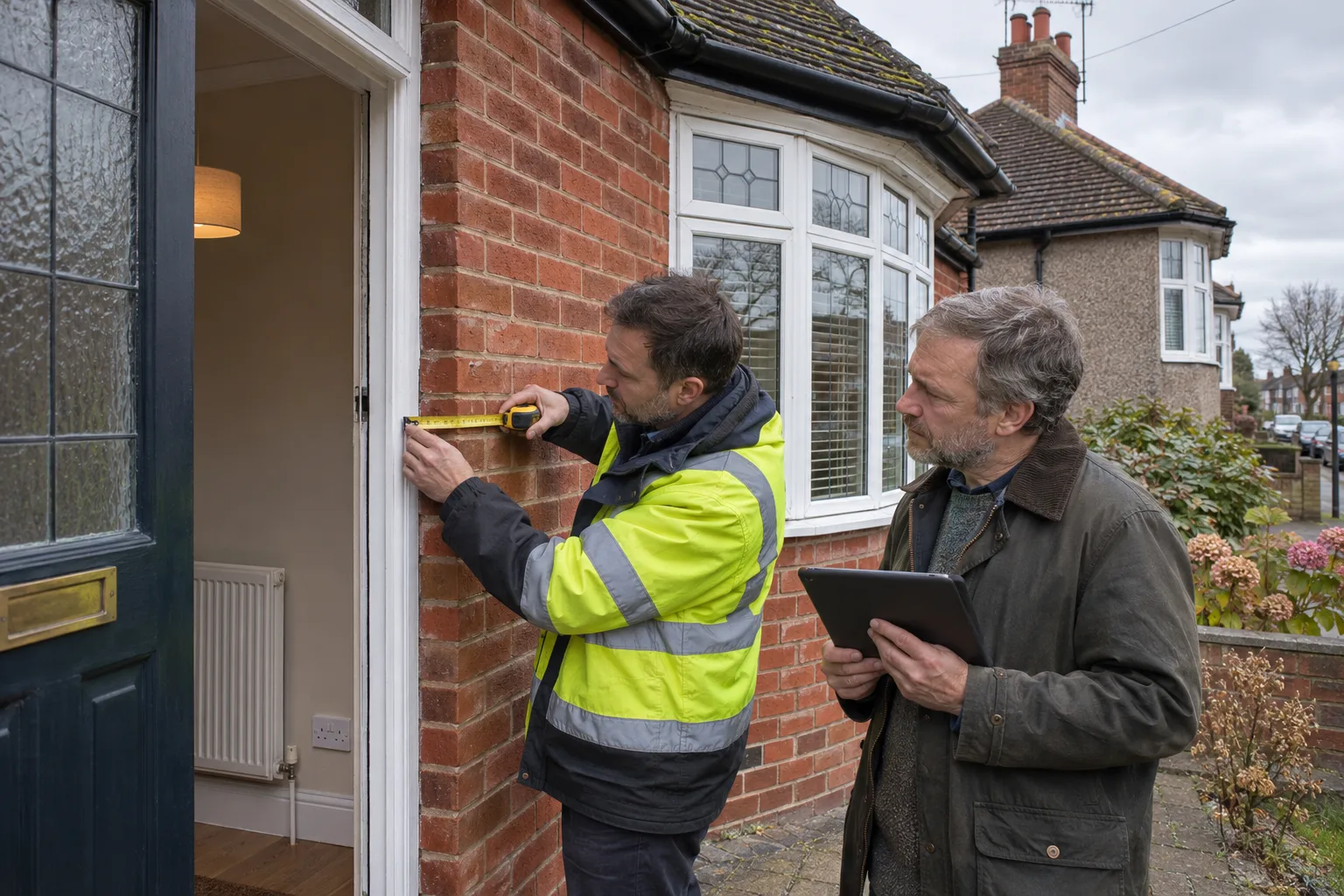
If an EPC records solid wall construction but you expected cavity walls, check the building part, insulation evidence and correction route before paying for work.
If an EPC says solid wall but you expected cavity construction, pause before pricing insulation or challenging the whole rating. The useful first step is to identify exactly which wall and which field the certificate describes. Wall construction, added wall insulation and the resulting energy rating are related, but they are not the same input.
For a D-rated rental, resolving that distinction can prevent the wrong upgrade plan. A genuine construction error may need correction, while a correctly identified cavity wall can still appear as “as built” when there is no accepted evidence of later cavity fill. Neither situation proves that the property will gain a particular number of points.
Gather the current certificate and any property records before commissioning work. Start your free EPC assessment to compare the recorded wall details with the building evidence and the wider D-to-C route.
The short answer: wall type and wall insulation are separate checks
The current RdSAP 10 specification gives assessors separate entries for wall construction, wall thickness and wall insulation. Construction options include solid brick, cavity, stone, timber frame and system build. The insulation entry then records conditions such as as built, filled cavity, internal insulation or external insulation where the method permits them.
That means “solid brick” is a construction description. “Cavity, as built” describes cavity construction without accepted evidence of insulation added after the original build. “Cavity, filled cavity” records a later fill supported by the required evidence. A disagreement about one field should not be turned into a conclusion about all three.
The official RdSAP 10 conventions state that where a cavity wall has been identified it should be entered as cavity, irrespective of the cavity width. They also require the assessor to record the insulation level, dry lining and wall thickness. This makes a specific wall-type query appropriate when the observed construction and certificate do not appear to match.
Why an EPC may not match your expectation
The property may contain more than one wall construction
A house can have solid original walls, a cavity extension, an alternative wall around part of the elevation or a later infill section. A flat can also have heat-loss walls that differ from walls elsewhere in the block. Read every wall entry and the stated proportions before assuming one line describes the whole building.
The certificate may be describing the external wall, not the party wall
A terraced or semi-detached property has walls adjoining another dwelling as well as walls exposed to outside. RdSAP treats external, alternative and party-wall information separately. A construction note about one element cannot safely be transferred to another without checking the assessment data and the building layout.
Visible brickwork can be hidden or misleading
Render, cladding, extensions and altered elevations can conceal the original construction. Brick bond and wall thickness can provide useful clues, but a single photograph or tape measurement is not a complete diagnosis. The assessor has to identify the construction using the applicable conventions and retain evidence that supports the entry.
A wall can be cavity construction without proven cavity fill
This is the most common distinction to preserve. If the wall is correctly recorded as cavity but the added insulation is not recognised, the relevant question is evidence of the fill rather than construction type. The cavity-wall insulation evidence guide owns that separate workflow.
The recorded age or building part may need checking too
RdSAP uses the age band and construction details together when applying standard values. An extension can have a different age from the main dwelling. If the certificate appears inconsistent, compare the build period and the way the home was divided into building parts rather than asking only whether the word “solid” is wrong.
A landlord evidence checklist before you query the EPC
1. Download the current certificate
Use the official find an energy certificate service and check that you are reading the newest certificate for the correct address. Record its report reference number, assessment date, rating and score. Older certificates can still be useful for comparison, but the newest lodged EPC is the valid one.
2. Copy the exact wall descriptions
Note each entry in the certificate’s property-features section, including its construction, insulation description and displayed performance. If the main wall, extension or another building part is described separately, keep those lines separate in your query.
3. Map the parts of the property
Mark the original building, extensions, converted areas and elevations that appear different. Clear external and internal photographs can help an assessor understand what you are questioning, but avoid presenting appearance alone as proof of a concealed cavity.
4. Collect property-specific records
Useful records can include approved plans, building-control documents, construction specifications, completion information and records from a relevant insulation installation. The government’s domestic EPC guidance says owners should gather up-to-date building information before the visit, but the assessor remains responsible for validating what is used.
5. Compare previous EPCs without treating them as proof
A previous certificate can expose a change in wall type, age band or building-part description. Ask why the inputs differ, but remember that one assessor cannot adopt an earlier entry simply because it produced a higher score. Each assessment must be supported under the method in force at the time.
6. Write one precise question
A useful query identifies the exact field, the section of wall, the evidence you hold and the explanation you want. For example: “The main front and rear walls are recorded as solid brick. The approved extension plans appear to show cavity construction for the rear addition. Was that addition entered separately, and what evidence would you need to review the input?”
What to do if the wall type appears wrong
Start with the assessor named on the certificate
Government guidance says complaints about EPC quality or accuracy should go to the energy assessor first. The current get a new energy certificate service repeats that route and explains that the assessor’s accreditation-scheme details appear on the certificate.
Send the focused evidence pack and ask the assessor to explain the construction entry. The answer may confirm that a different part of the property was being described, request stronger evidence, or identify an input that needs correction. Keep the exchange factual; a lower-than-expected rating by itself is not proof of negligence.
Escalate to the accreditation scheme if it is not resolved
The official domestic EPC consumer guidance says the accreditation scheme must investigate unresolved complaints. Where information is found to be incorrect, a new EPC must be issued and the register amended, with that complaint procedure followed at no cost to the complainant.
That does not mean every disagreement results in a replacement certificate. The scheme considers the assessment evidence and applicable method. If the existing entry is supported, the next decision may be to obtain different evidence, commission a fresh assessment when appropriate or plan improvements using the confirmed inputs.
Do not try to edit the lodged certificate yourself
Only an approved assessor can lodge assessment data. A landlord, installer or consultant cannot directly change a wall input on the register. Specialist testing or documentary evidence can inform a qualified assessment, but it does not alter a lodged EPC on its own.
How the answer changes a D-to-C plan
A corrected wall construction can change the modelled building, its recommendations and potentially its score, but the direction and size of any change depend on the complete assessment. Cavity construction is not automatically better in every recorded condition, and proving a cavity does not also prove that it is filled.
Review the wall question alongside the whole certificate. The evidence-first D-to-C plan explains how to separate evidence corrections, proportionate measures and larger upgrades. The guide to a lower replacement EPC is useful when two certificates disagree across several inputs.
The current domestic private-rented minimum in England and Wales remains EPC E unless a valid exemption applies. Government policy sets a higher standard for 1 October 2030, subject to the planned legislative implementation. For a D-rated rental, checking a material wall discrepancy now is sensible commercial preparation; it is not a promise that correction alone will deliver C.
Do not confuse an accuracy query with the solid wall insulation exemption guide. An exemption is a compliance route for defined circumstances. It does not correct a wall description or add points to the EPC.
Primary sources checked
The technical distinction between construction, thickness and insulation comes from the current BRE RdSAP 10 specification and MHCLG-approved RdSAP conventions version 12.2. The conventions are applicable from 6 August 2026.
The assessment, evidence and complaints process is supported by the government guide for domestic EPCs, the Energy Performance of Buildings Regulations 2012 and the government’s 2026 EPC accuracy research. That research examines weaknesses in assumptions, defaults and assessment processes; it does not mean that any individual certificate is inaccurate.
Frequently asked questions
These answers cover domestic EPCs in England and Wales. The correct response still depends on the recorded building part, the evidence available and the assessor’s review.
Does “solid brick” on an EPC mean the wall has no insulation?
Not by itself. Solid brick describes the wall construction. Added internal or external insulation is a separate input. Read the full property-features line and ask what evidence supported both parts.
Does “cavity, as built” mean the assessor made a mistake?
No. It can mean cavity construction was identified but no accepted evidence showed insulation added after the original build. If cavity fill exists, provide property-specific evidence for the assessor to validate.
Can a wall-thickness measurement prove cavity construction?
It is a useful survey observation, not a universal proof on its own. Wall age, materials, finishes and mixed construction can complicate the picture. The accredited assessor must apply the current conventions and retain supporting evidence.
Will correcting the wall type guarantee EPC C?
No. The score uses the whole dwelling, including dimensions, age bands, glazing, roof, floor, heating, hot water and other inputs. A correction should improve accuracy; the final band can only be known after the qualified assessment is completed and lodged.
Should I pay for wall insulation before resolving the discrepancy?
Not solely because of the disputed line. First confirm the construction, insulation evidence and complete assessment route. If work is still appropriate, obtain property-specific advice on suitability, moisture, ventilation, detailing and cost.
Resolve the input before choosing the upgrade
A wall-type discrepancy is worth checking because it can send a landlord towards the wrong evidence request or the wrong work. Separate construction from insulation, map each building part, give the assessor a precise evidence pack and use the formal accreditation route only when the first review does not resolve the issue.
Start your free EPC assessment to review the certificate, wall evidence and lowest-cost credible D-to-C options before committing to major work.