Hidden cavity-wall insulation can be missed without proof. Use this landlord checklist to prepare address-specific evidence for an EPC assessor.
If cavity-wall insulation is hidden, an EPC assessor may need property-specific evidence before it can be recorded. The useful outcome for a landlord is not simply finding any old insulation document. It is assembling proof that identifies the rental, shows completed work and can be validated before the assessment is lodged.
A clear evidence pack can prevent a real installation being missed. It cannot manufacture a better input, guarantee an EPC point gain or promise band C. Start with the current certificate and the actual wall construction, then ask the assessor which records are usable for that property.
The short answer: prove the property and the completed work
The government guide to domestic EPCs says that cavity-wall insulation may not be visible during an existing-home survey. Without supporting information and evidence, such as receipts, the assessor may be unable to include the feature. That is why finding the paperwork before the visit matters.
The current BRE RdSAP 10.2 conventions say acceptable documentary evidence can include certificates, warranties, guarantees, official registered-social-landlord correspondence or other documents verifying that work was carried out. The assessor must be confident that the evidence relates to the property being assessed and that there is no physical or documentary evidence to the contrary.
Evidence that someone intended to install insulation is not enough by itself. A quotation, product brochure or planning drawing may describe a proposed job without proving completion. The strongest file connects the address, installation, date and completed work in a way the assessor can verify.
Why cavity-wall insulation can be missed on an EPC
An EPC for an existing home is based on a site survey and the current RdSAP method. The survey is non-destructive. An assessor will not open walls simply to confirm what is inside them, and a rendered or repointed elevation may hide the signs of an earlier cavity fill.
Where added insulation cannot be established, the method uses the permitted construction and age inputs rather than accepting an unsupported statement from the owner. That is not the assessor choosing the worst possible value. It is the standardised evidence rule that keeps certificates comparable.
A previous EPC can help identify what was recorded before, but it does not remove the current assessor’s responsibility to validate the input. If two certificates disagree, compare the wall description and the supporting records instead of assuming that the newer certificate is wrong. The landlord guide to a lower EPC rating explains the wider comparison.
A cavity-wall insulation evidence checklist
1. A certificate, warranty or guarantee tied to the address
Look for the installation certificate, warranty or guarantee supplied when the cavity was filled. The document should identify the property and the completed work rather than only the customer or installer. Keep every page, including schedules that contain the installation address, date, material or scope.
2. An invoice or receipt that describes completed installation
A paid invoice or receipt can support the file when it clearly names the property and the cavity-wall insulation work. A generic card payment, materials receipt or quotation is weaker because it may not show where the product was installed or whether the job was completed. Preserve the original digital file where possible.
3. Installer or scheme completion records
If the paperwork has been lost, ask the original installer, guarantee provider, energy supplier, local authority or delivery scheme whether it holds a property-specific completion record. Do not substitute a neighbour’s certificate or a generic specification for your rental. Evidence must belong to the dwelling being assessed.
4. Building-control and project documents
For an extension, conversion or wider refurbishment, building-control approval, completion information, drawings and specifications may help establish what was built. The current conventions distinguish intention from completion, so a proposed insulation note on a drawing is not automatically proof that the finished wall contains it. Include oversight or completion records and any corroborating site evidence.
5. Dated photographs and visible site evidence
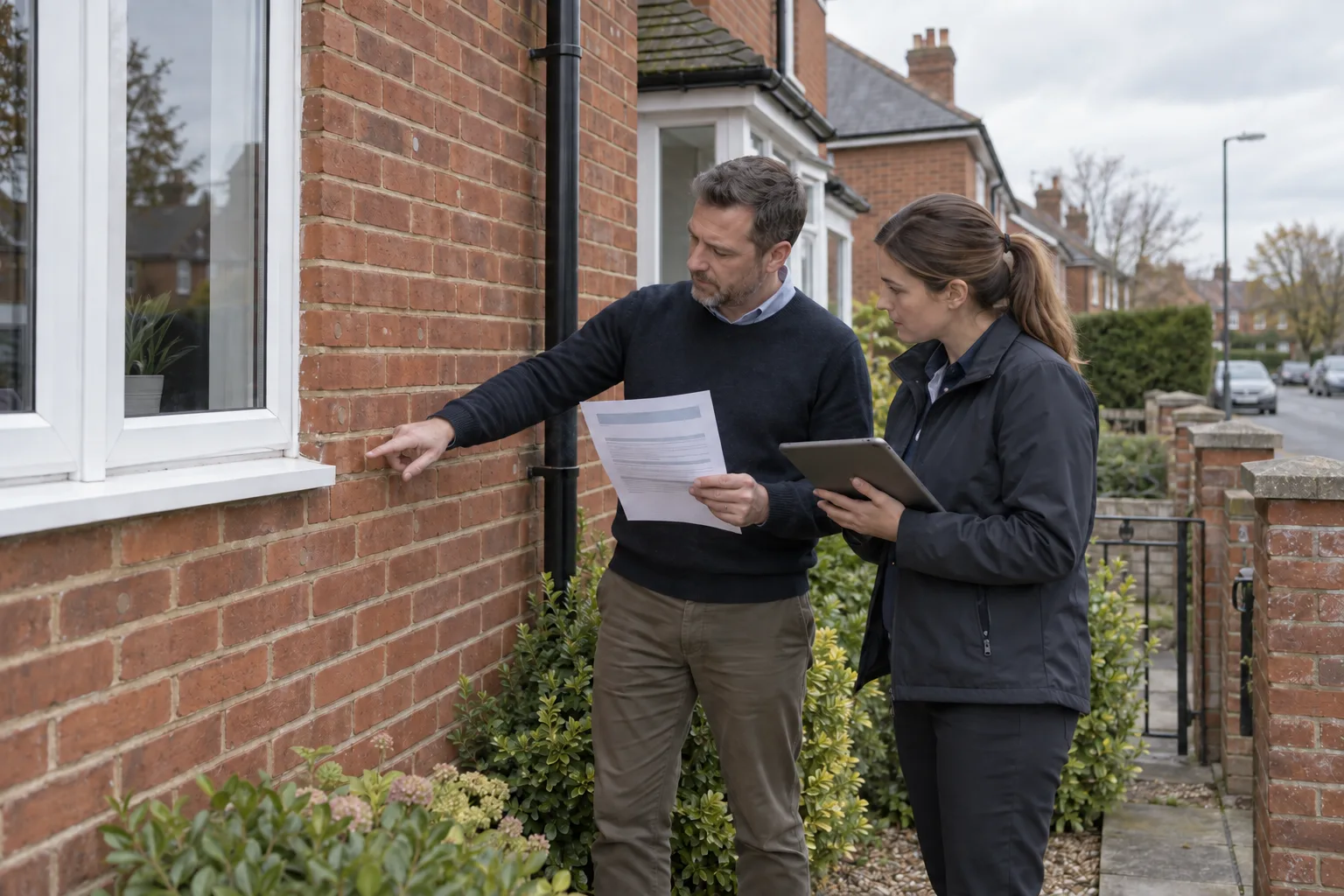
Dated photographs taken during installation can help an assessor understand the work, especially when they identify the property and show the relevant wall. Visible fill patterns or sealed drill holes may also prompt a closer review. Neither should be presented as automatically conclusive: repairs, render, partial treatment or unrelated holes can make the picture ambiguous.
6. A short index for the assessor
Put the address, installation date, wall areas treated and source of each document on one page. Keep the underlying originals with it. Send the pack before the appointment and ask what the assessor can accept; do not wait until the survey is nearly finished to introduce a large folder of unexplained files.
What usually does not prove completed cavity-wall insulation
Weak evidence often describes a product or intention rather than the actual dwelling. A brochure, unsigned estimate, grant eligibility letter, planning application on its own, photograph with no identifiable property, or statement from a landlord or tenant may not demonstrate that the work was completed at this address.
A recommendation on an EPC is also not evidence that the recommendation was carried out. Likewise, the absence of cavity-wall insulation from a certificate does not prove that the cavity is empty. It tells you what the assessor could record under the available evidence and survey conditions.
Do not edit documents, infer a specification from memory or ask an assessor to copy an earlier entry without review. If records conflict with the physical property, flag the conflict. The current conventions reserve “unknown” for limited situations and require the assessor to document uncertainty rather than choose whichever input produces the best score.
What to do when the paperwork is missing
Begin with the organisations most likely to hold the original record: the installer, warranty or guarantee provider, the scheme that funded the work, the council building-control team, the managing agent or the previous owner’s conveyancing file. Use the full address and an approximate installation date to narrow the search.
Next, show the current EPC and the evidence you do have to an accredited domestic energy assessor. Ask whether the record can support a cavity-fill entry, whether further validation is needed and which wall areas it covers. A document for the main house may not prove that a later extension or every elevation was treated.
Avoid commissioning new insulation merely to solve an evidence problem. First establish whether the cavity is already filled, whether the property is suitable and whether the wall input is material to the D-to-C route. The separate cavity-wall insulation cost and suitability guide owns that installation decision, while the general EPC evidence guide for landlords covers the rest of the property file.
How accepted evidence can affect the EPC rating
It can change the recorded wall input when it proves insulation that would otherwise be treated differently, but there is no universal cavity-wall EPC points figure. The effect depends on the wall area, construction, age, heating, fuel and every other input in the dwelling model. Accepted evidence could improve the score, leave the band unchanged or confirm what the certificate already records.
Evidence does not alter a certificate already on the register. A new result only exists after an accredited assessor completes and lodges a fresh EPC. Coordinate the evidence review with any other completed changes so that the assessment reflects the actual property once, rather than paying for repeated certificates.
For covered private rentals in England and Wales, current domestic MEES guidance still sets an EPC E minimum unless a valid exemption applies. The government has separately confirmed a higher private-rented standard for 1 October 2030, subject to the planned legislation and implementation. This practical checklist is not legal advice and should not be used as evidence for an exemption application.
Turn the evidence file into a D-to-C decision
Cavity-wall paperwork is commercially useful when it resolves a material assumption before a landlord buys major work. It is not an end in itself. Compare the current numerical score, the recorded wall description and the evidence with the full property model.
If the proof is accepted and the score still falls short, the next step may be another evidence item, a proportionate measure or a larger fabric or heating route. If the wall is genuinely uninsulated, suitability must be assessed before installation. The D-to-C landlord plan shows how to separate those routes.
Cucumber Eco can review the current EPC, cavity-wall entry and available records before you commission work or a new certificate. The initial property assessment is free and without obligation. Start your free EPC assessment with the current certificate and the evidence you already hold.
Frequently asked questions
These answers cover the most common cavity-wall evidence questions before a landlord EPC assessment.
Does an old EPC prove that cavity-wall insulation is installed?
An older EPC is useful context, but the current assessor remains responsible for validating the property data used in a new certificate. Keep the old EPC with the installation documents rather than relying on the earlier entry alone.
Is an insulation receipt enough for an EPC assessor?
It may be useful if it identifies the property, completed work and relevant details. A generic purchase receipt or quotation may not prove installation. Ask the assessor to review the actual document before the visit.
Do drill holes prove that a cavity has been filled?
Visible fill patterns can support a site review, but they may be obscured or ambiguous and do not always show which areas were treated. The assessor must consider the physical and documentary evidence together.
Does proving cavity-wall insulation guarantee EPC C?
No. Accepted evidence can affect the wall input, but the EPC score comes from the whole dwelling calculation. The result may improve without crossing a band, and another property may need different evidence or measures.