LEDs can improve a current EPC, but there is no fixed points gain. Learn what assessors count and when lighting could help a D-rated rental reach C.
LED light bulbs can improve a current-style EPC when they replace tungsten or halogen lamps in permanent fittings, but there is no fixed points gain. Lighting is only one input in the whole dwelling calculation. For a D-rated landlord, the commercial question is whether completing a low-cost LED change could close a small score gap or whether the property needs a different evidence or improvement route.
That makes lighting a sensible item to check before paying for disruptive work, especially when the existing score is close to C. It is not a shortcut that turns every D into a C. Review the current certificate, count what the assessor can actually record, complete suitable changes before the visit and model the whole property before assuming a result.
The short answer: LEDs can count, but the result is property-specific
A domestic EPC is an asset rating based on the dwelling and its installed services. The government guide to domestic EPCs explains that lighting is part of the assessment and that approved software combines the property data with standard performance tables. The rating does not simply award the same number of points for every bulb changed.
The current BRE RdSAP 10.2 conventions tell assessors to consider lamps in permanent fittings. LEDs are recorded as LED, compact fluorescent lamps and fluorescent tubes are recorded separately, while tungsten and halogen lamps are treated as incandescent. The assessor records the lighting present at the visit under those conventions; buying LEDs but leaving them boxed does not change the installed input.
Government MEES guidance includes an illustrative recommendation table in which low-energy lighting moves one example property from D55 to D56. The ratings in that table are cumulative and belong to that example. They are useful evidence that lighting can affect an EPC, but they are not a promise of one point for another rental.
Why there is no universal LED points figure
The EPC score comes from a calculation across the whole property: its type, dimensions, construction, insulation, glazing, heating, hot water, controls, ventilation, lighting and any qualifying generation. Changing one input alters that combined result. The effect of LEDs therefore depends on the starting proportion of efficient lamps and the rest of the dwelling model.
A property with mostly halogen lamps has more lighting input left to improve than one already recorded with almost all LEDs. A score can also move within the D band without crossing the C threshold. If the present score is 68, a small measure may deserve careful modelling; if it is 58, lighting alone is unlikely to bridge the full gap. Only a property-specific assessment can establish the outcome. Read what an EPC rating D means for landlords before treating the letter as the whole diagnosis.
Rounding and the interaction with other inputs also matter. A theoretical change in calculated running costs may not always create the band movement a landlord expects. Avoid adding together points figures from online examples. Start with the actual certificate and ask what the proposed LED change does in that dwelling model.
What lighting an EPC assessor records
Under the current RdSAP convention, the assessor considers lamps in permanent fittings throughout the dwelling, including fixed under-cupboard kitchen lighting. The current rule counts lamps rather than simply counting fittings. Plug-in table lamps and freestanding floor lamps are not permanent fittings, so swapping those is useful for electricity use but is not the same EPC input.
Tungsten and halogen lamps are not recorded as low-energy lighting under the current convention. LEDs are recorded as LEDs, and compact fluorescent lamps or fluorescent tubes are recorded in their own category. A smart bulb does not gain a special EPC advantage because it connects to an app; its relevant lighting type still needs to be identified.
Make every permanent fitting safely accessible for the appointment where practical. The assessor must record what is present and identifiable, rather than accept a landlord’s estimate of what will be installed later. Do not remove fittings, expose wiring or ask an assessor to rely on an unsafe inspection. Use a competent electrician where a fitting, circuit or compatibility issue needs electrical work.
A landlord’s LED-before-EPC checklist
1. Start with the numerical score
Download the current EPC and note the score as well as the band. C begins at 69 on the current Energy Efficiency Rating, so the difference between D68 and D55 is commercially important. Check whether low-energy lighting already appears in the property description or recommendations, and remember that an older certificate records the property at its earlier assessment date.
2. Walk the permanent fittings
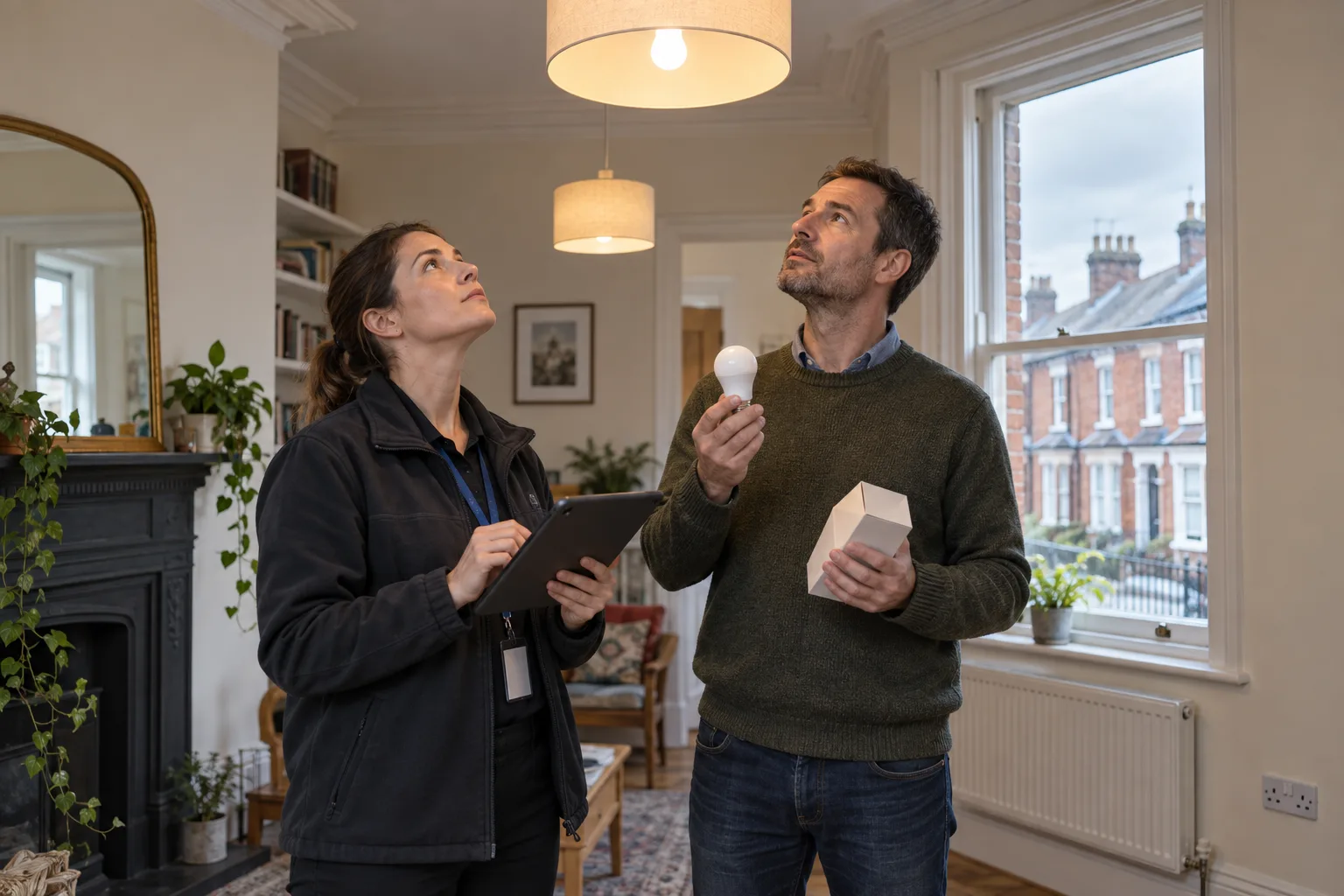
List the lamps in ceiling pendants, wall lights, fixed downlights and fixed kitchen lighting. Separate identifiable LEDs and compact fluorescents from tungsten and halogen lamps. Ignore plug-in lamps for this particular EPC check. This simple inventory shows whether there is meaningful lighting input left to improve before you spend money or book a reassessment.
3. Replace suitable lamps, not whole systems by reflex
Where the fitting is safe and compatible, an LED lamp may be the proportionate change. Match the cap, size, dimmer compatibility, light output and location. A failed fitting, damaged wiring or unsuitable enclosed luminaire needs proper technical attention; an EPC target is not a reason to improvise electrical work. Keep invoices for property records, but expect the assessor to verify the installed lighting at the visit.
4. Review the rest of the D-to-C route
Lighting should sit beside the other recorded inputs, not replace their review. Check heating controls, insulation evidence, glazing, hot-water details and material assumed or not-inspected entries. The landlord EPC evidence guide explains how to prepare useful records, while the D-to-C assessment plan shows how to compare evidence, small measures and larger work.
5. Reassess only when the result is worth lodging
Changing lamps does not edit an EPC already on the register. A new rating exists only after an accredited domestic energy assessor completes and lodges a fresh assessment. If LEDs are one part of several completed changes, coordinate the evidence and assessment once rather than paying for repeated certificates. Our guide to a new EPC after improvements helps with that timing decision.
Comparing LEDs with heating controls
Check both before choosing. LEDs can be quick and inexpensive where incandescent lamps remain. Heating controls may have a different effect, but their treatment depends on the installed heating system and what the assessor can record. Neither measure has a universal points value. The right priority is the lowest-cost credible change that closes the actual property’s gap without creating unnecessary work.
If the EPC shows incomplete low-energy lighting, finish that low-disruption check. If it already records efficient lamps throughout, repeating the change adds nothing. Review the separate TRVs and heating-controls EPC guide before assuming a thermostat or radiator valve will deliver a fixed uplift.
For a property several points below C, a combination may be needed. Evidence can sometimes correct a material assumption; a modest measure can sometimes close the remaining gap; other properties need fabric or heating work. A free initial assessment should compare those routes before the landlord commissions a major upgrade.
Keep today’s EPC calculation separate from the future standard
For covered private rentals in England and Wales, current domestic MEES guidance still sets an EPC E minimum unless a valid exemption applies. A D-rated property can therefore be above today’s legal floor while the landlord plans for the confirmed higher standard. This article is practical information, not legal advice on an individual tenancy or exemption.
The government’s response on the 2030 private-rented standard confirms a single 1 October 2030 compliance date, subject to the planned legislation and implementation. It also describes a transition route for an Energy Efficiency Rating of C achieved before 1 October 2029. Future EPCs will use new headline metrics, and the final product-level effects under the Home Energy Model should not be guessed from today’s calculation.
The sensible action is not to buy bulbs because of a promised future score. Use the current certificate to understand the property, complete proportionate improvements that make sense now and keep the wider route under review as the new methodology is finalised.
Turn a lighting check into a property decision
LEDs are worth checking because they are visible, low-disruption and explicitly recorded in the current assessment method. Their value is greatest when the existing EPC shows incandescent lighting and the property is close to the next band. Their limit is equally important: they may make only a small difference and they do not replace a whole-property review.
Cucumber Eco can review the current score, lighting entry, assumptions, evidence and realistic measures before you pay for a new certificate or major work. The initial property assessment is free and without obligation. Start your free EPC assessment with the current EPC and a short description of the property.
Frequently asked questions
These answers cover the common lighting questions landlords ask before a reassessment.
How many EPC points do LED bulbs add?
There is no fixed national points figure. The result depends on the existing lamps and the rest of the property calculation. Government guidance shows a one-point change in one cumulative example, but that is not a forecast for another rental.
Does every bulb need to be LED for the EPC?
The assessor records the lamps in permanent fittings under the current RdSAP convention. Increasing the LED proportion can improve the lighting input, but the EPC result is property-specific. Replacing every lamp is not a guarantee of a higher band.
Do plug-in lamps count towards the EPC lighting input?
The current convention focuses on lamps in permanent fittings. Freestanding floor lamps and table lamps that plug into sockets are not the same input. Fixed under-cupboard lighting is included.
Do LEDs update an existing EPC automatically?
No. The registered certificate does not change when lamps are replaced. An accredited domestic energy assessor must complete and lodge a new assessment for the register to show a new score or band.