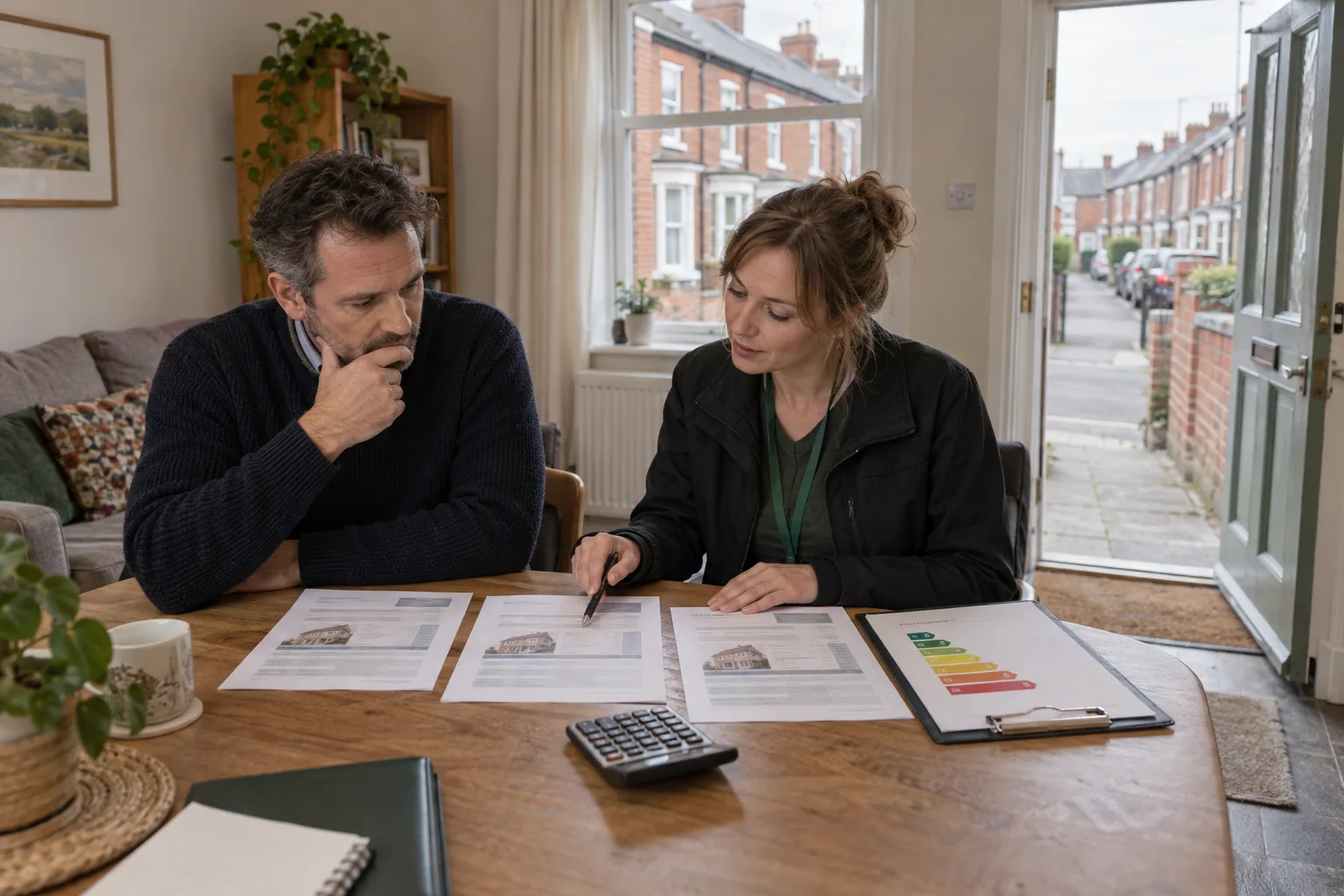

The right EPC evidence can replace some assumptions before a landlord pays for major work. Learn which documents and photographs to gather for a D-to-C assessment.
Before paying for insulation, a new heating system or a bundle of small measures, a landlord should find out whether the current EPC is using the best available information about the property. Useful evidence can help an accredited assessor record features that are not safely visible, identify where an assumption is unavoidable and separate a genuine upgrade need from a paperwork gap.
The commercial value is simple: organise the evidence before committing capital. A property-specific specialist EPC assessment can then test the credible route from D to C. Evidence may improve the accuracy of the inputs, but it does not mean the score will rise and it cannot change a lodged EPC by itself.
The short answer: provide proof that belongs to the property and the work
Gather documents that identify the rental property, describe completed work and can be checked against what the assessor finds on site. Useful examples can include Building Control records, installation certificates, warranties, formal installation assurances, itemised invoices, product details, dated photographs and plans. The assessor decides whether each item is acceptable under the current methodology and accreditation rules.
Why evidence matters on an existing home EPC
An EPC assessment for an existing dwelling is a physical survey, but some important features are concealed. The government's EPC guide gives cavity-wall and underfloor insulation as examples that may not be visible. Without suitable supporting information, the assessor may be unable to include the feature and may have to use an age-based assumption.
The current government methodology page identifies RdSAP 10.0.1 as the version used for existing dwellings and explains that RdSAP reduces data collection by applying assumptions. Those conventions support consistency, but they also mean that a missing document can matter. If a newer certificate differs from an older one, use the EPC input-comparison guide to identify what changed before assuming the building became less efficient.
Build a property-specific evidence pack
Use one folder per address. Name each file clearly and retain the original document or image wherever possible. The most useful pack usually covers five areas.
- Property history: title documents, searches, dated plans and records showing the original build period or the date and construction of an extension.
- Insulation: installation certificates, warranties, Building Control notices, itemised invoices and dated photographs showing the material, thickness, location and surrounding property context before it was covered.
- Windows and doors: installer certificates, warranties or invoices that identify the address, installation date, glazing type and products fitted.
- Heating and hot water: commissioning records, manuals, model numbers, invoices and clear photographs of the boiler, heat pump, cylinder, controls and any secondary heating.
- Renewables and controls: commissioning documents, MCS or product certificates where applicable, system specifications and photographs that connect the equipment to the assessed dwelling.
Do not edit photographs to make them more persuasive. Preserve dates and context, and tell the assessor when and why an image was taken. A photograph of insulation on its own may show a product but not prove where, when or how it was installed.
What makes documentary evidence useful
The Elmhurst domestic assessor evidence requirements describe acceptable documentary evidence as including certificates, warranties, formal installation assurances, official landlord correspondence and other records verifying completed work. The assessor must be able to connect the document to the actual property and confirm that physical or other evidence does not contradict it.
That creates four practical tests: does the evidence identify the address, does it describe the completed work, is it detailed enough for the relevant EPC input, and does the site inspection support it? A professional quote or planned specification proves an intention to install; on its own, it does not prove that the work was completed.
Evidence that may not be enough
- A quotation, order confirmation or brochure that shows what was proposed but not what was installed.
- A bank transaction, unitemised receipt or invoice with no property address or meaningful description of the work.
- A close-up photograph with no date, location or surrounding detail that links the subject to the rental property.
- A previous EPC entry, tenant recollection or verbal assurance treated as conclusive proof of a concealed feature.
A six-step pre-assessment process
- Download the current EPC and record its band, numerical score, issue date and entries marked assumed, not inspected or not rated.
- Walk through the certificate against the property records and list only material conflicts or missing proof.
- Ask the installer, conveyancer, managing agent or previous owner for original records where there is a credible reason they may exist.
- Send the pack before the visit so the assessor can flag missing details rather than discovering the gap after the survey.
- Provide safe access to rooms, the heating system and the loft where practical, but do not ask the assessor to take unnecessary risks or damage finished surfaces.
- Ask for the evidence, testing and upgrade routes to be modelled separately so the next spending decision is clear.
Evidence, testing and physical upgrades are different routes
Documentary evidence supports facts about work or property construction. Specialist testing measures a characteristic where the current methodology permits that input. Physical upgrades change the building. For example, the separate airtightness evidence guide explains when a measured result may be relevant and why the test alone does not change the register.
Use the evidence-first D-to-C plan to compare these routes in order. Start with credible documents, add suitable measurements only when they can answer a material question, model proportionate measures and consider larger works when the property genuinely needs them.
Why landlords should organise evidence now
The government response on the higher private-rented standard confirms a single compliance date of 1 October 2030, subject to the planned legislation. It also sets out a transition route under which an EER C achieved before 1 October 2029 can be recognised until that EPC expires or is replaced.
That is a reason to understand D-rated properties early, not to rush every rental into a new certificate. Evidence should improve the decision: which inputs can be verified, whether a credible current-method route exists and where actual work is still necessary.
Three costly evidence mistakes
Do not order major work solely because an EPC says a feature is assumed. The assumption may be correct, and accepted evidence may not change the score enough to alter the route.
Do not pressure the assessor to accept weak or contradictory documents. The assessor is responsible for accurate inputs and must be able to defend the evidence through the accreditation scheme's quality process.
Do not describe an evidence review or modelled scenario as a lodged EPC C. Only an accredited assessor can complete the assessment and lodge the resulting certificate on the official register.
Turn the evidence pack into a spending decision
Cucumber Eco can review the current certificate, identify the evidence gaps worth pursuing and compare a credible evidence, testing or upgrade route before you commit to major work. Start your free EPC assessment.
Frequently asked questions
Is an invoice enough evidence for an EPC assessor?
It depends on the detail and the EPC input being supported. An itemised invoice that identifies the property and completed work can be useful, but the assessor must still connect it to the dwelling, check that the site evidence does not contradict it and decide whether it meets the applicable rules.
Can photographs prove concealed insulation?
They can support the evidence pack when they are clear, dated and show enough property context, but a photograph is not automatically conclusive. The assessor must be satisfied that it relates to the assessed property, shows the relevant feature and is consistent with the inspection and any other documents.
Can evidence change an existing lodged EPC?
A lodged EPC is not edited by uploading documents. Accepted evidence can be used in a new assessment, and the accredited assessor may then lodge a new certificate based on the complete verified dataset.
Does better EPC evidence mean a D-rated property will reach C?
No. Evidence can improve the accuracy of property inputs, but the accepted facts may confirm the existing assumptions or may not add enough points. The credible route remains property-specific and can require documentary evidence, suitable testing, small measures or larger upgrades.