
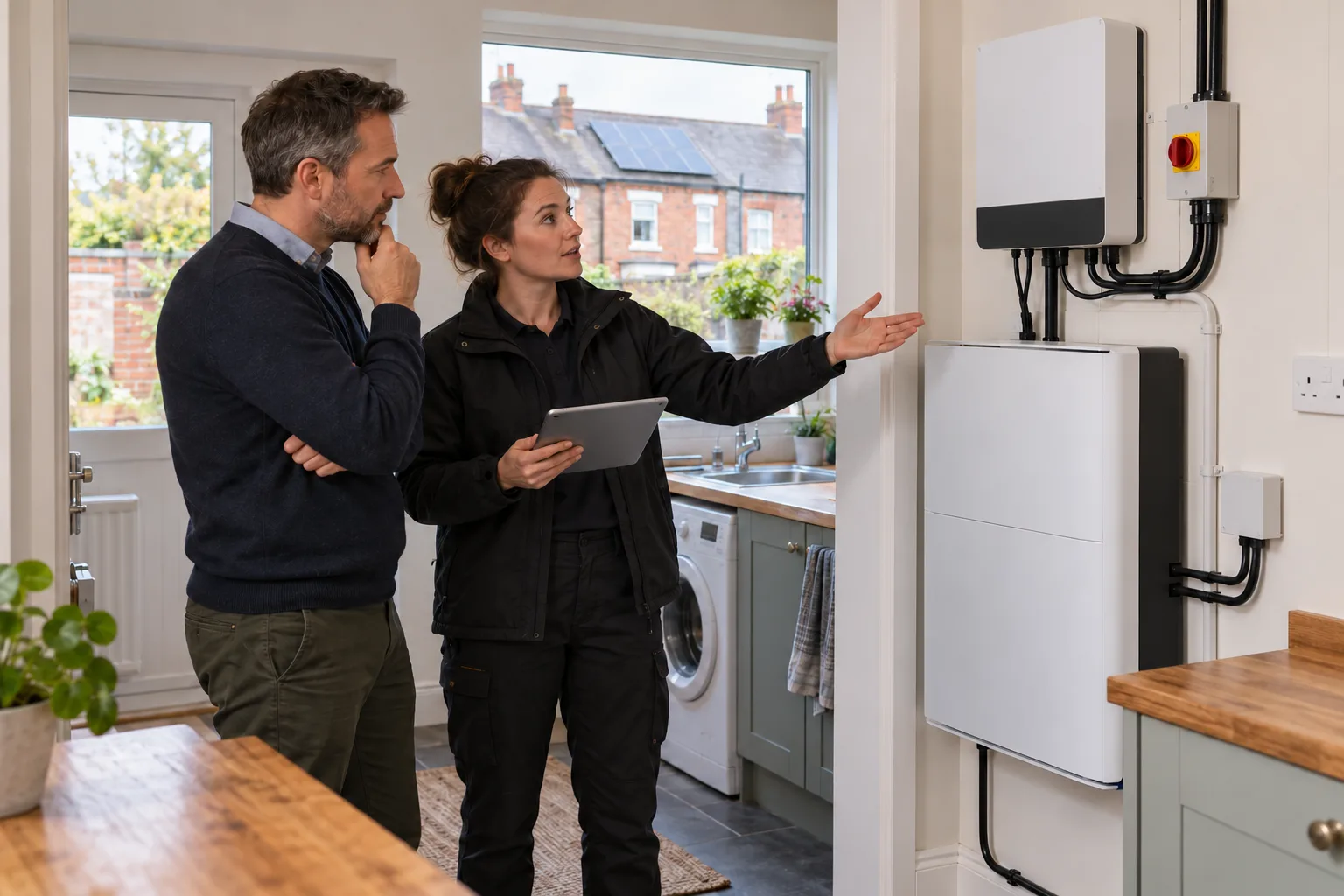
A solar battery can be recorded in a current domestic EPC assessment, but its treatment depends on the system and it should not be bought on the promise of an assured band change.
A solar battery can affect the calculation behind a current domestic EPC when it is connected to photovoltaic panels and recorded under the approved assessment method. That does not mean a battery automatically adds a fixed number of points, moves a rental from D to C or makes a weak fabric rating disappear.
A battery installed without solar is treated differently: the current RdSAP specification says the assessment does not include PV-independent battery storage. For a landlord, the practical decision is therefore to separate three questions: how the present EPC records the system, whether the battery makes commercial sense in use and how future smart-readiness rules may value storage.
The short answer for landlords
Under the current domestic methodology, an assessor can record battery storage associated with a solar PV system. The latest BRE RdSAP 10 specification tells assessors to collect the number of batteries and their capacity. Its improvement modelling also includes adding a 5 kWh PV battery where a dwelling has solar panels but no battery.
The government’s response on SAP and RdSAP amendments explains the reason: the revised solar-electricity self-use factor can allow for the effects of battery storage and PV diverters. In plain English, storing more solar electricity for use in the home can influence the model rather than being ignored completely.
The result remains property-specific. Solar-array size, orientation and shading, the dwelling’s electricity demand and the rest of the building all affect the calculation. Battery storage should not be sold as a standalone EPC shortcut or with a universal points claim.
PV-connected and standalone batteries are not the same
A battery connected to solar PV
RdSAP 10 has data fields for PV batteries and battery capacity. If the exact capacity is unavailable, the specification provides a default for the calculation; if the capacity is known, the assessor records the appropriate number of battery units. This is one reason landlords should retain technical documents rather than asking an assessor to infer the installation from a box on the wall.
The solar array remains the generating technology. The battery stores some of that electricity for later use. A current EPC may therefore reflect the battery through the solar self-use calculation, but the uplift cannot be separated into a reliable national promise such as “one battery equals three points”.
A standalone or grid-charged battery
The current RdSAP 10 addendum is explicit that the assessment does not include PV-independent battery storage. A standalone battery may still reduce bills or help a household use a time-of-use tariff, but those operational benefits do not automatically become a better current EPC rating.
That distinction prevents a costly mistake: buying storage because it is useful for tariff shifting is a different decision from buying a measure to close a known EPC score gap. Both can be sensible, but they need different evidence and financial tests.
Evidence the assessor should see
Give the assessor documents that identify the property and installed system clearly. Useful material can include the MCS certificate for the solar installation, commissioning paperwork, installer invoice, product data sheet, inverter details, battery make and model, usable capacity and a simple system diagram showing how the battery is connected.
The official government guide to domestic EPCs explains that existing homes are normally assessed through RdSAP and that supporting information can matter where features cannot be established through inspection alone. The accredited assessor decides what evidence is acceptable and what can be entered.
Do not assume that an app screenshot, electricity bill or marketing brochure proves the installed specification. Keep final installation and commissioning records together with the property’s wider EPC evidence pack.
Battery storage versus solar panels for an EPC goal
Solar PV and battery storage do different jobs. Panels generate electricity and are a direct input to the assessment. A battery changes how much of that generation can be used later in the dwelling. If the landlord’s immediate goal is EPC C, the starting score and the modelled effect of the whole solar-and-storage system matter more than the battery’s headline capacity.
Our separate guide to solar-panel EPC points owns the question of how array size, orientation and the property affect the solar contribution. The solar battery storage guide covers costs, payback and tariff pairing. This article is narrower: it explains the assessment boundary so a landlord does not confuse financial value with an assured EPC outcome.
Before buying either technology for compliance planning, compare the modelled route with fabric, heating-control, hot-water and evidence options. A battery may be commercially attractive and still not be the lowest-cost route from this property’s D score to C.
A practical decision sequence
- Read the current EPC and note the exact score, not only the band. Band D covers a wide range, so a property at 68 has a different gap from one at 55.
- Confirm whether solar PV is already installed, correctly recorded and supported by technical evidence.
- Ask whether the proposed battery will be connected to that PV system or operate independently from it.
- Model the present EPC route before treating the installation as a compliance measure. Do not rely on a salesperson’s generic points estimate.
- Compare battery payback, tariff suitability, warranty, usable capacity, fire-safety siting and tenant arrangements as a separate commercial decision.
- Keep final documents and arrange a new assessment only when a fresh lodged EPC is useful. Installation alone does not update the register.
This follows the same evidence-first order as our landlord D-to-C plan: establish the real gap, test the credible options and spend only after the route is understood.
How the 2027 EPC reforms change the picture
Domestic EPC reform is scheduled for the second half of 2027, subject to the necessary implementation. The government plans four headline measures for new-style certificates: fabric performance, heating system, smart readiness and energy cost.
The Home Energy Model EPC methodology consultation proposes that smart readiness should assess a home’s ability to generate energy, store it and respond flexibly. It discusses options in which storage works alongside microgeneration, but it does not provide a final universal battery-to-band conversion.
The government’s July 2026 Clean Flexibility Roadmap update confirms that the planned smart-readiness measure is intended to recognise generation, optimisation and flexible energy use. That makes batteries more relevant to future EPC conversations, but landlords should not present a consultation option or policy direction as a finished scoring rule.
What this means for the 2030 landlord standard
The current general minimum for covered domestic private rentals in England and Wales remains EPC E unless a valid exemption applies. The live domestic MEES landlord guidance is the source for today’s legal position.
Separately, the government has confirmed a higher private-rented standard for 1 October 2030, with implementing legislation still required. Its formal response on improving privately rented homes sets out a future requirement for fabric performance C plus either heating-system C or smart-readiness C, or a valid exemption.
Battery storage could therefore become relevant to the secondary smart-readiness route. It cannot replace the fabric C requirement, and the final HEM calculation and band boundaries must be published before anyone can promise that a particular battery will secure C. A current-style EER C lodged before 1 October 2029 also has a separate intended transition route, covered in our October 2029 landlord guide.
The commercial decision
For an existing D-rated rental, the right sequence is assessment first, technology second. A PV-connected battery may be recognised in the current calculation and may improve the economics of using solar electricity. A standalone battery can have operational value while remaining outside the current RdSAP assessment. Future smart-readiness policy strengthens the long-term case for storage, but it does not assure a particular score today.
Cucumber Eco can review the lodged EPC, the solar and battery evidence and the property’s wider D-to-C options before you commit to a system for the wrong reason. Start your free EPC assessment.
Primary sources checked
These primary sources were checked on 20 October 2026 for the current assessment, evidence, reform and landlord-policy boundaries in this guide.
- BRE RdSAP 10 specification, 7 June 2026: PV-battery data, battery capacity, the modelled improvement and the exclusion of PV-independent storage.
- Government response on SAP and RdSAP amendments: the revised solar self-use factor and treatment of batteries and PV diverters.
- Government domestic EPC guide: RdSAP use for existing homes, survey inputs and supporting information.
- Home Energy Model EPC methodology: proposed smart-readiness treatment of generation, storage and flexibility.
- Clean Flexibility Roadmap, July 2026 update: the second-half-2027 reform timetable and the intended role of smart readiness.
- Current domestic MEES guidance: today’s EPC E minimum for covered rentals in England and Wales.
- Government response on the higher private-rented standard: the 1 October 2030 policy and future fabric plus heating or smart-readiness route.
Frequently asked questions
These answers separate current EPC treatment from future smart-readiness policy and do not promise a result for an unseen property.
Can a solar battery add points to a current EPC?
It can affect the current domestic calculation when it is connected to solar PV and correctly recorded, because RdSAP 10 allows battery storage in the solar self-use treatment. The effect depends on the whole property and system, so there is no universal points figure.
Does a standalone home battery improve an EPC rating?
Not under the current RdSAP 10 treatment described by BRE. The specification says PV-independent battery storage is not included in the assessment, even though it may still offer bill, tariff or resilience benefits.
Will a battery count towards the 2030 landlord EPC standard?
Battery storage is relevant to the planned smart-readiness metric, but the final method and band boundaries are not yet published. The confirmed policy also requires fabric performance C, so a battery cannot be assumed to replace fabric improvements.
What battery documents should a landlord keep?
Keep the installer invoice, commissioning record, product data, battery capacity, inverter information, MCS documentation for associated solar PV and a system diagram. The accredited assessor decides which evidence can be accepted for the EPC.