A smart meter can improve billing data and unlock time-of-use tariffs, but it does not add points to a current EPC. Here is what landlords should check instead.
A smart meter can make energy use easier to understand, reduce estimated bills and unlock tariffs that charge different rates through the day. Those are useful benefits for a landlord or tenant, but they answer a different question from the one an Energy Performance Certificate answers.
For a current domestic EPC, installing a smart meter does not add points to the calculation and does not change a certificate already lodged on the register. The property needs a new assessment and a lodged certificate before its published EPC can change. If a rental is sitting at D, the commercial task is to identify which accepted property inputs could credibly close the gap to C.
The quick answer
No, a smart meter does not improve the current EPC rating by itself. The government’s SAP specification allows assessors to record whether a smart electricity meter is fitted, but states that this does not affect the SAP calculation result. It may still help the household manage energy, support accurate billing and access suitable smart tariffs. Those benefits should not be presented as current EPC points.
What a current EPC measures
An EPC is an asset rating based on a standardised model of the dwelling. It is not a report of the tenant’s actual gas and electricity consumption. The government confirms that the current methodology for existing homes is RdSAP 10.0.1. The assessment uses information about the building and its fixed systems, including dimensions, construction, insulation, windows, heating, hot water, controls, lighting and renewable technologies. Where accepted detail is unavailable, the methodology can use assumptions. A specialist EPC assessment should start with those recorded inputs rather than the household’s latest bill.
That distinction protects landlords from buying the wrong solution. A lower bill after fitting a smart meter does not prove that the building fabric or heating system improved. Equally, high tenant consumption does not automatically mean the EPC should be lower. The certificate models the property under standard conditions so that homes can be compared consistently.
What a smart meter does help with
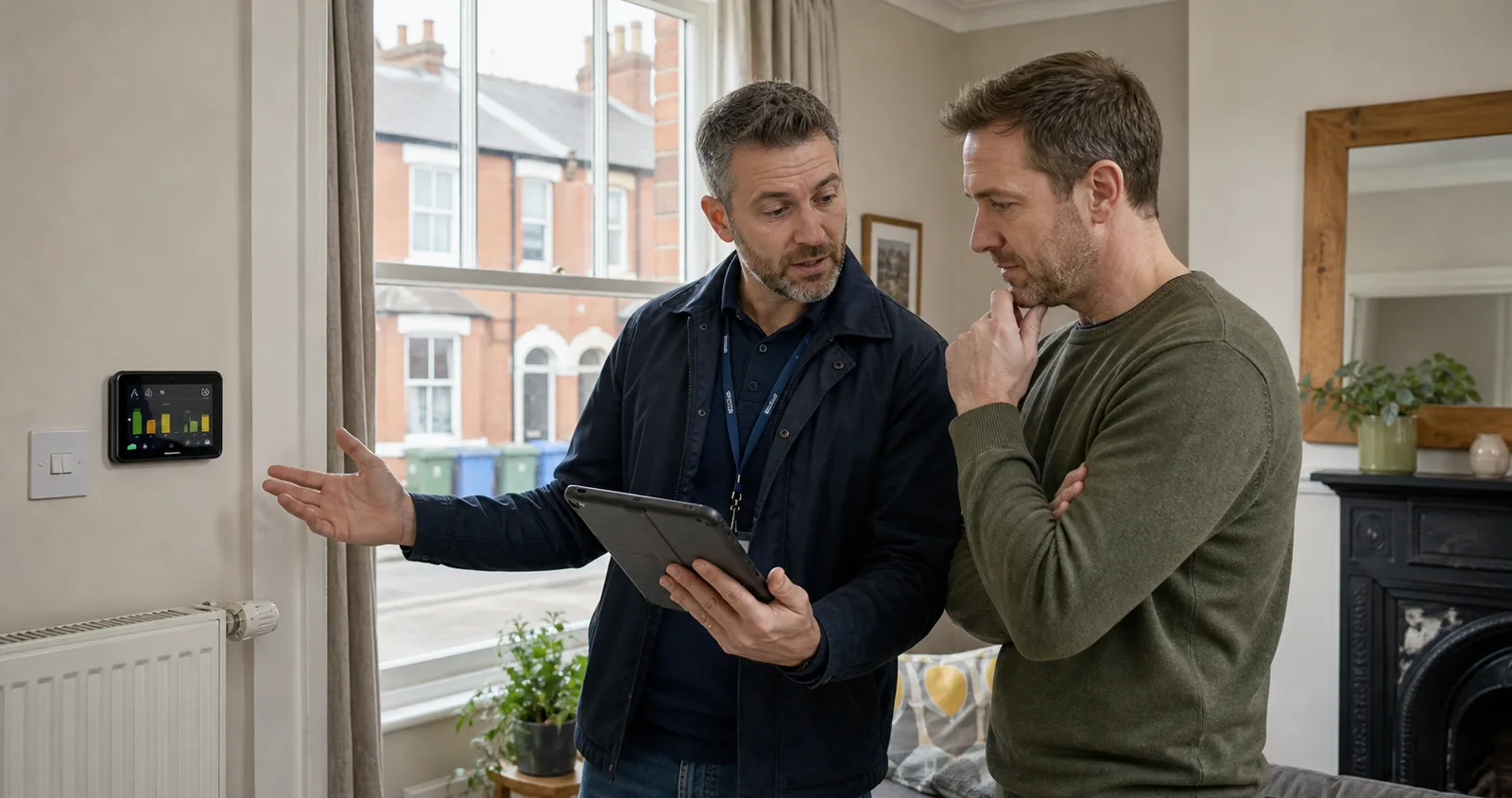
A smart meter records consumption and can send readings to the energy supplier automatically. The in-home display shows energy use and cost more frequently than a traditional meter. The official household guide explains these billing and usage benefits, while our detailed smart-meter guide covers installation, meter types and tariffs.
- It can reduce estimated billing when the meter communicates correctly.
- It can make waste easier to spot, although action by the occupier is what changes consumption.
- It can provide access to time-of-use tariffs where the supplier, meter and household are compatible.
- It can support decisions about a heat pump, electric vehicle, solar panels or battery by providing a clearer consumption profile.
Do not confuse a smart meter with heating controls
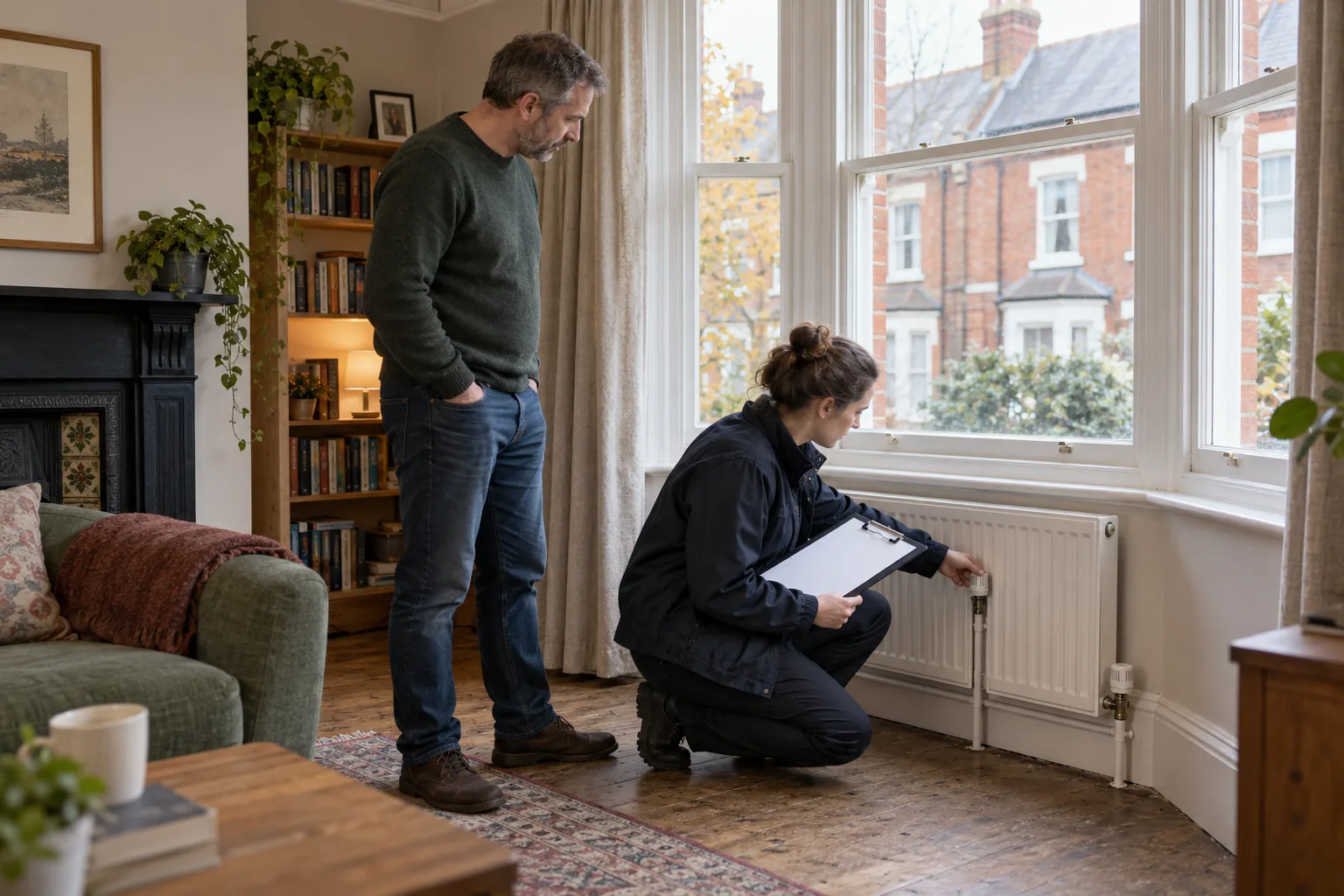
The electricity or gas meter measures energy supplied to the property. A programmer, room thermostat, thermostatic radiator valve or other heating control manages when and where heat is delivered. These are not interchangeable in an EPC assessment.
Heating controls can be relevant inputs when they are present, correctly identified and accepted by the assessment methodology. A smart meter cannot be used as a substitute for missing controls. Nor should a landlord buy controls simply because a generic EPC recommendation mentions them. The expected effect depends on the existing system, the current score and the complete property model.
Three smart-meter and EPC myths to avoid
Myth 1: a lower energy bill means the EPC rating has improved
A tenant may reduce consumption after using the in-home display, changing a tariff or heating fewer rooms. That can lower the bill without changing the walls, roof, windows or fixed heating system. The current EPC uses standardised occupancy and energy assumptions so that one property is not rewarded simply because one household uses less energy than another. Bills can help explain real running costs, but they are not a replacement EPC calculation.
Myth 2: anything recorded on the EPC must affect the points
Assessment software can hold contextual information that does not change the numerical result. The smart-electricity-meter field is a clear example under the current SAP specification: it may be recorded and referenced on the certificate, but it does not affect the calculation. Landlords should ask whether a proposed item is a scored input, supporting evidence or simply useful property information. Those three roles should not be blurred.
Myth 3: smart-meter data proves which upgrade will reach C
Half-hourly data can reveal when a home uses electricity and can improve decisions about tariffs, batteries and electrically powered heating. It cannot, on its own, confirm wall insulation, roof U-values, airtightness, glazing specifications or the exact efficiency of an unidentified heating appliance. A D-to-C route still needs accepted evidence and a whole-property assessment. Consumption data is a useful planning input, but it does not assure a particular lodged rating.
When the consumption data is still commercially useful
Landlords do not need to disregard the data merely because it does not create current EPC points. With the occupier’s appropriate access and consent, a real usage profile can help compare tariff structures, understand peak demand and test whether a proposed electric-heating or battery plan is commercially sensible. It can also reveal a meter that is not communicating correctly before a new tariff is chosen. Keep that exercise separate from the EPC evidence review: one tests how the household uses energy, while the other models the dwelling under an approved national method.
What changes with future smart-readiness EPCs
Domestic EPC reform is scheduled for the second half of 2027. The planned certificate has separate headline measures for fabric performance, the heating system, smart readiness and energy cost. The government’s Home Energy Model consultation says the proposed smart-readiness metric is expected to take account of smart meters alongside technologies such as solar generation, storage and smart controls. Our MEES guide explains how those future metrics relate to the confirmed direction for private rentals.
That does not mean fitting a smart meter now establishes a future C on the smart-readiness measure. The final scoring, band boundaries and product-level effects are still being finalised. It also does not turn an existing D into a C under today’s calculation. Landlords should separate a sensible future-ready improvement from a claim about a current EPC result.
A better D-to-C checklist for landlords
If the objective is EPC C, start with the certificate and the property evidence rather than with a product. This order reduces the risk of spending money on a measure that does not address the score gap.
- Record the current EPC score, not only the D band. A property at 68 needs a different conversation from one at 55.
- Check entries marked assumed, not inspected or not rated, then gather suitable evidence for insulation, glazing, extensions, heating and controls.
- Confirm whether the installed heating controls are accurately recorded. Keep model details, installation records and clear photographs where they can be accepted.
- Model credible routes before ordering work. Documentary evidence, accepted testing, proportionate small measures or a larger upgrade may be appropriate depending on the property. Testing provides evidence; it does not change the lodged EPC by itself.
- Complete the accepted assessment route and have a qualified assessor lodge the resulting EPC. Only then should the public register show the new result.
The commercial decision
A smart meter can be a sensible improvement for billing, energy management and future flexibility. It is simply not a current D-to-C measure in its own right. For a landlord, the higher-value action is to find the lowest-cost credible route that the property evidence supports. Review the wider landlord EPC service, or Start your free EPC assessment.
Frequently asked questions
Can a smart meter move an EPC from D to C?
No. Under the current SAP calculation, the presence of a smart electricity meter can be recorded but does not affect the result. A D-to-C plan must be based on other accepted property inputs and a newly lodged assessment.
Will smart meters count on EPCs from 2027?
The proposed future smart-readiness metric is expected to include the presence of a smart meter among several technologies. Exact scoring and band effects are not final, so a future C outcome should not be promised from a smart-meter installation alone.
Do smart heating controls improve an EPC?
Some heating controls can affect the current assessment when they are installed, correctly identified and accepted by the methodology. Their effect depends on the complete property model, so they should be assessed rather than treated as an assured band change.