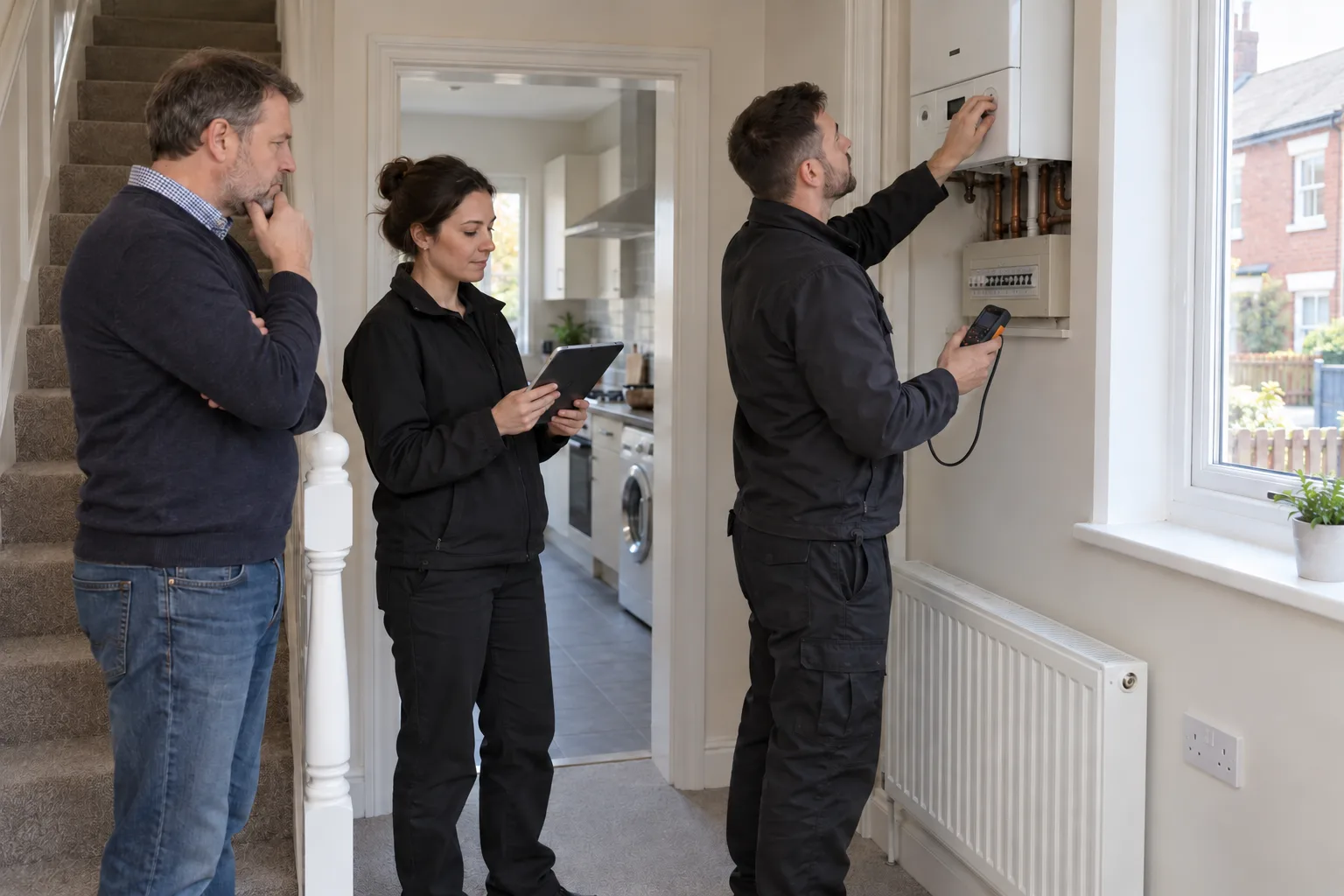

HHSRS excess cold and EPC ratings answer different questions. Learn what landlords in England should check before repairs, upgrades or reassessment.
An EPC cannot clear a landlord of an HHSRS excess cold risk, and an HHSRS assessment does not give or change an EPC rating. The two systems answer different questions. An EPC models the energy performance of the building and its fixed services. The Housing Health and Safety Rating System assesses the risk of harm from housing conditions.
For a landlord with a D-rated rental in England, separating those jobs protects both the tenant and the budget. A broken heating system or serious draught needs a repair response, not a promise that the next EPC will be better. Once urgent condition issues are addressed, an evidence-led assessment can identify the lowest-cost credible route towards C without confusing energy improvement with housing-safety enforcement.
The short answer: HHSRS and EPC are not interchangeable
Use an EPC to understand the modelled energy-efficiency rating, current inputs and recommendations. Use the HHSRS framework to understand whether a housing condition creates a risk to health or safety. The same radiator, window, insulation layer or heating fault may be relevant to both reviews, but the assessor, method, evidence and outcome are different.
- EPC: an accredited energy assessor records the dwelling and its fixed services under the approved methodology. The result is an A-to-G asset rating based on standard occupancy assumptions, plus recommendations and a potential rating. It is not a general safety certificate.
- HHSRS: a trained officer or assessor examines deficiencies and the risk of harm over the next 12 months. Each hazard is scored separately, with the most serious classed as Category 1. It does not produce an EPC band or update the EPC register.
The 2026 HHSRS changes for landlords
The government’s updated HHSRS collection says new regulations brought the reviewed system into force in England in 2026. The number of hazards reduced from 29 to 21, statistically similar hazards were combined, and the assessment process gained new descriptive bands, baseline indicators, statutory guidance and case studies.
The new landlord and agent guide, last updated on 16 September 2026, explains that scores of 1,000 or more fall in the High Band and are Category 1 hazards. Scores below that threshold are Category 2 hazards in the Medium or Low Band. A local council must take action on a Category 1 hazard and has discretion to act on Category 2 hazards.
These HHSRS updates apply to England. Wales has separate HHSRS regulations and guidance, while EPC and domestic MEES guidance commonly covers England and Wales. A portfolio crossing national borders needs the correct housing and energy rules for each property.
How HHSRS excess cold is assessed
Excess cold is one of the 21 hazards. The assessment begins with a full inspection and looks for deficiencies that may raise the risk of harm. The landlord guide gives the example of a home without a properly installed heating system in good working order. That deficiency can contribute to excess cold and may also contribute to damp and mould.
The assessor considers the likelihood of harm requiring medical attention during the following 12 months and the severity of the possible outcomes. With most hazards, the assessment considers the age group most vulnerable to that hazard rather than simply the current tenant. It is therefore a risk judgement about the actual dwelling condition, not a conversion from an EPC score.
Government has published new HHSRS case studies, including excess cold examples, to show how assessors benchmark likelihood, harm and remedial work. They are useful for understanding the process, but they do not predetermine the score for another rental.
How an EPC rating answers a different question
The official EPC guide for homes says an EPC uses the building fabric and services, including heating, insulation, ventilation and fuel, to produce an energy-efficiency rating related to running costs. It uses standard occupancy assumptions, so the result may differ from one household’s actual bills or heating pattern.
A landlord can use the guide to what an EPC rating D means to identify the score gap and likely inputs. A D rating does not automatically establish an HHSRS hazard. Equally, an EPC C should not be treated as proof that the heating works, the windows are sound or the property is free of excess cold risk.
Three situations that show why the distinction matters
1. The EPC is D and the boiler has failed
The immediate job is to respond to the loss of heating and assess the condition and risk. Ordering a new EPC first does not repair the system, and the lodged rating will not tell a council whether the current failure creates an HHSRS hazard. After repair, the landlord can decide whether controls, evidence or another improvement also helps the D-to-C plan.
2. The EPC is E and the property meets current MEES
Current domestic MEES guidance says covered private rentals in England and Wales must presently reach E unless a valid exemption applies. Meeting that minimum does not remove the separate duty to address hazardous conditions. MEES compliance and an HHSRS risk decision should stay as two lines in the property plan.
3. The EPC is C but a serious draught or defect appears later
An EPC is valid for up to 10 years unless replaced by a newer certificate, but the physical condition can change during that period. A failed window, damaged heating component or new disrepair complaint needs investigation on its own facts. The older C certificate is useful energy information; it is not a live condition survey.
A practical landlord checklist
- Respond to current conditions first. Record tenant reports, inspect loss of heating, serious draughts, damp or defective openings promptly, and arrange the relevant repair or professional assessment. Do not wait for an EPC appointment where a possible hazard or urgent repair needs action.
- Separate repairs from upgrades. Restoring working heating or fixing a broken window is a condition response. Insulation, controls or evidence work may also improve energy performance, but that effect should be modelled rather than assumed.
- Review the EPC evidence. Use the landlord EPC evidence guide to compare the certificate with the property, identify material assumptions and collect documents or accepted measured evidence. Testing is evidence for a qualified assessment, not a repair and not an automatic score change.
- Keep a usable property file. Retain inspection notes, repair reports, installation invoices, product details, photographs and tenant communications. The evidence needed for an EPC input is not necessarily the same as the evidence requested by a council, insurer or contractor.
- Model the commercial route after condition issues are understood. The evidence-first D-to-C plan can compare accepted evidence, small measures and major upgrades against the real score gap before money is committed.
Keep current duties and the 2030 EPC plan separate
The maintained MEES 2030 guide explains the planned higher private-rented standard. That future energy target does not delay a current repair or HHSRS response. It also does not mean a landlord should buy the largest upgrade first. Start with the current condition, then use a specialist EPC assessment to find the credible energy route.
This article is practical guidance, not legal advice. A council decides the HHSRS assessment and enforcement response, while an accredited energy assessor is responsible for the EPC. Cucumber Eco can review the certificate, evidence and improvement options, but it does not replace either decision-maker.
Turn the distinction into a property plan
A landlord does not need to choose between a safe home and an efficient one. The useful sequence is to deal with current condition risks, confirm what the EPC actually records, then compare the lowest-cost credible improvement route. Start your free EPC assessment.
Primary sources checked on 7 October 2026
The HHSRS landlord guide, case studies, EPC guide and current MEES guidance linked above were also reviewed for the distinctions used in this article.
Frequently asked questions
These answers keep the housing-condition assessment, energy rating and improvement decision in their proper roles.
Does an EPC D mean a property has an HHSRS excess cold hazard?
No automatic conversion applies. An EPC D is an energy-performance result. HHSRS requires a separate inspection and risk assessment of deficiencies, likelihood and possible harm. The EPC can be useful evidence, but it does not determine the hazard category.
Does an EPC C prove a rental is free from excess cold?
No. An EPC C is a modelled energy rating, not a current condition or safety certificate. Heating can fail, windows can deteriorate and other deficiencies can arise after the certificate is lodged. Investigate the present condition rather than relying on the band alone.
Can an HHSRS inspection change an EPC rating?
No. An HHSRS inspection does not alter the EPC register. If repairs or improvements change the property, an accredited energy assessor must complete and lodge a new EPC before the registered rating changes.
Should a landlord repair the heating or improve the EPC first?
A current loss of heating, serious defect or possible hazard needs the appropriate condition response first. Once the property is safe and the facts are known, model the EPC route so repair choices and energy improvements work together where practical.