
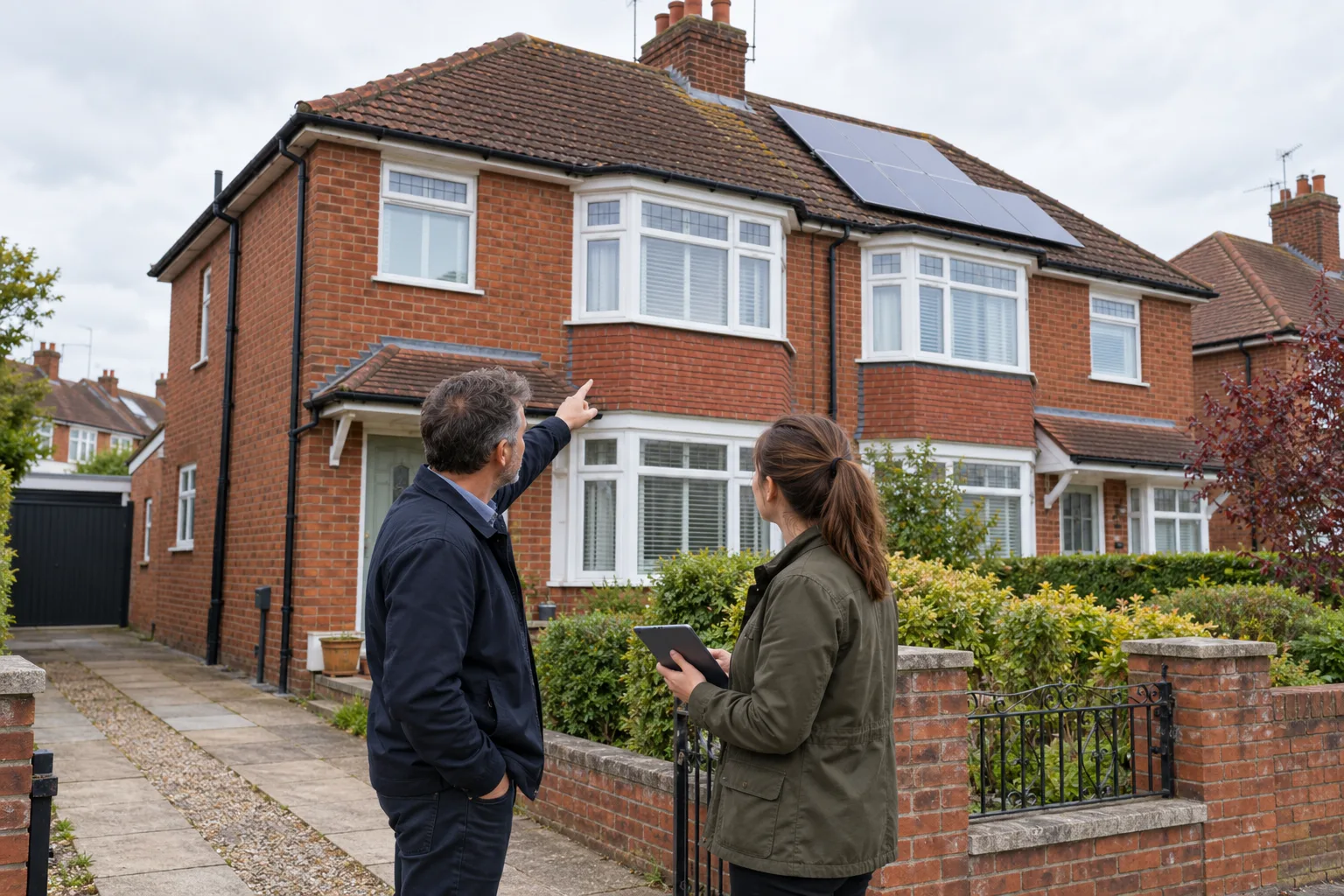
Solar panels are not a universal EPC C requirement. Learn how today’s rating, the 2030 fabric standard and the choice of smart-readiness or heating route affect a landlord’s decision.
No, a landlord does not automatically need solar panels to reach EPC C. Under the current Energy Efficiency Rating, a property can reach C through the combination of fabric, heating, controls, lighting, renewables and accepted evidence that works for that particular dwelling. Solar may help, but it is not a universal pass condition.
The confirmed 2030 policy also does not create a simple “solar on every rental” rule. It sets a primary fabric standard and a secondary standard that can be met through either smart readiness or the heating system. Solar is one possible part of the smart-readiness route; the alternative heating route may suit a different property. Exact product-level band effects still depend on the final Home Energy Model implementation and legislation.
The commercial question is therefore not “where can I buy panels fastest?” It is “which credible route gets this property to the required standard at the lowest sensible cost?” Start with the current EPC, its score, the property evidence and the measures that genuinely fit the building.
The short answer for landlords
For a current EPC, solar is optional. RdSAP models the whole dwelling, so a C can result from many different combinations of inputs. A D-rated rental may need only better evidence or a modest measure; another may need fabric work, heating changes or solar. The effect cannot be guaranteed from the technology name alone.
For the planned 2030 private-rented standard in England and Wales, the government response says a home will need C or above on fabric performance and C or above on either smart readiness or the heating system, unless a valid transition route or exemption applies. The landlord chooses which secondary route to pursue.
Today’s enforceable minimum remains EPC E for covered domestic private rentals in England and Wales, subject to valid exemptions. The live MEES landlord guidance has not turned the future C policy into a current universal solar obligation.
Why the solar-panel myth is easy to believe
Solar appears in many EPC recommendation lists and can improve the modelled result under the current method. It is also named among the technologies that may support smart readiness under the future system. Those two facts are often compressed into a misleading claim that every landlord must install panels.
A recommendation is not the same as a compulsory shopping list. The current certificate shows modelled improvement options, but the most suitable route depends on the starting score, property construction, existing services, roof constraints and accepted inputs. A landlord can compare measures rather than assume the final recommendation is mandatory.
The future framework is broader again. Government describes solar panels, batteries, load-shifting appliances and smart meters as examples within the smart-readiness route. It also describes low-carbon heating, such as a heat pump or heat-network connection, as an alternative secondary route. The HEM:EPC consultation proposed how the new metrics and bands could be calculated, but final product-level boundaries have not yet been published.
Three different routes can be confused
1. Reach C on the current Energy Efficiency Rating
Before 1 October 2029, a landlord may obtain a current-style EPC showing Energy Efficiency Rating C without installing solar if the property reaches the band through its other assessed features. The government has confirmed transition recognition for a qualifying C certificate lodged before that date: it is treated as compliant with the higher standard until it expires or is replaced.
That makes the current assessment route commercially important, but it is not a reason to commission unnecessary work. Read the guide to reaching EPC C before October 2029 before deciding whether early action fits the property.
2. Use the future smart-readiness route
Under the confirmed policy direction, a rental using the smart-readiness route must first meet the fabric standard or hold the relevant exemption. It must then meet the secondary smart-readiness standard. Solar may be part of the recommended package, alongside technologies that help the property generate, store or shift electricity use.
This does not prove that panels alone will achieve C, that every roof is suitable or that the same package will apply to every rental. Orientation, shading, available roof area, tenure, planning or third-party consent and the final HEM rules can all change the decision.
3. Use the future heating-system route
A landlord can instead choose the heating-system standard as the secondary route. Government examples include a heat pump or connection to a low-carbon heat network, with related controls, emitters and hot-water measures where recommended. This route is not automatically cheaper or suitable, and it does not remove the primary fabric requirement.
A property that currently has a gas boiler is not automatically barred from reaching today’s EPC C. The gas-boiler rental guide covers that current-method question separately. Future compliance should be planned from the final metrics and the property’s new EPC, not inferred from today’s single rating.
When solar may be a sensible EPC C measure
Solar deserves a property-specific comparison when the roof and ownership arrangements are suitable, the current or modelled score gap remains after lower-cost evidence and fabric checks, and the wider bill or asset case supports the investment. It can be especially relevant where the landlord expects to pursue smart readiness under the reformed system.
- The current EPC or assessment identifies solar as a credible improvement and the remaining score gap is understood.
- The roof has appropriate usable area, orientation and limited shading, subject to a competent site assessment.
- The landlord has the necessary ownership, freeholder, lender, planning and tenant consents for the proposed work.
- The electrical installation, connection route and metering can be assessed by the appropriate installer or network parties.
- The bill, maintenance and long-term property case makes sense as well as the modelled EPC contribution.
If the current question is how the array affects today’s score, use the dedicated solar-panel EPC points guide. It explains why array size, orientation, pitch, shading and the rest of the dwelling matter, rather than promising a fixed point gain.
When solar should not be the first move
Solar should not be treated as the default first purchase simply because it appears near the bottom of an EPC recommendation list. The property may already have a lower-cost route to C, or the roof and tenure may make panels a poor fit.
- The existing EPC is based on a material assumption or incorrect input that should be checked before work is priced.
- A small, accepted measure or documented existing feature may close the score gap more proportionately.
- Fabric problems need attention for comfort, building performance or the future primary standard.
- The property is a leasehold flat, has a shared roof or needs consent that has not been obtained.
- Shading, roof condition, orientation or usable area undermines the technical or commercial case.
- The landlord intends to compare the future heating-system route and final HEM recommendations instead.
The evidence-first D-to-C landlord plan is the better starting point when the lowest-cost route is not yet clear.
A five-step decision check before requesting solar quotes
- Read the current EPC score, not only the band. A property at 68 faces a different decision from one at 55.
- Check whether material walls, floors, roofs, heating systems or controls are recorded accurately and whether accepted evidence exists.
- Model the credible current route to C, including evidence, proportionate measures and solar where appropriate.
- Separate today’s EER decision from the future fabric-plus-secondary-metric decision. Do not assume one current measure will satisfy an unpublished final band calculation.
- Compare installation cost, consent, disruption, bill value and assessment outcome before committing to a system.
This sequence protects the investment decision. Testing, documentation or a modelled option does not change a lodged EPC by itself. A qualified assessor must complete the relevant assessment and lodge the resulting certificate.
Cucumber Eco can review the current certificate, the property evidence and the credible routes before major work is commissioned. Start your free EPC assessment to compare solar with the other property-specific options.
What is confirmed and what is still changing
The government has confirmed a single compliance date of 1 October 2030, the fabric-plus-secondary-metric structure, the landlord’s choice between smart readiness and heating, and transition recognition for qualifying EER C certificates before 1 October 2029. It has also confirmed that reformed domestic EPCs are planned for the second half of 2027.
The higher private-rented standard still requires legislation, and government has said the exact C target on the new EPC will be reflected in secondary legislation after the final HEM policy and band calculations are confirmed. That is why a responsible article can describe the route structure but should not promise that a particular panel size, battery or heating product will achieve a future C.
For current assessments, RdSAP 10 is the applicable existing-dwelling methodology. Its calculation considers the whole dwelling. A product purchase, installer estimate or online points claim is not a substitute for a property-specific assessment and lodged certificate.
Frequently asked questions
These answers summarise the current policy boundary and the property-specific solar decision explained above.
Are solar panels mandatory for landlords by 2030?
No universal solar-panel mandate has been confirmed. The 2030 policy requires fabric C plus either smart-readiness C or heating-system C, subject to the transition and exemption routes. Solar may contribute to smart readiness, while another property may follow the heating route.
Can a rental reach EPC C without solar panels?
Yes. Under the current Energy Efficiency Rating, many combinations of assessed fabric, heating, controls, lighting, renewables and accepted evidence can produce C. The only reliable answer for a particular rental comes from its inputs and an appropriate assessment.
Do solar panels improve an EPC rating?
They can improve the current modelled rating, but there is no fixed point gain that applies to every home. Array characteristics and the rest of the property affect the result. Only a new lodged EPC records a changed rating.
Should a landlord wait for the new EPC before doing anything?
Not necessarily. A landlord can review the current EPC and make sensible, property-led improvements now. A qualifying current-style C lodged before 1 October 2029 has confirmed transition value. Major work should still be compared against the expected future route and the final guidance when available.
Does installing solar automatically update the EPC register?
No. Installation does not alter the existing lodged certificate. The work and supporting evidence must be considered in a new assessment, and the resulting EPC must be lodged before the register shows a new rating.