
A bungalow cavity-wall quote depends on exposed wall area, condition and access. Learn the cost benchmarks, suitability checks, funding routes and EPC questions landlords should resolve first.
Cavity wall insulation for a bungalow is often priced from the area and condition of the exposed walls, not simply from the number of bedrooms or storeys. Energy Saving Trust currently gives about £2,200 as a typical Great Britain installation cost for a home, but that is not a bungalow-specific quotation. A detached bungalow with four exposed elevations can cost more than a compact semi-detached or terraced bungalow, especially where access, repairs or ventilation work are needed.
For a landlord with a D-rated bungalow, the commercial question is wider than the installation price. First confirm that the walls are cavities, that they are unfilled or inadequately filled, and that the property is suitable. Then ask an EPC assessor whether the wall entry is material to the route from D to C. Existing insulation may only need acceptable evidence; unsuitable new work can create expense without delivering the assumed rating outcome.
The short answer and a realistic cost benchmark
The current Energy Saving Trust cavity-wall guide says a typical installation in Great Britain costs around £2,200. Treat that as a broad planning figure, not a fixed bungalow price. The same source says cost depends on the size of the home and recommends a registered installer and a suitability check.
Government modelling for the former Great British Insulation Scheme used £1,750 in 2022 prices for a 120 square metre reference bungalow with an easy-to-treat standard cavity. That figure is useful as historic policy evidence, but it is not a 2026 market quote and should not be uprated casually. Real quotations can be higher when the property falls outside those assumptions.
A useful budget therefore has three columns: the insulation installation, any enabling or remedial work, and the evidence or assessment needed afterwards. Ask for each cost to be shown separately so a cheap headline does not hide ventilation upgrades, access equipment, cavity clearing, repairs or making good.
Why bungalow quotations vary
Bungalows have less wall height than two-storey houses, but they can have a wide footprint and a large roof-to-floor ratio. The installer still needs to price the actual external wall area, the number of exposed elevations and the condition of the cavity. Property type alone does not decide the result.
- Detached, semi-detached or terraced form: four exposed walls usually require more material and drilling than two or three exposed elevations.
- Extensions and mixed construction: a later extension may have a different cavity width, insulation status or wall system from the original bungalow.
- Access and obstructions: conservatories, porches, narrow side passages, garages, sloping sites and dense planting can change how safely the elevations are reached.
- Cavity condition: rubble, damaged wall ties, narrow cavities, moisture penetration or an incomplete earlier fill can require further investigation or remedial work.
- Ventilation and combustion checks: the specification may need air vents, extract improvements or other safeguards rather than treating insulation as an isolated product.
- Finish and making good: rendered, painted or unusually detailed elevations may need more careful drilling and repair than plain brickwork.
Ask the contractor to state which elevations and extensions are included, the measured wall area, the proposed material, preparation, ventilation work, guarantee, exclusions and VAT treatment. Compare like with like rather than choosing from a single total.
Suitability comes before price
TrustMark guidance on energy-efficiency improvements warns that cavity wall insulation is not suitable in every situation. It identifies structural defects, poor maintenance, non-traditional construction, very narrow or dirty cavities, damaged wall ties, severe wind-driven rain exposure and defective guttering as reasons for particular caution.
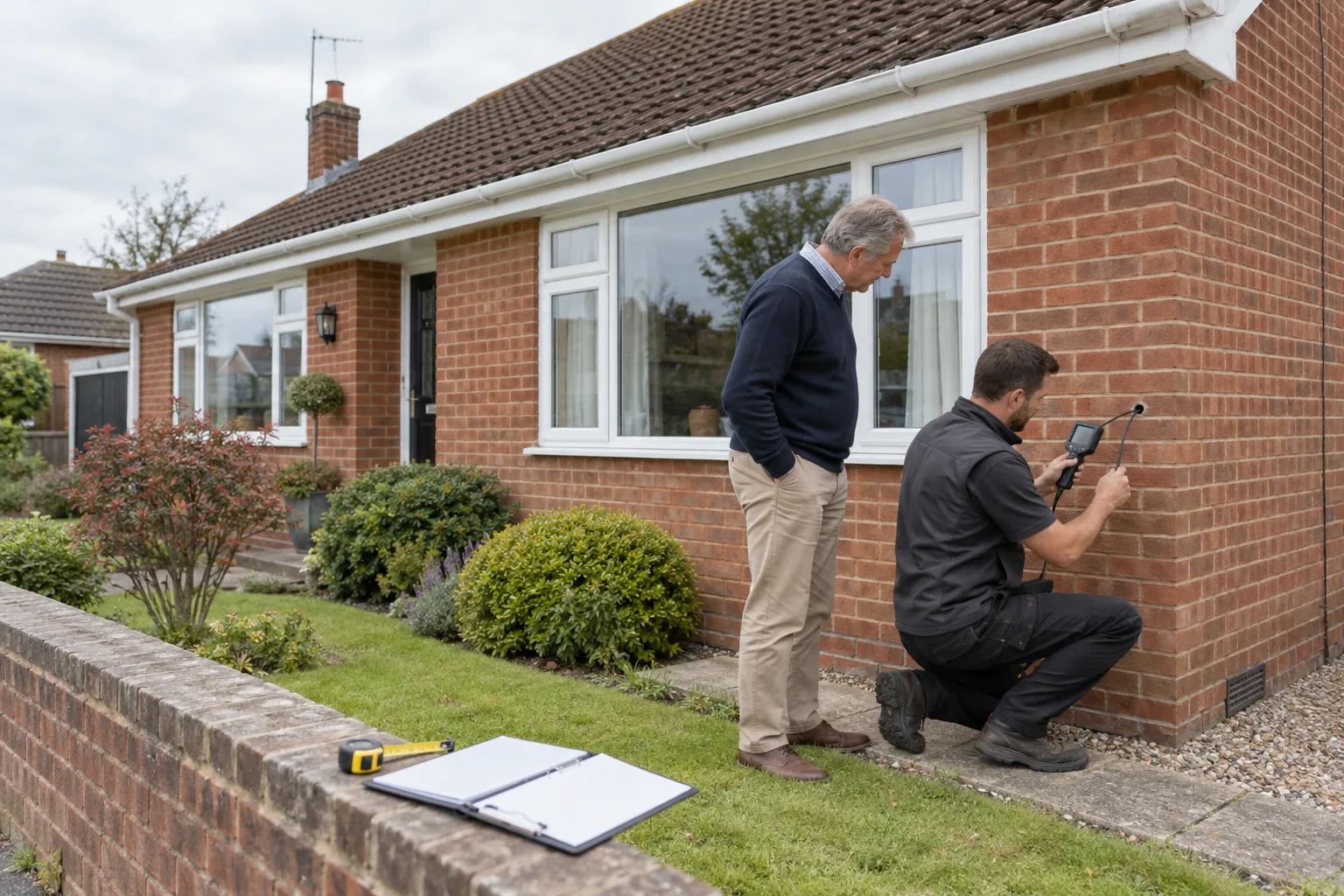
The installer should survey the wall rather than infer suitability from age alone. A borescope inspection can help establish the cavity, existing fill and obstructions. Damp staining, leaking rainwater goods, cracked masonry or failed pointing should be investigated before insulation is proposed. Insulation should not be used to conceal a defect.
Bungalows also deserve a whole-property moisture and ventilation check. Filling the walls changes one part of the heat-loss and moisture picture; the loft, floor, heating pattern, extract fans and background ventilation still interact with it. Where the property has unusual construction or high exposure, obtain specialist advice that is independent of a sales quotation.
Connect the quote to the current EPC
The official EPC guide for homes explains that an assessor may have to use age-based assumptions where a feature cannot be inspected and supporting evidence is unavailable. Cavity fill is a common example because a non-destructive visit does not expose the inside of a wall.
Check the existing certificate before ordering new work. If it already records insulated cavity walls, another installation is not the answer. If it records an age-based assumption or no added insulation, establish whether insulation is already present and whether acceptable records can prove it. A D-rated bungalow may need evidence, a new measure or a combination, but the certificate alone does not diagnose the wall.
Use the cavity-wall insulation evidence checklist to organise warranty documents, invoices, installer records and property-specific details. Our guide on whether a D-rated rental needs insulation to reach EPC C explains why the score gap and the complete dwelling model matter more than a generic measure list.
There is no reliable fixed number of EPC points for cavity wall insulation. The effect depends on the current input, wall area, heating and the rest of the dwelling. The work or evidence does not change the register by itself; an accredited assessor must accept the relevant information, complete the assessment and lodge the resulting EPC.
Current funding routes for a landlord
Do not describe cavity wall insulation as automatically fully funded. The household, property, geography, current EPC, local delivery capacity and proposed package all matter, and the scheme owner or authorised delivery route makes the decision.
The Warm Homes: Local Grant applicant service applies in England to privately owned homes with an EPC of D, E, F or G where the household meets an income, benefits or eligible-postcode route. Wall insulation may be included after a home survey. In a private rental, the tenant household must qualify, the landlord must consent and the landlord may need to contribute. Local availability and the assessed package vary.
Ofgem’s ECO4 guidance for landlords and domestic consumers says tenant eligibility is considered for private-rented retrofits and that the measures available depend on the starting EPC and package rules. ECO4 is not a simple cavity-wall voucher for every D-rated rental. The government extension decision keeps ECO4 open to 31 December 2026 but adds no new target, so a live supplier route still needs checking.
The Great British Insulation Scheme closed on 31 March 2026. Our GBIS closure guide for landlords separates closed applications from existing installations, complaints and the live alternatives. Do not let an old GBIS advert decide a 2026 budget.
Keep current law and the planned 2030 standard separate
For relevant domestic private rentals in England and Wales, the enforceable MEES minimum remains EPC E unless a valid exemption applies. A D-rated bungalow meets that current floor, but a landlord may still decide to plan towards C for future policy, lower running costs or asset quality.
The government response on the higher private-rented standard confirms a planned single compliance date of 1 October 2030, subject to Parliamentary approval and implementing legislation. The future standard will use new EPC metrics. It should not be presented as proof that cavity wall insulation alone will make a bungalow compliant.
A sensible D-to-C decision still starts with the current score, accepted evidence and a modelled route. If the bungalow is suitable and the wall input is material, cavity fill may be a proportionate fabric measure. If it is unsuitable, already insulated or immaterial to the score gap, the budget should be directed elsewhere.
A quote and assessment checklist
- Download the current EPC and record the score, wall description, potential rating and relevant recommendations.
- Confirm the bungalow construction, exposed elevations, extensions and whether any previous cavity fill can be evidenced.
- Obtain a suitability survey that checks the cavity, wall ties, damp, rain exposure, maintenance defects and ventilation implications.
- Request an itemised quotation covering wall area, material, access, enabling work, vents, making good, guarantee, exclusions and VAT.
- Compare self-funded cost with any live ECO4 or local-authority route without assuming the tenant or property qualifies.
- Ask an accredited assessor to model whether the accepted wall input is material to the property-specific D-to-C route before work is sold as an EPC solution.
- Keep the survey, specification, invoice, guarantee and completion evidence for the next assessment and for future property records.
Cucumber Eco’s specialist EPC assessment service can compare the wall evidence, score gap and proportionate alternatives before a landlord commits to insulation. The aim is the lowest-cost credible route for the bungalow, not the longest list of works.
Frequently asked questions
These answers summarise the main cost, suitability, EPC and funding checks for a rental bungalow.
How much does cavity wall insulation cost for a bungalow?
Energy Saving Trust currently gives around £2,200 as a typical Great Britain home installation, while government scheme modelling used £1,750 in 2022 prices for an easy-to-treat 120 square metre reference bungalow. Neither is a current property quote. Exposed wall area, cavity condition, access, ventilation and repairs can move the price materially.
Is a bungalow cheaper to insulate than a two-storey house?
Not automatically. Lower wall height can reduce the treated area, but a detached bungalow may have a broad footprint and four exposed walls. A compact terraced bungalow and a large detached bungalow should not share one budget assumption.
Will cavity wall insulation move a D-rated bungalow to EPC C?
It may help where the wall is suitable, currently uninsulated and material to the calculation, but there is no fixed points figure. The whole dwelling model decides the result, and only a lodged EPC changes the official rating.
Can a landlord get cavity wall insulation funded?
Potentially, but not universally. Warm Homes: Local Grant can support wall insulation for eligible households in D-to-G private homes in England, subject to local availability, survey and possible landlord contribution. ECO4 has separate tenant, EPC and package rules. The authorised scheme route decides eligibility and measures.
Price the right solution, not just the insulation
A defensible bungalow budget starts with suitability and the current EPC input. That prevents a landlord paying for work the wall cannot safely accept, repeating insulation that is already present or assuming one measure will secure C. It also creates the evidence needed for a reliable reassessment after the accepted route is complete.
Start your free EPC assessment to review the bungalow’s current certificate, wall evidence and lowest-cost credible route before you accept an insulation quote.