There is no universal conservatory roof replacement grant. See when insulation funding may apply and what landlords should check before work.
There is no universal government grant for replacing a conservatory roof. A landlord may find support only where the household, rental property and proposed energy-efficiency measure qualify under a live scheme. A leaking roof, cosmetic upgrade or general replacement does not become grant-funded simply because an insulated roof could make the room warmer.
The useful commercial question is therefore not “Who pays for a new conservatory roof?” It is “Does an approved survey identify an eligible insulation measure at this property, and does that measure help the rental’s wider energy plan?” That distinction protects landlords from budgeting around funding that a council, energy supplier or scheme delivery partner has not offered.
If the property is D-rated, check how the conservatory is treated on the current EPC before ordering a roof. Start your free EPC assessment to compare the room, roof and supporting evidence with the property’s realistic D-to-C options.
The short answer: funding depends on the assessed measure
The national Warm Homes: Local Grant application service covers eligible homes in England with an EPC of D to G and qualifying household circumstances. It lists measures such as wall, loft and underfloor insulation, heating controls, heat pumps and solar panels. It does not create a standalone entitlement to a replacement conservatory roof.
The council arranges a property survey and decides what can be offered under its local delivery route. The official Warm Homes: Local Grant guidance explains that private landlords may have to contribute towards work. An eligible tenant or postcode is the start of assessment, not approval for a landlord’s preferred project.
ECO4 is also not a general roof-replacement fund. Ofgem’s domestic consumer and landlord FAQs say obligated energy suppliers decide which projects and packages they support. Private-rented eligibility can depend on the tenant and the proposed package, with additional rules for rented homes.
Replacement, repair and insulation are different jobs
A roof repair is normally a maintenance decision
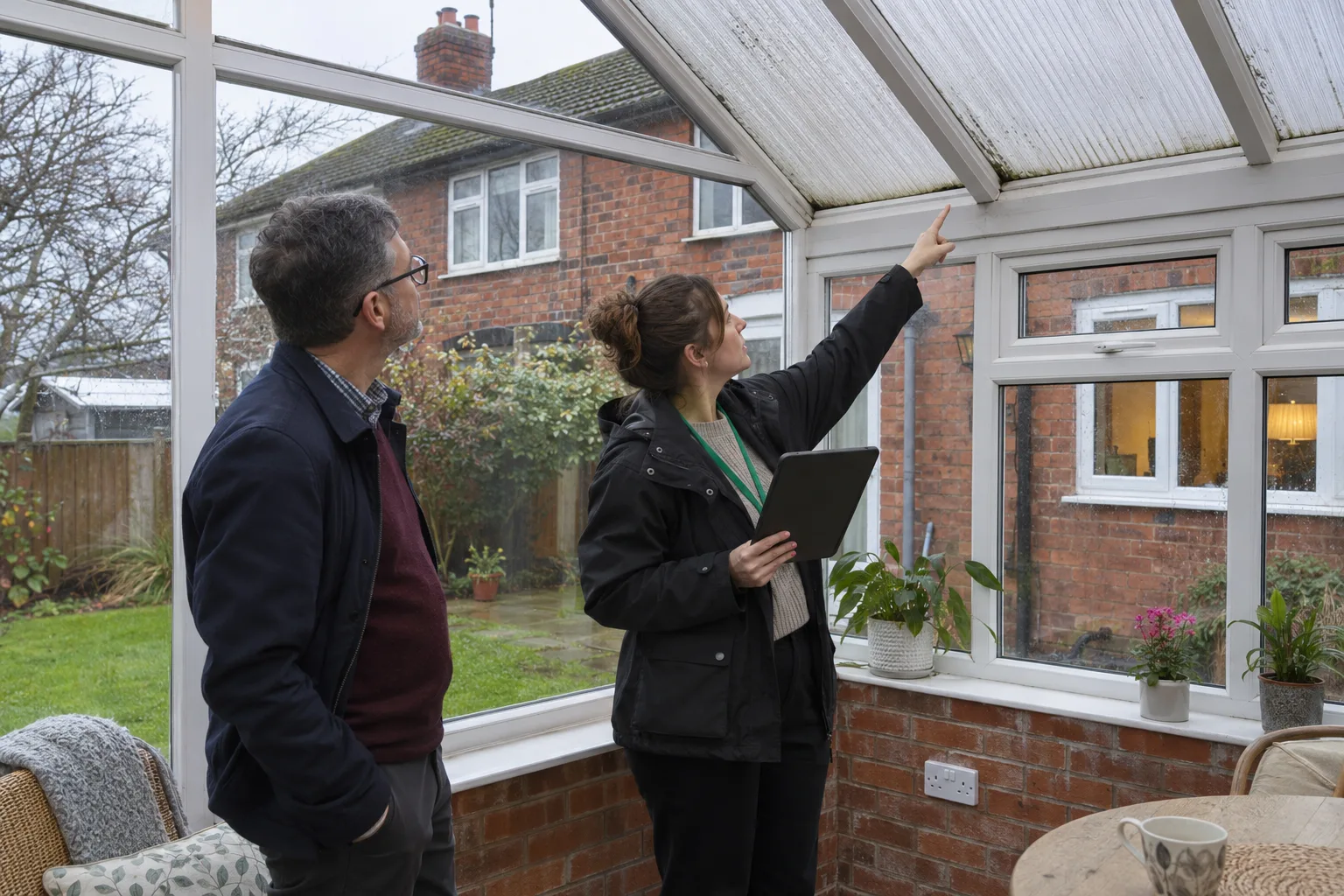
Broken panels, failed seals, leaks and unsafe roof components need a competent inspection. A grant scheme designed for energy-efficiency measures should not be treated as a blank cheque for maintenance. If a roof must first be made sound, ask the scheme delivery body which costs, if any, sit inside its approved measure and which remain the landlord’s responsibility.
An insulation measure needs a scheme route
Ofgem’s current ECO4 delivery guidance contains recognised roof-insulation categories and technical requirements. That does not mean every conservatory roof is one of those measures. The existing room, roof construction, use, scheme rules and survey all matter before a supplier can propose a compliant package.
A sales quotation labelled “thermal roof” is not evidence of grant approval. Obtain a written offer from the council, supplier or authorised delivery partner that identifies the property, approved measure, landlord contribution, installer route and any conditions before signing a separate contract.
A local exclusion is evidence about that route, not every scheme
Delivery details vary. For example, the London Warm Homes delivery FAQ lists conservatories among measures not included in that route. That example should not be turned into a UK-wide rule, but it shows why a landlord needs the current local answer rather than a generic promise from a roof company.
How the conservatory is treated on an EPC
A separated glazed conservatory may be disregarded
The MHCLG-approved RdSAP conventions version 12.2 define a conservatory by its glazed walls and roof and explain when a thermally separated conservatory is disregarded from the assessment. Doors or another suitable thermal separation between the dwelling and conservatory are therefore important facts.
A solid roof can change the assessment boundary
Under the same conventions, a structure with a solid roof or a false ceiling beneath a glazed roof is not recorded as a conservatory under that definition; it is treated as an extension. Open-plan connection to the dwelling can also change the assessment. This can alter the area and fabric included in the model, so a roof conversion is not automatically an EPC gain.
The existing landlord guide to conservatories and EPC ratings explains the classification and evidence boundary in more detail. This funding guide keeps the separate question of who might pay for an eligible measure.
No roof product provides certainty of EPC C
The final rating depends on the complete dwelling: heat loss, heating, hot water, controls, glazing, ventilation, lighting and the accepted evidence. Changing the roof may add a previously disregarded space to the assessed dwelling or alter its fabric inputs. Only a new assessment and lodged certificate can change the EPC register; testing, invoices and photographs alone do not do so.
Four landlord scenarios
1. A separated conservatory with a leaking glazed roof
Treat the leak and safety first. Because a qualifying separated conservatory may be disregarded from RdSAP, replacing its roof solely for EPC points can be a poor assumption. Ask whether any proposed scheme measure actually covers this structure and model the assessment boundary before spending.
2. A former conservatory already recorded as an extension
A solid roof, false ceiling or different glazing proportions may mean the room is an extension for EPC purposes. In that case, its roof and walls can be part of the assessed heat-loss fabric. Gather building-control records, plans, invoices and product details, then ask whether the local scheme’s eligible insulation specification applies.
3. An open-plan heated room
Where the original separating doors or wall have been removed, the room may already be part of the main dwelling for assessment. The heat loss can be material, but neither a grant nor a rating improvement follows automatically. The safest sequence is classification, energy assessment, scheme survey, written offer and only then a works decision.
4. A landlord wants a better-looking replacement
Appearance, summer comfort and usability can be valid reasons for a private project, but they are not the same as scheme eligibility. Keep any aesthetic or premium specification separate from the approved energy measure so the funding boundary, landlord contribution and contractor responsibility remain clear.
A pre-application checklist
Check the household and property route
For Warm Homes: Local Grant, use the official service to identify the relevant council and current household route. The property normally needs an EPC of D to G, while household income, benefits or postcode-based criteria may apply. Read the broader Cucumber Eco grants hub for the difference between national rules and local delivery.
Get the room and current EPC classified
Record whether the room is thermally separated, open-plan or already altered. Download the current certificate, photograph the wall and roof construction without exposing unsafe parts, and collect approvals or completion records. Do not describe a solid-roof extension as a separated glazed conservatory simply because that was its original name.
Ask the funding body precise questions
Ask whether the specific roof is within scope, which measure name and standard apply, whether preparatory repairs are excluded, who contracts with the installer, what the landlord must contribute and whether consent is needed before any private work starts. Keep the answers and formal offer in writing.
Check approvals and contractor responsibility
Roof alteration may need building-regulations approval. The government building-regulations approval guide tells owners to check with the local authority building-control service or an approved inspector where required. Planning, lease, lender and insurer conditions can be separate. This article is not legal or building-control advice.
Compare the measure with the whole D-to-C plan
Use an EPC evidence checklist for D-to-C planning to check whether another accepted fabric input, heating control or lower-cost measure matters more. Funding availability should not turn a minor or uncertain measure into the centre of the plan.
Current timing and landlord context
Warm Homes: Local Grant is being delivered through councils in England, subject to local availability and assessment. The 2026 grant update for landlords explains the route without assuming that every D-rated home or every measure will qualify.
The current domestic private-rented MEES guidance says the enforceable minimum in England and Wales remains EPC E for covered rentals unless a valid exemption applies. A D-rated property is above that present floor. Funding and future planning can still be useful, but a contractor should not present EPC C as today’s universal letting deadline.
Frequently asked questions
These answers cover current funding routes for domestic rented homes in England. Eligibility and the offered measure remain property-specific.
Is there a government grant for a conservatory roof?
There is no universal grant that pays for any conservatory roof replacement. Support may be possible only where a live scheme accepts the household, property and proposed energy-efficiency measure after its required survey and checks.
Can Warm Homes: Local Grant pay for a conservatory roof?
The national service lists several insulation measures but does not promise a standalone conservatory roof replacement. The relevant council and its delivery partner decide the offered package after assessment, and a private landlord may need to contribute.
Can ECO4 fund conservatory roof insulation?
ECO4 includes recognised insulation measures, but the supplier chooses eligible projects and packages under Ofgem’s rules. A conservatory roof is not automatically eligible. Ask the obligated supplier or authorised delivery partner for the exact measure and written offer.
Will fitting a solid conservatory roof improve the EPC?
Not necessarily. A solid roof can cause the space to be treated as an extension rather than a conservatory, changing the assessment boundary. The complete property calculation decides the result, so no fixed point or band improvement can be predicted.
Should the tenant or landlord apply?
It depends on the scheme. Household circumstances can establish eligibility, while the property owner normally needs to consent to work and may need to contribute. Use the official council or supplier route and do not rely on an unsolicited installer to decide eligibility.
Treat funding as a route, not a promise
A sensible sequence is to classify the room, check the current EPC, identify the live scheme, complete its survey and obtain a written measure offer before selecting a roof specification. That turns a vague grant search into a property-specific decision and prevents general repairs from being mistaken for approved energy work.
Start your free EPC assessment to see whether the conservatory, roof or another measure is the credible next step for your D-rated rental.