
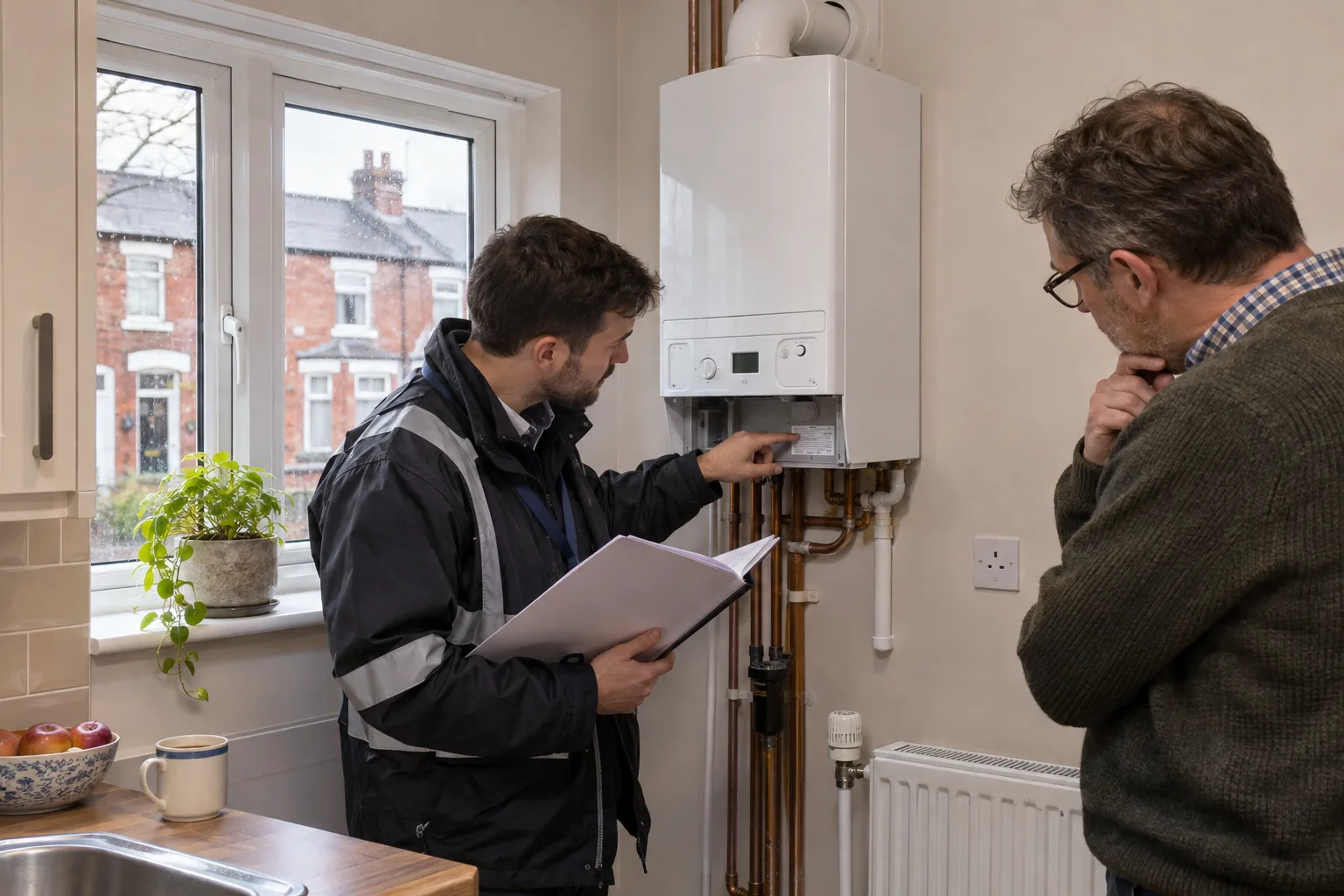
Boiler age is not a standalone EPC input. Learn how identification, efficiency, controls and evidence affect the landlord replacement decision.
Boiler age does not appear on an EPC as a standalone score. What matters is the heating system the assessor can identify, the efficiency data or approved generic entry used for it, its fuel, flue and controls, and how those inputs combine with the rest of the dwelling.
That distinction can prevent an unnecessary purchase. An older but correctly identified condensing boiler may not be the main reason a D-rated rental is below C. A much older, inefficient or unidentified boiler may justify replacement modelling, but the landlord still needs the likely whole-property result before ordering work.
For a property-specific comparison of the existing system, its evidence and the route to C, Start your free EPC assessment. The initial assessment is free and should establish whether heating is the material gap before major expenditure.
The short answer: efficiency and identification matter more than the birthday
An EPC is a model of the whole home under standard occupancy and fuel-price assumptions. It is not a boiler condition survey, a gas-safety record or a reward for installing the newest appliance. Two boilers of a similar age can be recorded differently if their type, efficiency, controls or product identification differs.
The government’s domestic EPC guide tells owners to provide the installation date, make and model of boilers and hot-water cylinders where possible, with manuals as potential evidence. It also asks assessors to record room thermostats and heating timers before approved software produces the certificate.
The installation year can therefore help identify the equipment, but it is not the final input by itself. The useful commercial question is whether the assessor can select the actual product and its characteristics, or must use an approved generic system description.
How a current RdSAP assessment records the boiler
Identified product data
The current RdSAP 10 specification asks for the brand name, model, model qualifier or product index number whenever possible for a boiler. When the product can be identified, its characteristics are obtained through the approved product database.
This is why a clear model plate, installation paperwork and a matching manual can be more useful than an estimate such as “about 12 years old”. The assessor still decides what evidence and input the methodology permits; the landlord cannot select an efficiency figure merely because it appears in sales material.
Approved generic system data
If the boiler cannot be matched to product data, RdSAP uses an applicable generic system entry. The current SAP 10.3 specification says gas and liquid-fuel boilers should use product-database efficiency where possible and otherwise use the defined table values and adjustments.
A generic entry is not evidence that the previous assessor made an error. It may be the prescribed route when the exact product cannot be identified. Better documents can help the next assessor identify what is installed, but they do not guarantee a different score.
Controls, distribution and hot water
The boiler is not recorded in isolation. The assessor also records the heating controls, heat emitters, hot-water arrangement and other applicable details. A programmer, room thermostat, thermostatic radiator valves or a recognised compensating controller can change the system description, but only the actual approved combination should be entered.
Read the separate guide to TRVs and heating controls on an EPC before treating a control purchase as a points package. Controls can be relevant, but the effect depends on the starting system and the whole dwelling.
Where boiler age is still useful evidence
Age can be a practical clue. It can help narrow the model range, show whether an installation pre-dates available paperwork and prompt a check of whether the appliance is condensing or non-condensing. It can also matter to the landlord’s maintenance and replacement planning.
Those are useful decisions, but they are not all EPC decisions. Reliability, parts availability, repair cost and legal gas-safety duties sit outside the energy-rating calculation. A boiler may need replacement for safety or serviceability even if the EPC uplift is small. Conversely, a working boiler should not be replaced solely because its age sounds unfavourable.
A routine boiler service does not itself create an EPC uplift. Servicing remains important for safety and reliability, while the EPC uses the recognised system and controls rather than awarding points for a recent service visit.
Evidence to prepare before the assessment
Prepare evidence that identifies what is physically present. The assessor may need to see the boiler and controls in context as well as the product label. Keep originals in the property record and provide clear copies where appropriate.
Useful boiler and control records
Gather the installation invoice or certificate, commissioning record, user manual, model and serial information, dated photographs taken before boxing-in, and any paperwork for the programmer, thermostat or compensating controls. Record where the thermostat and timer are located and whether the boiler also provides hot water.
Do not alter or remove a casing to photograph internal components. Gas appliances should only be opened or worked on by an appropriately qualified person. If the visible label is incomplete, ask the assessor what safe documentary evidence would help rather than guessing the model.
What the records can and cannot do
Evidence can help an accredited assessor identify the system. It cannot amend the register by itself, force use of a particular product entry or prove that the property will reach C. The wider landlord EPC evidence guide explains how to organise documents across heating, insulation, glazing and extensions.
When replacement deserves modelling
Replacement deserves a serious comparison when the current boiler is materially inefficient, non-condensing, failing, unsafe, unserviceable or part of a heating arrangement that cannot form a credible route. It can also be relevant where the current score remains below the target after evidence and proportionate smaller measures have been considered.
Ask the assessor or consultant to model the specific proposed system. A recommendation sequence on an EPC is cumulative: the rating shown after a later measure can include earlier measures too. It is therefore unsafe to attribute the whole displayed change to the boiler alone.
Compare capital cost, disruption, tenant needs, maintenance, the remaining life of the existing system and the likely EPC result. If the property is already close to C, another accepted input may be more proportionate. If the boiler is at the end of its useful life, coordinating the replacement with the EPC plan can avoid paying twice for surveys or controls.
The existing guide on whether a gas-boiler rental can reach EPC C owns the wider whole-property question. This guide owns the narrower age, identification and replacement-evidence decision.
A landlord decision sequence
1. Retrieve the current certificate
Use the official Find an energy certificate service and note the score, main-heating description, controls, hot-water system and recommendation order. A D at 68 is a different commercial problem from a D at 55.
2. Compare the certificate with the property
Check whether the recorded fuel, boiler type, controls and hot-water system match what is installed. A difference is a reason to gather evidence and ask an assessor to review it, not a reason to declare the certificate wrong.
3. Identify the exact boiler safely
Photograph the visible model information and collect the installation and control paperwork. Keep the full scene in at least one photograph so the evidence is tied to the property and system, while avoiding tenant documents or personal data.
4. Model credible packages
Compare retaining the boiler, improving recognised controls, correcting other material evidence and replacing the heating system where appropriate. Use the evidence-first D-to-C plan to sequence the whole property rather than buying one measure in isolation.
5. Lodge only after the accepted route is complete
Paperwork, testing and modelling do not change the registered EPC. The accepted evidence and completed measures must be used in a qualified assessment, and the resulting certificate must be lodged. Keep the new certificate and supporting records in the property file.
Current rules and future heating metrics are different tests
Current domestic private-rented MEES guidance still applies an EPC E minimum to covered rentals in England and Wales, subject to valid exemptions. A gas boiler does not automatically prevent a property reaching current EER C.
The government has confirmed a higher private-rented standard from 1 October 2030, subject to the legislation and implementing rules. The latest Energy Independence Bill factsheet confirms that direction, while the Parliament record shows the Bill is still a Bill rather than an Act.
For future EPCs, the Home Energy Model existing-dwelling methodology proposed that a home relying on primary fossil-fuel heating would not reach C on the new heating-system metric. That is a proposed metric principle, not a final product-level result. The confirmed private-rented policy also provides a secondary smart-readiness route after the fabric requirement, so it is wrong to claim today that every landlord must replace a gas boiler.
Frequently asked questions
These answers separate the current RdSAP assessment from future HEM proposals and from gas-safety or maintenance decisions.
Does an old boiler automatically lower an EPC rating?
No. Age can help identify the appliance, but the assessment uses the recognised boiler type, efficiency data or approved generic entry, controls and the rest of the dwelling. An older inefficient boiler can be a material input, but age alone is not a standalone EPC score.
Will a new boiler guarantee a higher EPC rating?
No. The result depends on the old and proposed systems, their recognised efficiencies and controls, and every other property input. Model the exact replacement before purchase and do not infer its contribution from a cumulative recommendation sequence.
What boiler paperwork should a landlord keep?
Keep the installation and commissioning records, invoice, make and model details, manual, visible product-label photographs and control paperwork. The assessor decides what evidence is acceptable and what system can be entered.
Does servicing an old boiler improve the EPC?
A routine service does not create a standard EPC uplift. It is important for safe and reliable operation, but the assessment records the recognised heating system and controls rather than the date of the latest service.
Must a gas boiler be replaced for EPC C by 2030?
Do not assume that today. A gas boiler can still form part of a current EER C property. Future private-rented compliance is intended to use fabric C plus either heating-system C or smart-readiness C, and the final HEM product-level treatment and implementing rules must be checked when published.
Find the cause of the score gap before replacing the boiler
Treat boiler age as a clue, not a verdict. Confirm what the certificate records, identify the actual appliance and controls, prepare usable evidence and compare the boiler with the other material inputs. Replace it when safety, condition, serviceability or a modelled whole-property route justifies the work,not because a round-number age was mistaken for an EPC rule.
Start your free EPC assessment to compare the present boiler, the evidence and the lowest-cost credible route for the rental.