If an EPC misses loft insulation that is present, check access, roof type, evidence and assessment timing before paying to insulate the property again.
If an EPC says a loft has no insulation, an unknown amount or an age-based assumption when insulation is actually present, do not pay to insulate it again until the entry has been checked. The commercial question is whether the current certificate reflects what an accredited assessor could inspect and evidence on the assessment date.
An accessible loft can normally be measured. A boarded, obstructed or unsafe loft may need property-specific documents or better access. Work completed after the EPC will not appear on the old certificate. These are different problems, and each has a different next step.
For a D-rated rental, Start your free EPC assessment before buying insulation or assuming that a corrected roof entry will deliver C. The aim is to establish the current input, the accepted evidence route and the material effect on the whole-property plan.
The short answer: visible insulation, hidden insulation and later work are different cases
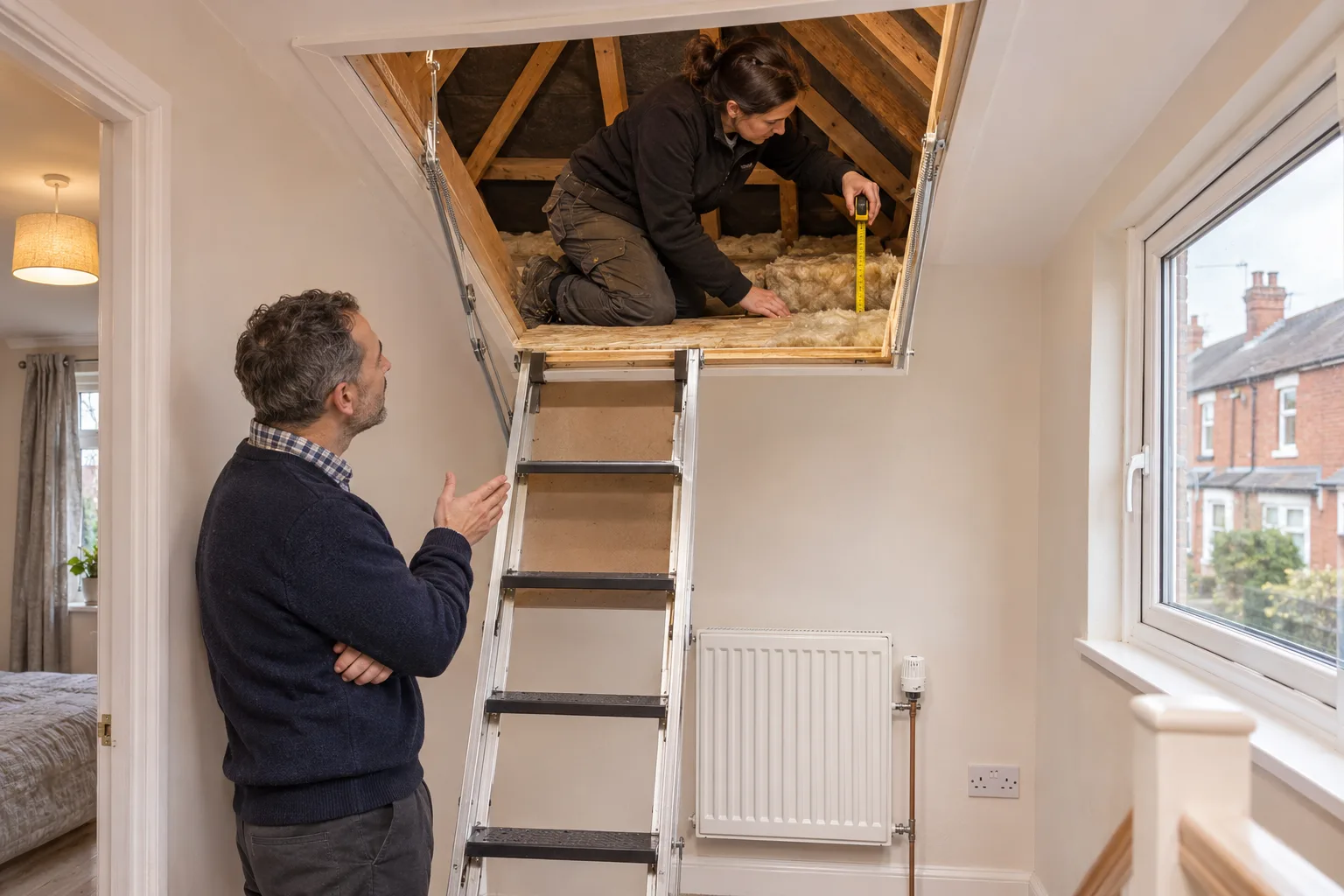
The current MHCLG-approved RdSAP conventions version 12.2 say that where safe and practicable loft access is possible, the assessor should measure the insulation and provide photographic evidence of its thickness. If the insulation is fully obstructed by boards or stored items, the entry is normally “loft insulation unknown” unless the householder provides documentary evidence, lifts boards or removes the obstruction.
That means an EPC can differ from the landlord’s understanding without automatically proving assessor error. The insulation may have been hidden, the hatch may have been unusable, the loft may not have been safe to enter, the paperwork may not have been available, or the insulation may have been added after the inspection.
Start by identifying which explanation fits. A dispute about a visible, safely accessible 200 mm layer is not the same as a fully boarded loft with no evidence, and neither is the same as insulation installed six months after the EPC was lodged.
Read the roof description before reading the recommendation
Use the official Find an energy certificate service and open the latest certificate for the exact dwelling. Note the assessment date, score, roof descriptions and recommendations. A house can contain more than one roof element: an original pitched roof, a flat-roof extension, a room in the roof or a later loft conversion may be recorded separately.
Wording such as “pitched, insulated” indicates a different assessment input from “pitched, no insulation”, “as built” or an unknown insulation entry. A recommendation to add loft insulation is generated from the recorded model; it is not a destructive survey result or proof that every part of the roof is bare.
If the certificate uses unfamiliar wording, the broader guide to what “assumed” means on an EPC explains the difference between a prescribed assumption, an as-built entry and an exceptional unknown entry. This guide stays with the narrower loft-insulation decision.
Why the EPC may not show loft insulation that exists
The loft was accessible and the insulation could be measured
Where the hatch, route and loft are safe and practicable to access, current convention 3.04 expects a measurement and photographic evidence. If a plainly visible, measurable layer appears to have been omitted from an EPC produced after that inspection, compare the property and assessment record, then contact the assessor with the specific roof entry and evidence.
The hatch existed but could not be used on the visit
A painted-shut hatch, fixed obstruction, unsafe ladder position or another health-and-safety barrier can prevent inspection. Current conventions distinguish this from a property with no means of loft access. Removing the obstacle before a future assessment may allow the insulation to be inspected, but do not create unsafe access or ask an assessor to take unnecessary risks.
Boards or stored items concealed the insulation
A fully boarded or obstructed loft does not let the assessor infer a depth from the landlord’s recollection. The conventions allow the boarded area to be treated as insulated to a thickness that can be established and evidenced at multiple locations, for example through gaps or visible edges. Otherwise, suitable documentary evidence or safely lifted boards may be needed.
The roof is not a simple cold loft
Rafter insulation, sloping ceilings, flat roofs and rooms in the roof follow different evidence and default routes. A photograph of mineral wool on one horizontal area does not prove the construction of every roof slope or extension. The assessor must match the evidence to the element actually being assessed.
The insulation was installed after the EPC
A lodged EPC is a record of the property information used for that assessment. It does not update automatically when work is completed. Keep the installation and completion evidence, then decide whether a new certificate is commercially or legally required rather than expecting the old register entry to change by itself.
What evidence can help with a boarded or hidden loft
Convention 9.02 allows property-specific certificates, warranty records and other documents that verify completed work. The assessor must be able to connect the records to the dwelling and be satisfied that there is no physical or documentary evidence to the contrary. A quotation or intention to install is not enough on its own.
A useful loft evidence pack can include the property address, installation date, contractor invoice, warranty or certificate, product and thickness details, the roof area covered, contextual photographs taken before boarding, and building-control information where it applies. The evidence must answer the actual roof input; a generic product brochure does not show that the material was installed at this property.
If work has not yet been covered, follow the EPC photo-evidence checklist so the address, room or roof context, installation stages, measured depth and completed area can be understood later. Photographs support the trail, but the assessor still decides whether the applicable convention is satisfied.
The general landlord EPC evidence guide helps organise property-specific records across walls, floors, roofs, heating and extensions. Use it when the loft is only one of several entries that may affect the D-to-C route.
A five-step landlord checklist
- Download the latest EPC and copy the exact roof description, assessment date, score and recommendation.
- Compare the certificate with the roof forms at the dwelling, including extensions, flat roofs and any room in the roof.
- Establish what the assessor could safely see on the visit and whether boards, storage or access prevented measurement.
- Gather completed-work evidence tied to the property and ask an accredited assessor which current input it can support.
- Model the whole-property effect before buying work or commissioning a replacement EPC.
For the appointment itself, the guide on whether an EPC assessor needs access to every room explains how safe access and preparation affect the survey without implying that every concealed feature can be verified visually.
Choose the right route: clarification, correction or a new EPC
Ask for clarification when the entry may be explainable
Contact the assessor with the EPC address, assessment date and exact roof line. Ask what access was available, what evidence was supplied and which roof element the entry describes. This can resolve confusion between the main loft, a flat extension and a converted roof without turning the first contact into a broad accusation.
Use the accuracy route when information appears incorrect
Government domestic EPC guidance says complaints about quality or accuracy should go to the assessor first and then, if unresolved, to the assessor’s accreditation scheme. If information is found to be incorrect, a new EPC must be issued and the register amended through that process at no cost to the complainant.
Commission a new assessment when the property changed later
If insulation was installed after the survey, the old EPC was not necessarily wrong. The decision is whether a new assessment is needed for marketing, compliance, finance or the landlord’s planning. Only an accredited assessor can use the current property information in approved software and lodge the resulting certificate.
The government’s 2026 EPC accuracy research includes case-study examples involving loft insulation not recorded and loft access not obtained. Those examples support checking the specific assessment trail; they do not establish that every disputed loft entry is wrong.
How a corrected roof input affects a D-rated rental
It can change the model where the accepted input differs from the one previously used, but there is no universal points figure. The effect depends on roof area, existing entry, insulation depth, property geometry, heating, hot water, controls and every other input in the calculation.
Evidence can also confirm that the existing entry was appropriate or that the loft is not the main constraint. That is commercially useful: it can prevent duplicate work and redirect attention to a wall, floor, heating system, hot-water arrangement or another material feature.
Use the D-to-C landlord plan to compare accepted evidence, small measures and larger upgrades against the actual score gap. Testing, documents and inspection do not rewrite the register by themselves; the assessor must accept the input and lodge the certificate.
Current rules and future EPC reform
For today’s position, the live domestic private-rented MEES guidance says covered rentals in England and Wales generally need EPC E or above unless a valid exemption applies. A disputed loft entry does not by itself decide whether the property complies.
The government has separately confirmed a higher private-rented standard from 1 October 2030, subject to the legislation and implementation process described in its response on improving private-rented homes. The response also recognises qualifying current-style EER C certificates obtained before 1 October 2029 until they expire or are replaced.
The proposed Home Energy Model methodology for existing dwellings is intended to support reformed EPC metrics, but detailed implementation and band boundaries remain relevant. Do not promise that a current loft-insulation input will create a particular future HEM band.
The commercial decision
When the EPC and the loft appear to disagree, the first purchase should not be another roll of insulation. Identify the exact roof element, establish the assessment-date access and evidence, then choose between clarification, correction, a new assessment or a wider property plan.
Cucumber Eco can review the current certificate, the loft evidence and the score gap alongside the rest of the dwelling. Start your free EPC assessment to find the lowest-cost credible next step before paying for duplicate work.
Primary sources checked
These primary sources were checked on 15 November 2026 for the current assessment, evidence, accuracy, MEES and HEM boundaries in this guide.
- BRE/MHCLG RdSAP conventions version 12.2: safe loft access, measurement, obstruction, documentary evidence and incorrect-lodgement handling.
- Government domestic EPC guidance: physical surveys, inaccessible features, accuracy complaints, redress and register correction.
- Government EPC accuracy research published 26 May 2026: case-study evidence on loft-insulation and access errors.
- Government certificate finder and current domestic MEES guidance: the live certificate and current rental standard.
- Government private-rented homes response and HEM existing-dwelling methodology: the 2030 policy direction and unfinished future-method detail.
Frequently asked questions
These answers separate a hidden or later loft upgrade from an error in the assessment record.
Why does my EPC say no loft insulation when I can see insulation?
Check whether the wording refers to the same roof area and what could be safely inspected on the assessment date. The loft may have been obstructed, the entry may describe another roof element, the work may be newer than the EPC, or the record may need clarification or correction.
Can photographs prove loft insulation for an EPC?
They can support the evidence trail, especially when they show property context, measured thickness, coverage and completed work. They are not automatically sufficient in every case. The accredited assessor must apply the current convention and be confident that the evidence belongs to the assessed dwelling.
Do I have to lift loft boards for an EPC assessment?
Not as a universal legal instruction. However, a fully boarded area may be recorded as unknown unless documentary evidence or safe visibility at multiple locations establishes the insulation. Discuss safe access with the assessor before the visit and do not create a hazard.
Will the assessor change my existing EPC if I send an invoice?
A lodged certificate is not casually edited. If the original information is found incorrect, the assessor and accreditation scheme can follow the correction process. If work happened later, a new assessment may be needed. An invoice must also be property-specific and support completed work, not merely an intention.
Does accepted loft evidence guarantee EPC C?
No. It may change one roof input, but the entire dwelling determines the score. Model the accepted evidence with the property’s geometry, heating, hot water, controls and other fabric before treating it as the route to C.