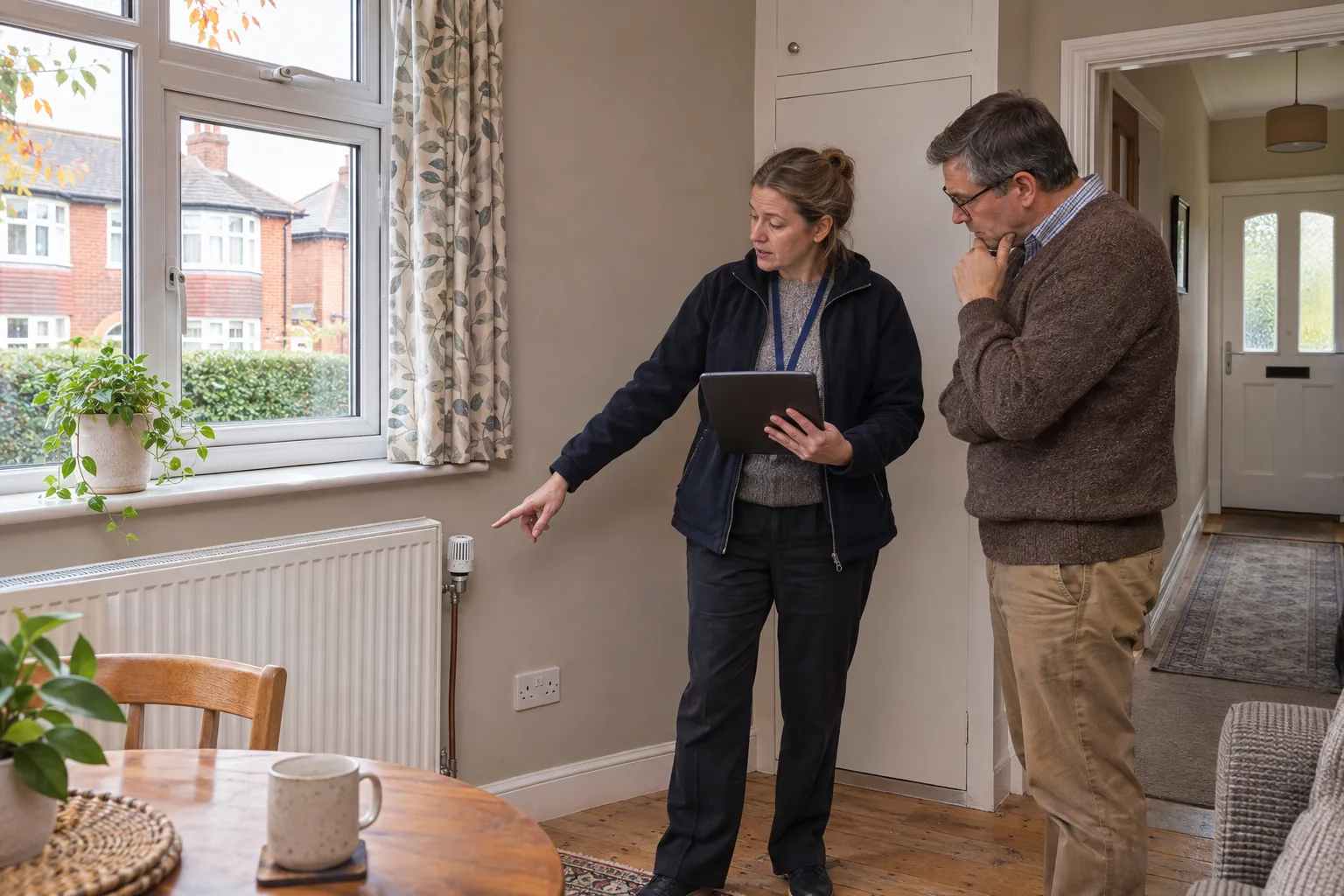
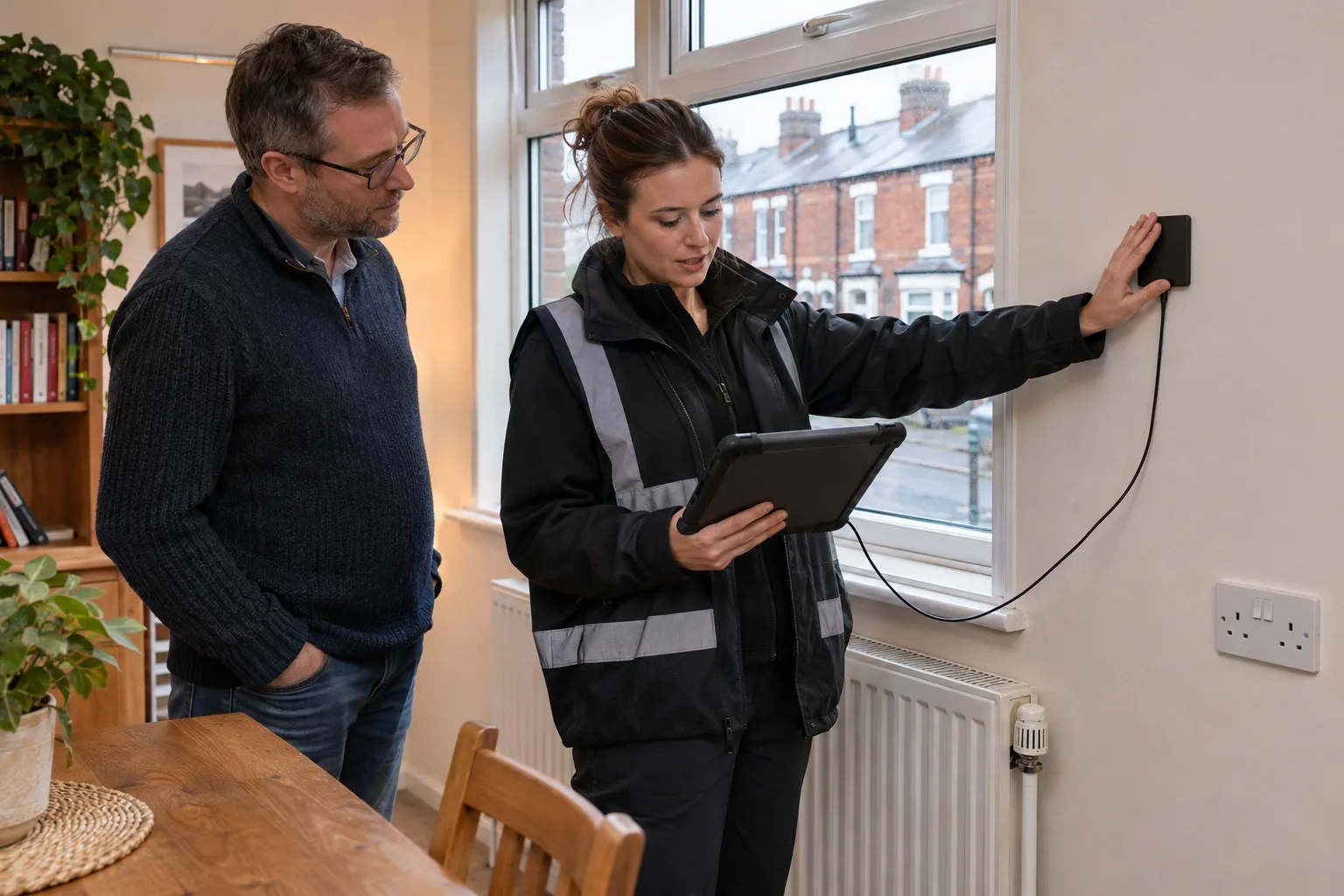
U-value testing can help when an EPC uses a fabric default, but only accepted property-specific evidence can influence a lodged assessment.
U-value testing can be useful when a landlord suspects that a wall, roof or floor performs differently from the default used in an EPC. The commercial value is not the test report by itself. It is the possibility of giving an accredited assessor acceptable, property-specific evidence before paying for disruptive work.
That distinction matters. A measurement, thermal image or survey does not independently add EPC points, change the register or guarantee band C. Under the current RdSAP conventions, a default U-value can be replaced only through evidence that meets the relevant rules and is accepted for the assessed property.
If a D-rated rental contains assumed or poorly evidenced fabric entries, Start your free EPC assessment. The first decision is whether better evidence could materially affect the route, not whether routine testing is appropriate.
The short answer: testing may help, but acceptance is the gate
A U-value describes how readily heat passes through a building element. Lower values indicate less heat transfer through that element. Existing-home EPCs normally use RdSAP defaults where the assessor cannot establish a permitted property-specific input.
The current MHCLG-approved RdSAP conventions version 12.2 say that the default U-values for existing walls, roofs and floors must not be overwritten unless the required documentary evidence is available. Convention 3.08 points to a whole-element U-value calculation prepared in accordance with BR 443 and produced or verified by someone with suitable expertise, or relevant building-control approval that defines the construction and states the calculated U-value.
This means that “a test was done” is not enough. Before commissioning any investigation, confirm what information the test will produce, who will turn it into the required calculation, how the result will be tied to the exact property and whether the assessor or accreditation route can accept it.
Why an EPC may use a default U-value
The government’s guide to domestic EPC assessments explains that insulation can be concealed. If the assessor cannot inspect a feature and there is no supporting information, an assumption may be made from the building age and construction.
That is part of the design of Reduced data Standard Assessment Procedure. The current government SAP and RdSAP overview says RdSAP uses assumptions to reduce the volume of information that must be collected for an existing dwelling. A default is therefore not automatically an error; it is the prescribed input when better evidence is unavailable.
The useful question is whether the default is materially less favourable than the property’s real construction and whether admissible evidence can establish a different whole-element value. A wall that genuinely lacks insulation will not become more efficient because it is tested. A wall that was upgraded but poorly documented may present a different evidence problem.
Accepted evidence for replacing a current RdSAP default
For walls, roofs and floors, the convention is narrower than many sales claims suggest. The evidence must apply to the property being assessed, describe the relevant element and support the whole-element U-value, including any added insulation.
Route 1: relevant building-control evidence
Building-control approval may be usable where it correctly defines the construction in question and states the calculated U-value. A planning drawing, quotation or general specification that only shows an intention to install insulation is not automatically proof that the work was completed as designed.
Route 2: a competent U-value calculation
The conventions allow a U-value calculation produced or verified by a person with suitable expertise and experience. They give examples of recognised competence but leave the assessor and accreditation framework responsible for deciding whether the evidence meets the applicable requirements.
Supporting proof that links the work to the property
Property-addressed certificates, warranties, invoices, photographs and records of construction can help demonstrate what was installed and where. They must be consistent with the physical building. Generic brochures, undated photographs and documents for another address do not establish the assessed element.
Use the landlord EPC evidence guide to organise the address, dates, element location, construction description and supporting documents before asking an assessor to review the pack.
U-value test, U-value calculation and thermal image are not the same thing
A test or material investigation
A site investigation may collect information about the element or its materials. Its usefulness depends on the method, coverage, conditions and the evidence trail. The result still needs to support the type of property-specific calculation that the current convention permits. A standalone reading should not be marketed as an automatic EPC input.
A whole-element U-value calculation
This calculation represents the complete construction rather than one layer or one product. It needs enough reliable information about the build-up to reflect the wall, roof or floor being assessed. Under current convention 3.08, the calculation must follow BR 443 and be produced or verified by a suitably competent person if it is to replace the default route.
Thermal imaging
A thermal image can help identify patterns worth investigating, such as uneven insulation or thermal bridging, but it does not by itself provide the documentary route described in convention 3.08. Weather, heating conditions, surface finishes and interpretation affect what the image shows. Treat it as diagnostic context unless the assessor confirms a separate accepted use.
The lodged EPC
Only an accredited assessor can use accepted inputs in approved software and lodge the resulting certificate. A testing company, calculation report or consultant cannot change the EPC register simply by issuing evidence. The final rating depends on the whole dwelling model, not one U-value in isolation.
When a U-value investigation may be commercially sensible
Testing is most credible when it answers a defined decision and the potential value of better evidence is greater than the cost and uncertainty of obtaining it.
The current EPC uses an age-related fabric assumption
An older solid wall, converted roof or upgraded floor may be recorded using a default because its build-up is concealed. If the owner has reason to believe the element was improved and no adequate records survive, an evidence-led investigation may be worth screening.
The property is close enough to C for one input to matter
A D-rated rental near the C threshold may justify closer review of material assumptions. That does not mean a better U-value will add a fixed number of points. Model the accepted input with the rest of the dwelling before treating it as a route to C.
The alternative is disruptive fabric work
Where the choice is between proving an existing element and installing new insulation, evidence can have high commercial value. Compare the investigation cost, likelihood of an accepted result, disruption, moisture and ventilation risks, and the benefit of the proposed work beyond the EPC score.
The same construction repeats across a portfolio
A portfolio may contain similar homes, but evidence must still be applicable to each assessed property and element. Do not assume that one result can be copied across neighbouring addresses. Ask the assessor what property-specific verification is required before designing a sampling plan.
When not to commission testing yet
Do not start with testing when the existing certificate is out of date, the wrong property or clearly superseded by completed work. Download the latest certificate and verify the address, assessment date, score, floor area, building parts and recommendations first.
Testing is also premature when the result cannot influence a decision, the assessor has not confirmed the evidence route, or the element is visibly uninsulated and improvement work is already required for comfort, condition or another technical reason. Better measurement cannot replace missing fabric.
For a broader sequence, use the D-to-C landlord plan. It places fabric evidence alongside heating, hot water, controls and other inputs so one promising assumption does not distort the whole-property decision.
U-value evidence compared with airtightness evidence
The two routes answer different questions. A U-value concerns heat flow through a building element. Airtightness concerns uncontrolled air leakage through the dwelling envelope. A property can have well-insulated walls and still leak air, or be relatively airtight while having poor fabric values.
Current RdSAP has separate conventions for each input. Read the airtightness testing landlord guide if the certificate uses a default infiltration rate. Neither route assures a point increase, and neither test changes the register without an assessor using accepted evidence in a lodged assessment.
A landlord checklist before approving a U-value test
1. Download the latest EPC and identify the exact wall, roof or floor input that is being questioned.
2. Ask an accredited assessor whether a different accepted value could materially affect the model.
3. Gather building-control records, plans, invoices, warranties and photographs before paying for new investigation.
4. Define the element and area to be investigated, including extensions or alternative wall types.
5. Obtain a written method explaining what will be measured, how the construction will be established and who will produce or verify the BR 443 calculation.
6. Confirm how the evidence will be tied to the property and retained for the assessor’s audit trail.
7. Model the accepted value before treating a test as the lowest-cost route to C.
8. Keep the result, calculation, photographs and assessor correspondence with the property records.
Current rules and the 2030 policy direction
Today, the domestic private-rented MEES guidance says covered rentals in England and Wales generally need at least EPC E unless a valid exemption applies. U-value evidence does not replace the need to check the current certificate, tenancy and exemption position.
The government’s private-rented energy-performance response confirms a policy direction for a higher standard by 1 October 2030, using reformed EPC metrics, with a transition for qualifying EER C certificates lodged before 1 October 2029. Implementing legislation and final operational guidance still matter.
The Home Energy Model EPC methodology consultation shows that future existing-dwelling EPC methodology is still being finalised. Do not assume that a current RdSAP evidence route, current point movement or individual product effect will translate unchanged into a future fabric-performance band.
Frequently asked questions
These answers summarise how current RdSAP evidence rules apply to a property-specific U-value decision.
Can U-value testing improve an EPC rating?
It can support a better property-specific input where the current default is not representative and the resulting evidence meets the applicable RdSAP rules. Testing alone does not add points; the assessor must accept the evidence, use it in approved software and lodge a new EPC when appropriate.
Does a lower tested U-value guarantee EPC C?
No. The rating uses the whole dwelling, including geometry, other fabric, heating, hot water, controls, lighting and renewables. The accepted value may improve, reduce or leave the overall route insufficient for C, depending on the rest of the model.
Can a thermal camera replace a U-value calculation?
Not on its own under the current convention described above. Thermal imaging can identify patterns and guide investigation, but it is not the same as the whole-element BR 443 calculation and property-specific documentary evidence required to overwrite a default U-value.
Which parts of a home can use a property-specific U-value?
Convention 3.08 covers existing elements such as walls, roofs and floors. Windows and doors have separate evidence rules. The assessor should identify the correct convention and confirm that the evidence relates to the element and property being assessed.
Will current U-value evidence work on a HEM-based EPC?
Do not assume that it will transfer unchanged. Reformed EPCs and the Home Energy Model are still being implemented for existing dwellings. Current evidence can inform a present decision, but future inputs, metrics and band boundaries must be checked against the final methodology.
Use evidence to avoid the wrong work, not to promise a score
U-value investigation is valuable when it resolves a material uncertainty before a landlord commits to insulation or another expensive route. Start with the latest EPC, ask what evidence the assessor can accept, and commission only the work needed to produce a defensible property-specific input.
Start your free EPC assessment to compare the existing fabric evidence, the score gap and the next proportionate step for your rental property.