
“Assumed” usually means an assessor could not verify a hidden feature and RdSAP applied a prescribed input. Learn what landlords should check before paying for work.
“Assumed” on an Energy Performance Certificate usually means the assessor could not verify a hidden feature and the current RdSAP method applied a prescribed input based on the property information available. It does not automatically mean the assessor made a mistake, that the home has no insulation or that the worst possible value was chosen.
For a landlord with a D-rated rental, the commercial question is whether an assumed entry is both inaccurate and material to the route to C. Check the latest certificate, identify which parts are assumed, then decide whether existing documents, safe inspection or a specialist evidence route could establish a permitted property-specific input before buying major work.
If you want that review tied to the whole dwelling rather than one line on the certificate, Start your free EPC assessment. The first step is to find the lowest-cost credible route, not to promise that every assumption can or should be replaced.
The short answer: “assumed” is a model input, not a verdict on the home
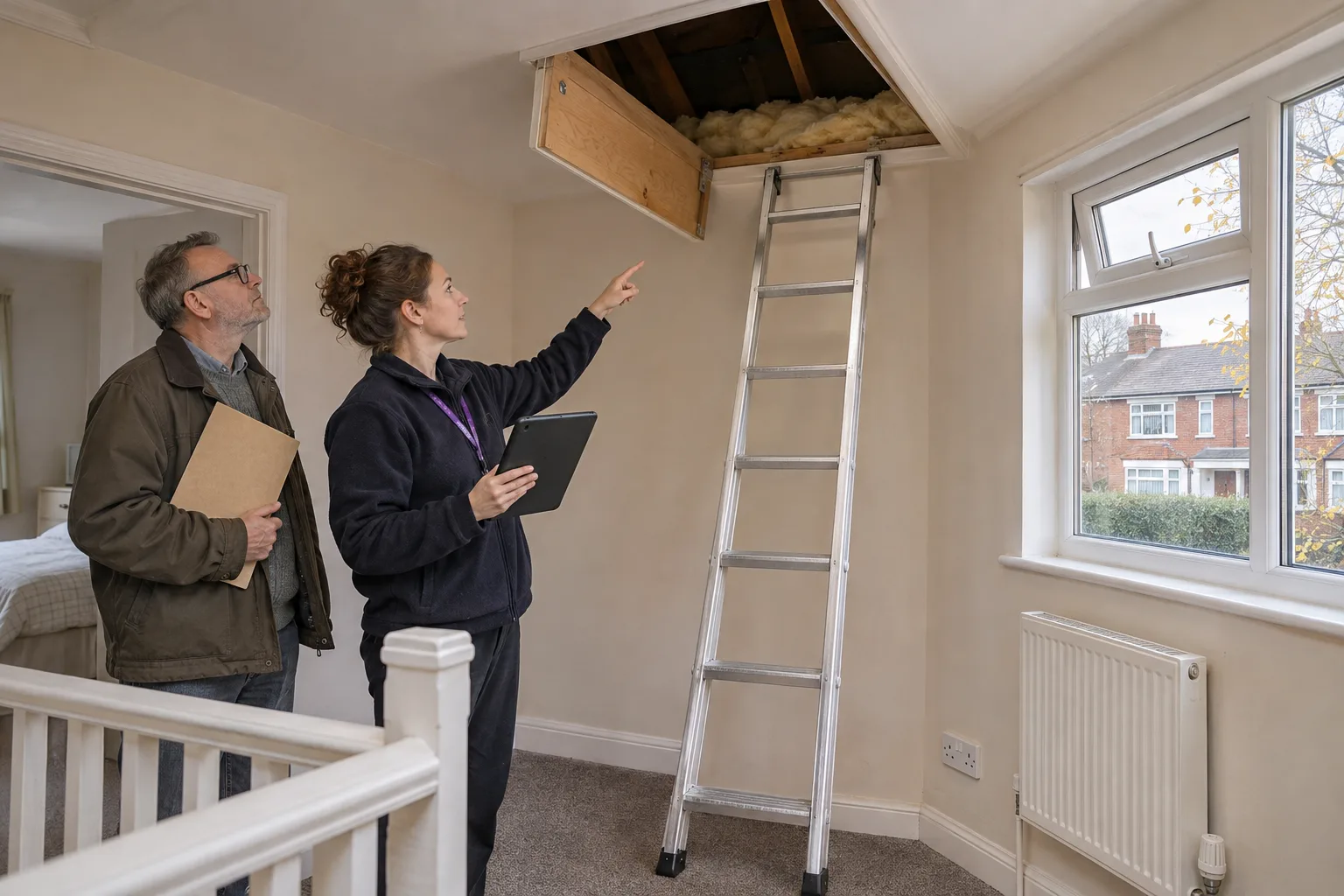
The government’s guide to domestic EPC assessments explains that an existing-home assessment is a physical survey, but some features cannot be seen. If a loft cannot be accessed safely, or cavity-wall or underfloor insulation is concealed, an assumption may be made from the building age when suitable supporting evidence is unavailable.
That approach is deliberate. The current government SAP and RdSAP overview says Reduced data Standard Assessment Procedure uses a set of assumptions to reduce the volume of information an assessor must collect for an existing dwelling. The resulting rating allows homes to be compared using standard occupancy rather than the current occupant’s bills or heating habits.
An assumption can still matter. If completed insulation, a conversion, a heating product or another feature was not visible and could not be evidenced, the model may not reflect the property as the landlord understands it. The remedy is not simply to tell the assessor what is present. The assessor needs evidence or observations permitted by the applicable conventions.
Why an EPC uses assumed values
The feature is hidden
Insulation is often behind plaster, beneath floors, above boarded loft areas or inside a roof build-up. An assessor is not expected to damage finishes or take unnecessary risks. Where the construction cannot be established through the survey or acceptable records, the methodology supplies the relevant default or age-related route.
The area could not be inspected safely
A sealed, obstructed or unsafe loft can prevent a direct check. A locked room, inaccessible meter or concealed heating component can also limit the evidence gathered. Better access may resolve some entries, but access alone does not prove insulation hidden inside a building element.
The paperwork was missing or could not be tied to the property
A quotation, product brochure or owner recollection may describe intended work without proving that it was completed at the assessed address. The assessor must be confident that records apply to the actual property and that there is no physical or documentary evidence to the contrary.
RdSAP requires a default unless a specific evidence rule is met
Some inputs have narrow replacement rules. For example, a wall, roof or floor U-value cannot be overwritten merely because one material was identified. The evidence must support the complete element in the way required by the current conventions.
“Assumed”, “as built” and “unknown” are not interchangeable
On a certificate, wording such as “as built, no insulation (assumed)” generally indicates that the methodology has applied the construction and insulation position associated with the property information and age band. It should not be read as a destructive inspection result.
The MHCLG-approved RdSAP conventions version 12.2 also restrict the use of “unknown” insulation type or thickness. “Unknown” is intended for exceptional situations, such as conflicting evidence, insulation that can be seen but not measured, or a fully obstructed loft without supporting documents. It is not a general substitute whenever information is incomplete.
The distinction matters because different entries can affect recommendations as well as calculations. Do not infer the remedy from the label alone. Ask which RdSAP input was used, why it was required and what evidence route would be needed to use something else.
A landlord’s four-part assumed-entry check
1. Confirm that you are reading the current certificate
Use the official Find an energy certificate service and check the address, assessment date, expiry date, floor area, score and building description. A newer certificate replaces an older one for practical review purposes, and completed works after the assessment will not appear on that earlier record.
2. List each assumed or unknown item separately
Do not treat “the EPC assumptions” as one problem. Record the exact wording for the main wall, alternative wall, roof, floor, windows, heating, hot water and controls. Note any extension, loft conversion or different building part. One property can legitimately use different constructions and age bands.
3. Decide whether the entry is likely to be material
An assumed input is worth investigating when there is a credible reason to believe it differs from the actual property and a better accepted input could influence the proposed route. If the home is many points from C, resolving one fabric entry may still be insufficient. Model the whole dwelling before treating one assumption as the answer.
4. Match the question to an accepted evidence route
Existing certificates, warranties, building-control records, property-specific invoices, dated photographs and safe visual inspection may help, depending on the feature. Some cases need a more technical calculation or investigation. Confirm the route with an accredited assessor before commissioning it.
Evidence that can help replace an assumption
The broad evidence standard is property-specific and completion-led. The landlord EPC evidence guide explains how to organise the address, installation date, element location, product or construction details and completion proof so an assessor can review the pack efficiently.
Useful records can include building-control approval that describes completed construction, warranties or certificates, invoices identifying the address and work, manufacturer information for an installed product, and photographs that show context as well as the hidden detail. No single document type is universally sufficient. The evidence must answer the particular input and survive the assessor’s quality-assurance trail.
If work is about to be covered, use the EPC photo-evidence checklist before plasterboard, flooring or loft boards hide it. Photographs can support a record, but a close-up of insulation with no address, room context, date or completion evidence may not settle the entry.
For property-specific wall, roof or floor performance, read the U-value evidence guide. Current convention 3.08 requires the permitted whole-element evidence route before a default U-value can be overwritten. A thermal image, product data sheet or isolated test reading is not automatically an accepted replacement.
What not to do after spotting “assumed”
Do not accuse a previous assessor of using the worst possible value without first checking the convention. A prescribed default can be correct even when the real property later proves to perform differently.
Do not install insulation solely because the certificate contains the word “assumed”. First establish whether insulation is genuinely absent, whether the element is suitable for the proposed work, and whether moisture, ventilation, condition, fire-safety or building-control considerations need specialist advice.
Do not commission airtightness testing, U-value work or another survey before confirming the decision it needs to answer. Testing is evidence, not a manufactured score. It cannot change a lodged EPC by itself, and it does not guarantee that a new assessment will reach C.
Do not assume a better fabric input will necessarily improve the band. The rating uses the whole dwelling, and the effect depends on geometry, heating, hot water, controls, fuel, lighting, renewables and other model inputs.
How assumed entries fit a D-to-C assessment
Begin with the score gap. A D-rated home at 68 has a different decision from one at 55, even though both display the same letter band. Then separate three routes: evidence for something already present, a proportionate physical measure, and a larger fabric or heating upgrade.
Evidence can be commercially valuable where it avoids paying twice for a feature that already exists. It can also show that the default was fair and that another route is needed. Either outcome is useful because it reduces the risk of choosing work from a generic recommendation list without understanding the property.
Use the D-to-C landlord plan to compare assumptions with the starting score, accepted evidence, low-disruption measures and any larger upgrade. The aim is a defensible sequence, not a fixed number of points for one document or test.
Current rules and the future EPC method
Today, the domestic private-rented MEES guidance says covered rentals in England and Wales generally cannot be let below EPC E unless a valid exemption applies. An assumed entry does not remove the need to check the current certificate and the property’s actual regulatory position.
The government’s response on the higher private-rented standard confirms the policy direction for a higher standard from 1 October 2030, subject to implementing legislation. It also describes a transition for qualifying EER C certificates obtained before 1 October 2029, lasting until that certificate expires or is replaced.
The Home Energy Model EPC methodology consultation sets out the proposed existing-dwelling route and new headline metrics, but final band boundaries and detailed implementation still matter. Do not assume that every current RdSAP default, evidence route or point effect will transfer unchanged to a future HEM-based EPC.
Frequently asked questions
These answers apply the current evidence rules to common landlord decisions about assumed EPC entries.
Does “assumed” mean there is no insulation?
Not necessarily. It means the certificate used the applicable assumption because the feature was not established through the permitted survey or evidence route. The real property may match that input, perform better or perform worse; further evidence is needed before deciding.
Is an assumed value an EPC error?
Not by itself. RdSAP is designed to use assumptions for existing homes. An error is a different issue, such as recording the wrong visible feature or property information. Ask the assessor or accreditation scheme about a suspected data error rather than treating every default as incorrect.
Can an invoice remove an assumed entry?
An address-specific invoice can support the evidence trail, but it may not prove the full construction, installation quality or completion required for the input. The assessor must apply the convention for that feature and decide whether the combined evidence is sufficient.
Will a new EPC remove all assumptions?
No. A new visit may improve access and use newly available records, but concealed features can still require defaults. Prepare the property and evidence before the appointment so the assessor can verify as much as the methodology permits.
Can replacing an assumption guarantee EPC C?
No. Accepted evidence may change one or more inputs, but the whole dwelling determines the rating. The assessor must use the accepted information in approved software and lodge the certificate; no document or test can promise a particular band in advance.
Turn uncertainty into a property decision
The word “assumed” is a prompt to investigate, not a promise of hidden EPC points. Start with the latest certificate, identify the exact input, gather property-specific evidence and ask whether resolving it could materially change the route before spending on testing or work.
Start your free EPC assessment to review the D-rated property, its assumed entries and the lowest-cost credible next step towards C.