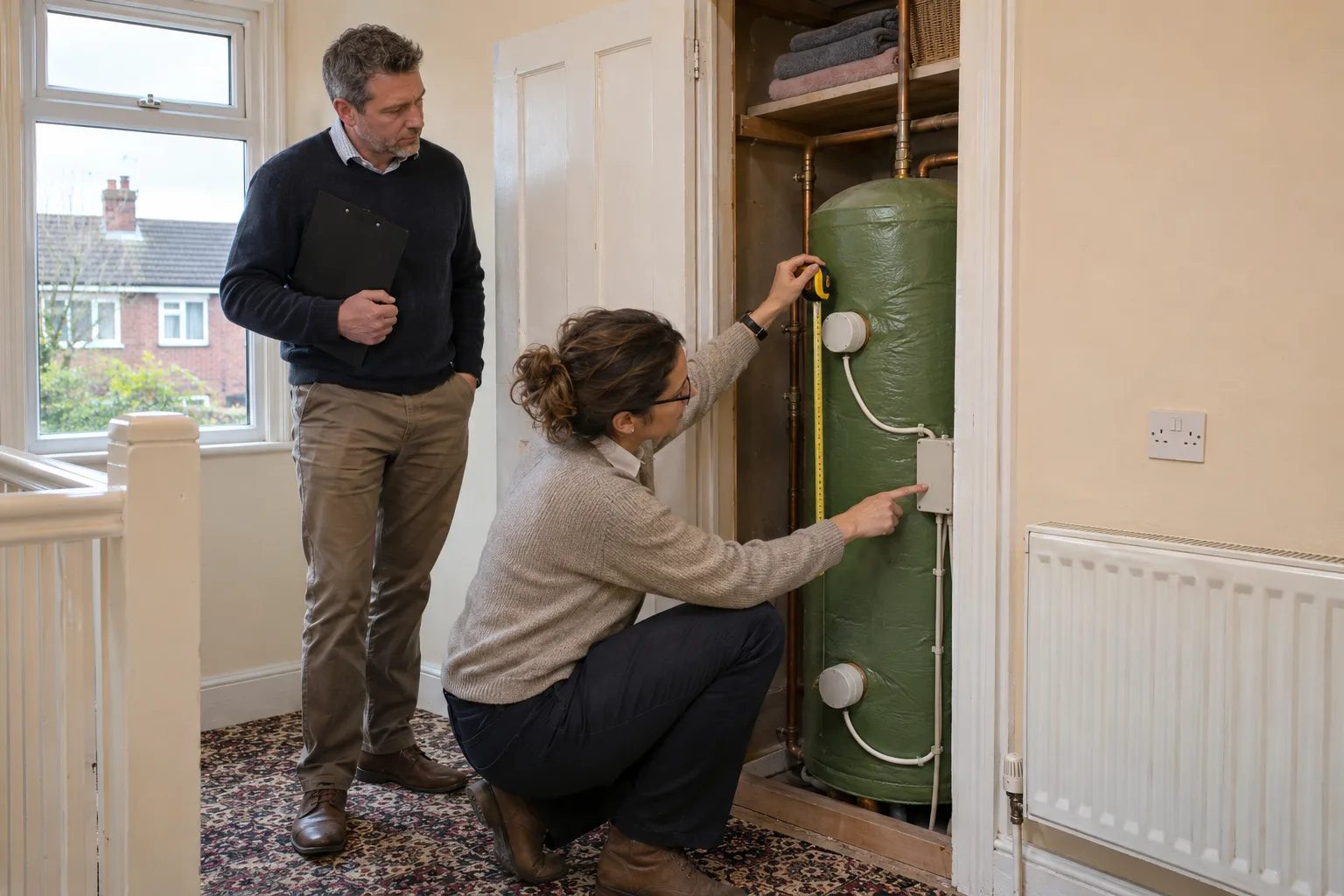
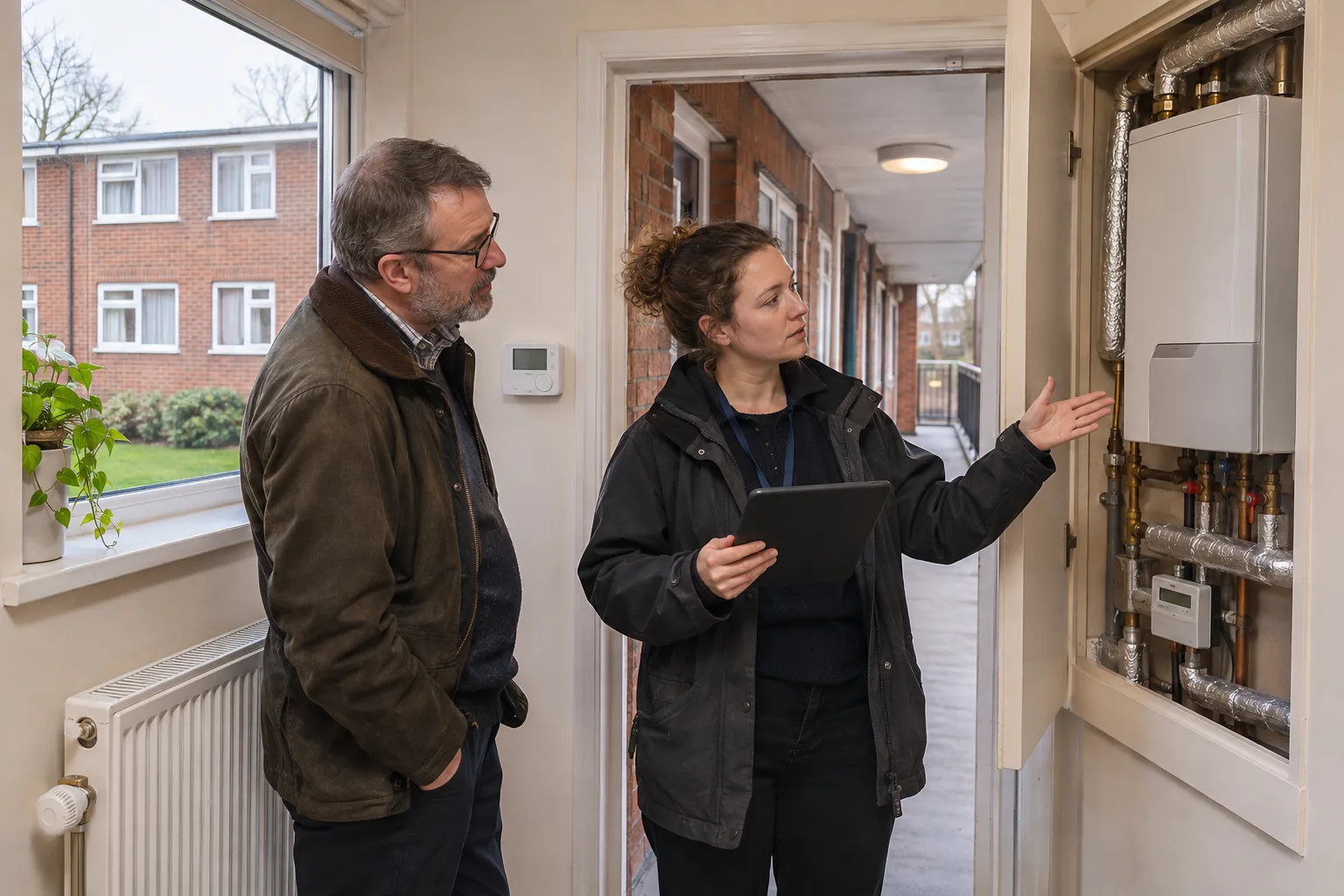
Communal heating can affect a flat’s EPC through the recorded heat network, charging method, controls and hot water. Check the evidence before choosing work.
Yes. Communal heating can affect a flat’s EPC because the current assessment records the heat network, the way heat is charged, the controls and whether the network supplies space heating, hot water or both. It does not mean that every communally heated flat receives the same rating, or that replacing the shared system is the landlord’s only route to C.
For a D-rated rental, the useful question is whether the certificate describes the actual arrangement and whether the landlord can improve other property inputs before proposing expensive block-level work. A flat’s position, fabric, glazing, controls, hot water, lighting and accepted evidence still contribute to the complete calculation.
Start your free EPC assessment to review the current certificate, communal-heating evidence and lowest-cost credible route before asking the freeholder or managing agent to commission major work.
The short answer: communal heating is a specific EPC input
The current RdSAP 10 specification defines community heating as heat supplied from a central source to more than one dwelling. A district heat network can distribute hot water through underground pipes, while a block system may serve several flats from plant within the building. For the domestic EPC calculation, both sit within the heat-network treatment.
The assessor first checks whether the network has an approved record in the Product Characteristics Database. If it does, the calculation can use that record’s plant efficiency, distribution losses and pumping energy. If it does not, RdSAP applies defined fallback assumptions according to the identified heat source, such as boilers, combined heat and power or a heat pump.
That is why the words “communal heating” alone do not predict the band. The network record or fallback, charging method, in-flat controls, hot-water arrangement and the rest of the dwelling all matter. There is no universal communal-heating points figure.
Community heating, district heating and a landlord’s own boiler are different
The current RdSAP conventions v12.2 say a system is community heating when a heat generator supplies heat or hot water to more than one premises. Each dwelling is still assessed individually. If the generator is inside the flat and serves only that flat, it is the flat’s own heating system rather than community heating.
The same conventions added a separate treatment for heat supplied as a service. Where a service provider owns or operates the heat generator, the arrangement is treated as community heating when the required documentary evidence is available. An electricity-powered service is entered as a community heat pump; other arrangements use the applicable community-boiler route.
A landlord should therefore avoid choosing the heating type from a service-charge label. “Heating included”, “district heat”, “communal boiler” and “heat as a service” can describe different contractual and technical arrangements. The assessor needs evidence tied to the actual flat and current system.
Which communal-heating details can affect the rating
The network or heat-generator record
An identified current heat-network record allows the method to use network-specific data. Where the network cannot be identified, the conventions say the assessor should establish the fuel where possible; if it cannot be ascertained, mains gas is selected. Better documentation can therefore prevent an avoidable fallback, but it does not guarantee that the resulting score will be higher.
How the occupier is charged for heat
RdSAP includes a heat-network charging-method input. A flat-rate arrangement is not recorded in the same way as a charging system linked to measured use. A service-charge statement may help explain the arrangement, but the assessor needs enough current information to apply the defined option rather than infer it from the tenant’s monthly payment.
Controls inside the flat
Programmers, room thermostats, thermostatic radiator valves and other recognised controls can be relevant where they are present and applicable. Record what the tenant can actually operate. A decorative dial, an app screenshot or a managing-agent promise is not a substitute for an identifiable installed control.
Whether the network also provides hot water
Some schemes supply both space heating and hot water; others supply only one. The assessment must reflect the actual source. An in-flat cylinder, immersion heater, heat-interface unit or separate water heater should not be assumed from another flat’s EPC.
What evidence should a landlord gather?
Start with the newest certificate from the official energy-certificate register. Note the numerical score, main-heating description, controls, hot-water entry and any assumptions. Then compare those entries with the current flat and block information.
Useful evidence can include:
- the current heat-network name and operator, where one exists;
- a recent managing-agent or freeholder statement describing the central plant and fuel;
- the heat-interface unit make, model and accessible data plate;
- documents showing whether the network supplies heating, hot water or both;
- the charging or metering arrangement, including an identifiable heat meter where present;
- clear photographs of programmers, thermostats, radiator valves and the interface unit;
- commissioning, replacement or major-upgrade records tied to the block and flat.
The landlord EPC evidence guide explains the wider evidence pack. Documents must relate to the property and completed system, and the assessor must be satisfied that nothing visible contradicts them. Evidence of a proposed network upgrade does not prove that the work has happened.
A D-to-C plan for a flat with communal heating
- Check the starting score. C begins at 69 on the current Energy Efficiency Rating, so a flat at D68 needs a different plan from one at D55.
- Verify the heating entry. Confirm whether the EPC names the network, uses a generic community system or appears to record an individual boiler incorrectly.
- Check charging, controls and hot water separately. Do not treat “communal” as one combined answer for all three.
- Map the flat’s heat-loss boundaries. A mid-floor flat, top-floor flat, exposed corner and flat over an unheated space have different fabric inputs.
- Review the rest of the certificate. Glazing, lighting, insulation evidence, floor area and other assumed entries may offer a more proportionate route than altering the network.
- Model credible scenarios. Compare accepted evidence and work inside the flat before proposing a shared-plant project that needs block approval.
- Lodge the result properly. Completed work and evidence only change the official rating when an accredited assessor uses them in a new or corrected lodged assessment.
Use the broader D-to-C landlord plan to compare evidence, small measures and major upgrades in that order. If the property is leasehold, the leasehold flat EPC C checklist covers responsibility, consent and the written trail to keep.
Do not confuse EPC evidence with actual heat bills
A heat-network bill can be useful evidence of the operator, tariff structure or metering arrangement. It does not make the EPC a calculation of the tenant’s actual consumption. Domestic EPCs use standardised occupancy and calculation inputs so that properties can be compared consistently.
High or low bills can still reveal an operational issue worth investigating, such as controls, metering, heat losses or tariff terms. Keep that investigation separate from the EPC decision. The article on energy bills and EPC ratings explains why actual consumption does not directly set the band.
What can the individual landlord change?
The answer depends on the lease, the building and the installed system. A landlord may be able to improve in-flat controls, glazing, lighting or property evidence, but may not control the central plant, distribution pipes, external walls, roof or block-wide metering. Do not promise a heating change before confirming responsibility and consent.
If the certificate appears wrong, start with the assessor named on it. Ask one precise question and provide the relevant evidence. For example: “The flat is served by the named heat network and has a metered heat-interface unit, but the EPC shows a generic communal boiler. What was recorded, and which documents would you need to review it?” A consultant, freeholder or landlord cannot directly edit the register.
If work has already been completed, the guide to getting a new EPC after improvements helps decide when a fresh assessment is worth lodging. Reassessment should follow a credible model rather than repeated certificates after each small change.
Current rules and the future EPC standard
Current domestic MEES landlord guidance says covered private rentals in England and Wales must currently reach EPC E unless a valid exemption applies. A D-rated flat can therefore be above today’s legal floor while the landlord plans for the higher standard.
The government response on the higher private-rented standard confirms a single compliance date of 1 October 2030, subject to the planned legislation and implementation. It also recognises an existing-style EER C lodged before 1 October 2029 until that certificate expires or is replaced.
Reformed EPCs will use new headline metrics under the Home Energy Model. Do not assume that today’s heat-network treatment or a product’s current score effect predicts its final future heating-system or smart-readiness band. The safe decision is to verify the current property, model a credible route and keep future methodology claims clearly dated.
Landlord decision summary
- Communal heating is a specific assessment input, not an automatic EPC advantage or penalty.
- The network record, charging method, controls and hot-water source can all matter.
- Each flat is assessed individually even when several homes share the same plant.
- Gather current network and in-flat evidence before accepting a generic fallback.
- Model evidence and proportionate in-flat measures before proposing block-level work.
- Only an accredited assessment and lodgement changes the official EPC.
Start your free EPC assessment to review the communal-heating entry and the lowest-cost credible route from D to C.
Primary sources checked
This guide was checked on 27 November 2026 against the live BRE RdSAP 10 specification dated 7 June 2026, MHCLG-approved RdSAP conventions v12.2 applicable from 6 August 2026, the government guide to domestic EPCs, the official energy-certificate register, current domestic MEES guidance and the government response on the higher private-rented standard.
Frequently asked questions
These answers cover domestic EPCs for flats with communal or district heating in England and Wales. The result remains property-specific.
Can a flat with communal heating reach EPC C?
Yes. Communal heating does not set a fixed maximum band. The result depends on the network and charging inputs, controls, hot water, fabric, glazing, lighting and the rest of the dwelling calculation.
Does a heat meter improve the EPC rating?
A meter can support the correct charging-method entry, but it does not provide a guaranteed points uplift. The assessor must confirm the installed arrangement and calculate the whole property.
What if the landlord cannot access the communal plant room?
The current conventions recognise that community heating may not be accessible inside the dwelling. Provide current documents from the freeholder, managing agent or operator so the assessor can identify the network, heat source and service arrangement where possible.
Can a managing-agent letter correct a lodged EPC?
No. It can be useful evidence for an accredited assessor, but it does not edit the register by itself. The assessor or accreditation scheme must follow the appropriate correction or reassessment process.
Does changing the communal boiler guarantee EPC C?
No. A network upgrade can change heating inputs, but the flat’s complete calculation determines the band. Confirm the completed system, accepted evidence and modelled result before making an EPC promise.